Instant Water Heater Price: Costs and Ranges in 2026
Explore instant water heater price ranges for point-of-use and whole-home systems, plus key cost drivers, install factors, and how to estimate total project costs in 2026.


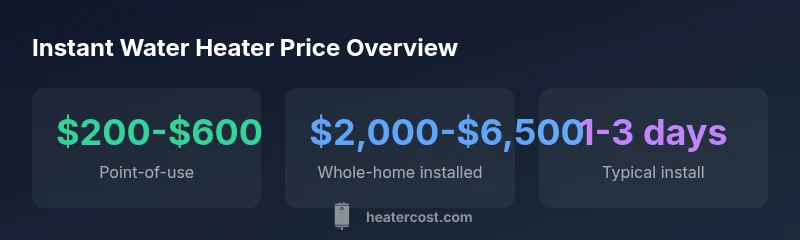
Instant water heater price varies by type and capacity. Point-of-use models typically cost about $200 to $600 for the unit alone, while whole-home tankless systems—including installation—usually run $2,000 to $6,500. Prices depend on factors like flow rate, fuel source, installation complexity, and local labor rates. For a precise figure, request quotes after a professional assessment.
What Instant Water Heaters Are and How They Differ from Traditional Heaters
Instant water heaters, often called tankless or on-demand systems, heat water directly as it’s needed, avoiding storage costs. The term instant water heater price describes the range you’ll see for units and installation. According to Heater Cost, price reflects capacity (gallons per minute), fuel type, and installation requirements. For homeowners, it’s essential to distinguish point-of-use models (single fixture) from whole-home tankless systems (serves multiple outlets). Electric models are typically simpler to install but may have higher electrical load, while gas units require venting and gas line work. Energy efficiency, warranty coverage, and local labor rates all influence the final invoice. In 2026, buyers should expect price bands that align with usage patterns: occasional-hot-water needs versus heavy daily use. This article walks you through ranges, real-world scenarios, and practical decision points.
Price Ranges and Where They Show Up in a Home
Pricing for instant water heaters shows up in two main places: the unit itself and the installation work. Point-of-use (under a sink or shower) electric models typically cost the least, while whole-home tankless systems demand more upfront and labor. Electric point-of-use units are often cited in the lower end of the price spectrum, whereas gas models add costs for venting and gas-line work. When you estimate a project, consider the total installed price rather than the unit price alone. Local code requirements, existing venting, and the home's electrical capacity all influence final numbers. In practice, you’ll see ranges like $200-$600 for a compact electric unit, $300-$800 for a compact gas unit, and $2,000-$6,500 for a full-house system with installation. These bands reflect common market conditions tracked in Heater Cost Analysis, 2026.
How to Estimate Your Instant Water Heater Cost
Begin with hot-water demand: calculate the number of fixtures and peak flow you need. A higher GPM requirement pushes you toward larger or multiple units. Next, decide on electric or gas and between point-of-use versus whole-home. Get at least three licensed quotes to compare equipment costs, venting needs, and labor. Ask for a breakdown: unit price, installation, permits, and any required remediation work (electrical panel upgrades, gas line pressures). Don’t forget to factor ongoing energy costs, which vary by fuel type and efficiency rating. For homeowners, a realistic estimate in 2026 includes both the base unit price and the installation bundle, with a buffer for unexpected issues.
Hidden Costs, Financing Options, and Maintenance
Beyond the sticker price, several hidden costs can affect the total. Venting requirements for gas units, gas-line upgrades, electrical panel capacity, and permits can add thousands. Financing options, rebates, and tax incentives may reduce the out-of-pocket burden; check local programs and federal energy credits. Maintenance matters too: mineral buildup, and occasional flushing affect performance and longevity. Budget for annual checkups and recommended service intervals to keep the system efficient and reliable. Investing in a higher-efficiency model now may lower operating costs over time.
When to Repair, Replace, or Upgrade
A failure in an instant water heater often signals a repair is possible, but the wrong choice can leave you cold. If the unit is older than 10–15 years, or recurring issues indicate mounting repair costs, replacement may be more cost-effective. Upgrading to a higher-capacity or more efficient unit can improve comfort, reduce energy use, and simplify maintenance. For renters and property managers, weigh downtime and tenant satisfaction against upfront costs. In many cases, a staged replacement plan with professional quotes helps manage cash flow while ensuring reliable hot water.
Regional Variations in Instant Water Heater Pricing
Prices vary by region due to labor rates, permitting costs, and fuel prices. In high-cost metro areas, installed price for a whole-home tankless system can exceed the national average, while rural markets may offer lower labor costs but longer lead times. Access to qualified installers also influences pricing; shortages can push quotes higher. The fuel mix matters too: natural gas tends to have different venting requirements and permit charges compared to electric installations. Local code amendments and incentive programs can reduce upfront costs in some states. For homeowners evaluating offers, ask for a regional breakdown showing equipment, installation, permits, and any required upgrades specific to your area. Heater Cost analyses for 2026 emphasize factoring regional price volatility into your long-range budgeting.
Gas vs Electric: Total Cost of Ownership
Gas tankless models tend to have higher upfront costs because of venting, gas-line upgrades, and permit fees, but they can offer lower running costs in homes with high hot-water demand. Electric models usually have lower installation costs but higher peak electrical load, potentially requiring panel upgrades. Over a 10-year period, energy savings depend on your usage pattern, fuel prices, and climate. To compare, calculate initial price plus installation plus expected energy costs; also consider maintenance and potential replacement cycles. This section helps you judge not just the sticker price but the entire cost of ownership across a typical home.
Choosing the Right Size and Capacity to Control Costs
Size is a major driver of price and performance. A unit with too low a capacity will run constantly, shortening service life and increasing wear; too large leads to unnecessary upfront costs. Start with peak flow calculations: how many fixtures require hot water at once and the temperature rise needed. Use a per-minute flow requirement (GPM) and consider cold-water inlet temperature. For households, a two- or three-point approach works: one point-of-use for a bathroom, one for a kitchen, and a central heater. For small families, an electric point-of-use 2-4 GPM model may suffice; for large households, a multi-unit setup or a higher-capacity system is often more cost-effective in the long run. This helps trim waste and keep the price within a sensible band.
Final Checklist Before Purchasing
Check compatibility with existing plumbing and electrical or gas systems; verify venting and noise levels; confirm warranty terms; verify annual maintenance plan; get quotes with itemized line items; verify service availability in your area; review any available rebates or tax credits. A detailed checklist reduces post-purchase surprises and helps lock in the best instant water heater price.
Estimated price ranges for instant water heaters by type and installation scenario
| Category | Typical Unit Price | Typical Installed Price | Notes |
|---|---|---|---|
| Point-of-use electric | $200-$600 | N/A | Compact under-sink units; easy install |
| Point-of-use gas | $300-$800 | N/A | Gas models; venting required |
| Whole-home electric | $2,000-$6,000 | $3,000-$8,000 | Higher upfront; electric panel needs |
| Whole-home gas | $2,500-$6,500 | $3,500-$9,000 | Vent and gas line work; higher efficiency |
Got Questions?
What affects instant water heater price the most?
The main factors are the required flow rate (how much hot water you need at once), the fuel type (electric vs gas), and the installation complexity, including venting, electrical upgrades, and any required gas-line work.
The price mostly depends on how much hot water you need, the fuel type, and how complex the install is.
Are instant water heaters worth the investment for a small home?
For very low hot-water use, the payback may be longer; for households with frequent hot water needs, energy savings and comfort often justify the upfront cost.
If you use a lot of hot water, it can be worth it; for light use, payback may take longer.
Do I need permits to install a tankless water heater?
Yes, many jurisdictions require permits for both gas and electric tankless installations. Check with your local building department and hire a licensed professional.
Most places require a permit—talk to a licensed installer to confirm the rules in your area.
What maintenance does an instant water heater require?
Annual flushing or descaling is recommended in hard-water areas, along with periodic vent and connection checks. Follow the manufacturer’s maintenance schedule for best results.
Flush yearly in hard water areas and check vents regularly.
Can I install a tankless heater myself?
DIY installation is generally not recommended and may violate local codes. Most jurisdictions require licensed professionals for gas and vented electric units.
It’s usually not a DIY job; hire a licensed pro to stay compliant.
How long does installation typically take?
Most installations take 1–3 days depending on system type, existing plumbing, and electrical or gas upgrades needed.
Most installs finish in a day or two, depending on complexity.
“Price is only the starting point; installation, fuel type, and ongoing energy costs determine the true value of an instant water heater.”
The Essentials
- Define your hot-water demand before choosing a unit.
- Compare unit prices against installed costs to gauge true value.
- Factor fuel type, venting, and electrical capacity into total price.
- Get multiple quotes and check for rebates or incentives.