Water Heater Prices Tankless: Costs and Comparison for 2026
Explore realistic water heater prices tankless, including unit and installed costs for electric and gas models, regional variations, permits, and maintenance. Get a practical 2026 budget guide with price ranges and planning tips.


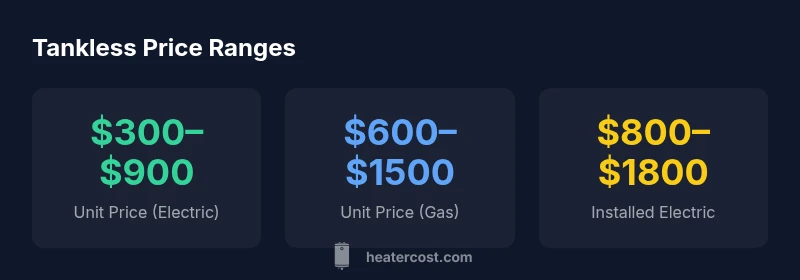
Water heater prices tankless vary by energy source and installation, with electric units typically cheaper upfront than gas models. Unit costs range roughly from $300–$900 for electric and $600–$1,500 for gas, while installed totals run about $800–$1,800 for electric setups and $1,800–$3,500 for gas setups. Total costs depend on venting, permits, and labor, plus regional labor rates in 2026.
Overview of Tankless Water Heaters and Price Drivers
When homeowners shop for water heater prices tankless, they should look beyond the sticker price to the total installed cost. Tankless systems heat water on demand, which can deliver long-term energy savings, but installation complexity varies widely by home. The Heater Cost team finds that price drivers include unit type (electric vs gas), required venting or special electrical work, regional labor rates, and any necessary plumbing retrofits. In addition to the unit price, customers should budget for permits, potential electrical panel upgrades, and venting hardware. The result is that total cost can swing by thousands of dollars depending on how the system is integrated with existing V-rated or gas infrastructure. This section maps out how those factors interact with 2026 market dynamics and helps readers build a realistic budget.
Unit Costs: Electric vs Gas Tankless
Electric tankless heaters typically carry a lower upfront unit price than gas models because they do not require venting or gas lines. Electric units commonly fall in the $300–$900 range for the unit itself, while gas tankless units commonly range from $600–$1,500. The energy source shapes not just the unit price but also the install complexity: electric installations often involve upgrading the electrical panel or dedicated circuit, whereas gas installations may require venting routing and gas line work. In both cases, expect the total installed price to reflect labor intensity, local permitting rules, and potential sequencing with other home upgrades. The Heater Cost analysis highlights that buyers should separate “unit price” from “installed price” when comparing quotes to avoid underestimating total cost.
Installed Price Ranges: What Affects Total Cost
Total installed costs for tankless systems depend heavily on installation complexity. Electric installations may require upgrading a panel, running new wiring, or adding a dedicated circuit, while gas installations often need venting runs, combustion air, and gas line work. Permits and inspections add another layer of cost that varies by jurisdiction. On average, installed prices can range from $800–$1,800 for electric and $1,800–$3,500 for gas, but regional differences can push these figures higher or lower. Labor availability and contractor scheduling can also influence the final price. For a thorough forecast, homeowners should obtain multiple bids that itemize unit price, electrical or venting work, and permit fees.
Typical Price Ranges by Type and Size
Tankless heaters are sized by flow rate (GPM) and temperature rise. Electric tankless units are usually cheaper up front and simpler to install in smaller homes, while gas units offer higher flow suitable for busy households. The price spectrum breaks down roughly as follows: Electric Unit Price $300–$900; Gas Unit Price $600–$1,500; Installed Electric $800–$1,800; Installed Gas $1,800–$3,500. As homes scale up in hot-water demand, higher-GPM models and additional venting or larger gas lines can push prices toward the top end of these ranges. When evaluating options, compare the total installed price rather than unit price alone to understand value.
Regional Variations and Permits
Prices vary by region due to labor costs and permit requirements. In some areas, permits may require inspections and venting adjustments that add hundreds of dollars to the project. Similarly, cities with stricter building codes may require more extensive venting runs or seismic bracing, driving up both unit and installation costs. Homeowners should contact local authorities or a licensed contractor to obtain a precise estimate that reflects regional rules and the specific installation scenario. Heater Cost analysis shows that regional variation is one of the primary reasons total costs diverge across markets in 2026.
Hidden Costs and Maintenance Considerations
Beyond the initial purchase and installation, tankless systems incur ongoing costs that influence long-term value. Descaling and flushing are recommended in hard-water regions, typically every 12–24 months, to extend unit life and maintain efficiency. Filter replacements, electrical or gas line upgrades, and occasional venting service may also be necessary. While maintenance adds to annual costs, well-maintained tankless heaters can deliver reliable hot water and efficiency advantages over traditional tanks, offsetting some of the upfront investment over time. Budget for annual maintenance as part of your lifecycle cost plan.
How to Budget and Plan
A practical budgeting approach starts with a clear scope: choose electric or gas, estimate unit price, obtain 2–3 quotes for installation, and check permit costs. Add a contingency for unplanned electrical or venting work. Consider long-term energy savings and potential rebates or tax incentives when evaluating value. Create a side-by-side comparison of quotes that separates unit price, install, and permit line items, and use a project timeline to align permits and inspections with other home upgrades. The goal is to establish a realistic total cost target that reflects both initial outlay and lifetime savings.
Price comparison by system type
| System Type | Typical Unit Price | Typical Installed Price |
|---|---|---|
| Electric Tankless | $300–$900 | $800–$1800 |
| Gas Tankless | $600–$1500 | $1800–$3500 |
| Traditional Tank Heater | $400–$1000 | $1200–$2500 |
Got Questions?
What is the average total cost for a tankless water heater installed?
Total cost includes the unit, installation, venting or electrical work, permits, and any necessary retrofits. Electric totals commonly range from about $800–$1,800, while gas totals range from roughly $1,800–$3,500, depending on home specifics.
Total cost includes the unit, installation, venting, and permits. Electric installs are usually cheaper upfront, while gas installs can be higher due to venting and gas work.
Are electric tankless heaters cheaper to install than gas?
Generally yes, electric installs involve less venting and gas line work, lowering labor costs. However, total cost still depends on electrical upgrades, panel capacity, and regional labor rates. Gas models may offer higher flow but can incur more installation complexity.
Electric installs are usually cheaper upfront, but total cost depends on electrical capacity and regional rates.
Do permits add to the price of tankless water heaters?
Permits and inspections can add hundreds of dollars, depending on your locality and the scope of work. Some regions bundle permit fees into the contractor’s price, while others bill separately.
Yes, permits can add hundreds; check local rules and get itemized bids.
What maintenance is required for tankless units?
Regular descaling or flushing is recommended in hard-water areas, typically every 12–24 months. Filters should be inspected, and occasional venting or electrical checks may be needed to maintain efficiency.
Descale regularly to keep efficiency high and extend life.
How long do tankless water heaters last?
Most tankless units last 15–20 years with proper maintenance. Lifespan can vary by model, water quality, and installation quality. Proper sizing and routine service help maximize longevity.
Most last 15–20 years with regular maintenance.
What features most affect price differences?
Flow rate (GPM), energy source, venting requirements, warranty options, and brand reliability are major price drivers. Higher GPM units and advanced features can substantially raise both unit and installed costs.
Higher flow, venting needs, and warranties drive price differences.
“Tankless systems can deliver meaningful energy savings, but homeowners must account for upfront costs and installation complexity to realize those benefits.”
The Essentials
- Base your budget on total installed cost, not just unit price
- Electric tankless usually cheaper to install than gas, but not always
- Permits and venting can add hundreds to thousands of dollars
- Hard-water areas may incur regular maintenance costs
- Obtain multiple bids and compare breakdowns for accuracy