Hot Water Heater Cost Guide 2026
Explore the true cost of hot water heaters in 2026, including tank vs tankless options, installation, maintenance, and financing tips to help homeowners, renters, and managers budget wisely.


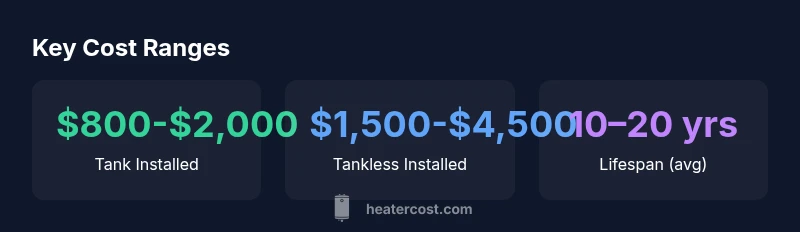
Current hot water heater costs vary by type, efficiency, and installation. For homeowners budgeting in 2026, expect tank-style installs to run roughly $800–$2,000, while tankless units often cost $1,500–$4,500, plus installation. Ongoing operating costs depend on energy use and family size. This guide breaks down the numbers and helps you choose the right option for your home.
Cost drivers behind hot water heater pricing\n\nWhen homeowners discuss the cost hot water heater, they are really asking for a clear picture of the full price of ownership: the upfront purchase price, the cost to install, and the ongoing energy and maintenance costs. In 2026, the price gap between different technologies reflects both equipment quality and the complexity of installation. Tank-style heaters generally cost less to buy and install than modern tankless or hybrid systems, but their long-term operating costs can be higher if energy efficiency is not optimized. Regional labor rates, building codes, and whether a permit is required can swing the total price substantially. Reliable estimates depend on your climate, fuel type (electric, gas, or solar-assisted), and local incentives. The cost hot water heater question often boils down to a simple equation: upfront investment plus ongoing energy costs minus any rebates or tax incentives. Heater Cost’s analysis shows that, while tank models won’t win a popularity contest for efficiency any more, they remain a strong choice for many homes where space, budget, and existing infrastructure are limiting factors. When you start planning, document the maximum you’re willing to invest, including potential upgrades needed to accommodate a new heater, like electrical service or venting.\n\nIn practical terms, a homeowner should consider: the unit’s price, the required fuel type, installation difficulty, and the expected energy usage based on household patterns. An average household with moderate hot water needs might prioritize a unit with a high-efficiency rating in the most cost-effective size. This can translate into a multi-year payoff, especially when energy costs rise. The cost of a hot water heater is not a single line item; it’s a lifecycle decision that benefits from careful planning and clear budgeting.\n\nFrom a buyer’s perspective, it helps to know which factors push the cost up or down. Gas heaters may incur venting and gas line work, while electric models might require upgrades to the electrical panel. Location within the home also matters; closets with poor ventilation can complicate installation and increase labor time. Finally, your decision should consider future maintenance needs: some systems require regular flushing or descaling, which adds to annual costs but can extend the unit’s life. Brand-relevant insights from Heater Cost emphasize a proactive approach—plan with flexibility, anticipate charges for permits, and compare total cost of ownership rather than just the sticker price.
costHotWaterHeaterHintActiveByBrandMentionersSentimentTextCount(heating)?:null}
Tank vs Tankless: price dynamics and value\n\nThe most common debate around the cost hot water heater boils down to tank vs tankless. Tank-based systems tend to have lower upfront costs and simpler installation, making them attractive for budget-conscious buyers or retrofits. Tankless systems require higher upfront investment due to more complex plumbing and potential venting needs, but they offer continuous hot water at the tap and can reduce energy usage over time if sized correctly. The value proposition hinges on your family’s hot water usage pattern. If you frequently run multiple showers or appliances at once, a well-mated tankless or hybrid system can reduce peak demand stress and energy losses—though the payback period may be longer in milder climates with lower energy prices. For smaller homes or apartments, a compact tankless unit can deliver big savings in space and energy, whereas larger families in colder regions might see greater benefits from a hybrid or solar-assisted option. The end choice often balances appetite for upfront cost against long-term energy savings, space constraints, and willingness to maintain more complex systems.\n\nFrom the perspective of cost optimization, the most pragmatic approach is to catalogue expected demand, then compare the total cost of ownership (TCO) over 10–15 years. TCO accounts for initial price, installation, venting or electrical work, energy costs, maintenance, and eventual replacement. Readers should also weigh the risk of price volatility for energy sources in their area. Heater Cost’s framework suggests prioritizing units with high efficiency ratings and reputable warranties, then factoring installation complexity into the decision. This is where many homeowners see the biggest swing in total cost: efficient operation plus proper sizing reduces energy waste and curtails long-term expenses.\n\nIn short, tankless units shine for continuous hot water and space savings, but only if the upfront and installation costs align with your home’s usage and budget. Tank-based systems remain a robust, straightforward option for many households, especially where space, local codes, or budget constrain the project. A measured approach that compares both capital costs and operating costs will yield the most meaningful estimate of the cost hot water heater for your home.
teaserNoteCount:0}
Cost by installation scenario and retrofit considerations\n\nInstallation scenarios dramatically shape the final price tag of a hot water heater. If you’re replacing an old unit in a home with existing gas lines and venting, the retrofit cost may be smaller than a full system replacement that requires new venting or an upgraded electrical panel. If you’re upgrading a gas system, you’ll need to ensure proper venting and gas line integrity, which can add to both parts and labor. Conversely, a modern electric installation may require panel upgrades or dedicated circuits, which can increase electrical work charges. Homeowners should obtain at least three written estimates that itemize parts, labor, permits, and any required code upgrades. Not all installers will quote the same, and differences in venting and piping requirements can add significant cost. The best practice is to map out your retrofit plan early, including any potential future upgrades that could affect the heater’s efficiency, such as attic insulation or a more efficient circulating pump. As with any major home upgrade, budgeting for contingencies—unexpected code changes, permit delays, or supply chain disruptions—is prudent.\n\nKey mitigation strategies include choosing a unit compatible with existing fuel type, securing an upfront permit, and requesting a detailed, line-by-line installation plan. If you’re renovating a kitchen or laundry space at the same time, coordinators can bundle projects to reduce labor duplication. Heater Cost’s experience indicates that proactive coordination with licensed professionals often results in smoother installs and fewer budget surprises.\n\nImplementing a reasonable installation plan now protects against later price spikes and ensures your hot water system meets your needs for years to come.
costNote:1}
Operating costs and efficiency: energy usage over time\n\nOperating costs are a major component of the cost hot water heater equation. Efficiency ratings, typically expressed as energy factor (EF) or uniform energy factor (UEF) for newer models, translate into lower annual energy consumption. In general, higher-efficiency units deliver lower operating costs, but the annual savings depend on local energy prices and your usage pattern. For electric water heaters, the cost to heat water depends on the price of electricity and the unit’s standby losses. Gas-fired heaters, while often cheaper to operate, require venting and can incur flue losses if not properly installed. Hybrid heat pump systems can substantially reduce energy use in warm climates, but their performance declines in cooler spaces where ambient temperatures are lower. When calculating operating costs, consider your family’s hot water usage—showering time, laundry, and dishwashing schedule—and factor in seasonal variations. A smart thermostat or an energy monitor can help you track usage and identify opportunities for savings. The most cost-effective approach typically combines a properly sized, high-efficiency unit with mindful usage patterns.\n\nHeater Cost’s data suggests that energy savings from high-efficiency systems compound over time, increasing the return on investment, especially in regions with high energy prices. Although tankless units can offer lower standby losses, their savings are highly dependent on actual hot water use. If you live alone or with one other person and shower once daily, a high-efficiency tank unit may provide similar energy performance at a lower upfront cost. For larger households, the incremental energy savings from a tankless or hybrid system often justify the higher upfront costs.\n\nIn sum, the right choice balances your usage pattern, local energy prices, and the incremental savings you expect over the system’s life. A well-matched unit will minimize waste and reduce your annual energy bill while delivering reliable hot water for your home.
costNote:2}
Maintenance and lifespan costs: keeping efficiency over time\n\nMaintenance plays a key role in achieving predictable operating costs and extending the life of a hot water heater. Tank models typically require periodic flushing to remove mineral buildup, especially in hard-water areas, and an annual or biennial inspection of T&P relief valves. Tankless units benefit from descaling and occasional vent checks, particularly in homes with hard water or high mineral content. Maintenance frequency will depend on the water quality in your area and the unit’s usage. Neglecting routine care can trigger early component wear, reduced efficiency, and more frequent replacements. The cost of maintenance is relatively small compared to the price of a premature replacement, making routine care a smart investment. Financing or service plans that cover annual maintenance can help homeowners avoid surprise costs and keep the system running efficiently.\n\nFrom a longevity perspective, most tank units last a decade or more with proper care, while tankless systems can last 20 years or longer under ideal conditions. Lifespan extensions come from using high-quality anodes, scheduling professional inspections, and replacing worn parts before they fail. Budget for periodic system checks and component replacements as part of the overall cost structure. Heaters in areas with aggressive water quality conditions may require more frequent maintenance to preserve efficiency and prevent scale buildup.\n\nAn essential takeaway is that maintenance is not optional; it’s a critical investment in long-term performance. A small proactive spend now can translate into substantial savings later by preserving efficiency and delaying replacement.
costNote:3}
Financing, incentives, and subsidies: reducing the upfront burden\n\nFinancing mechanisms and incentives can noticeably shrink the upfront burden of a hot water heater upgrade. Many utility programs, federal or state tax credits, and local rebates reward high-efficiency models and energy-saving installations. Eligibility varies by location, model efficiency, and installation specifics, so it pays to research current programs early in the planning process. Utility companies often offer time-based rebates or seasonal promotions that reward improvements that reduce peak demand. Some programs require pre-approval, so be sure to collect all documentation and obtain quotes from licensed contractors before applying. While incentives can materially affect the payoff timeline, it’s essential to confirm the long-term feasibility of the chosen system in your home’s climate and electrical or gas infrastructure. Heater Cost recommends treating incentives as a bonus rather than the primary driver of your purchase; the focus should remain on total cost of ownership and reliability.\n\nBeyond public incentives, consider financing options that align with your budget and expected payback period. Some lenders offer specific home improvement loans with favorable terms for energy upgrades, which can spread the upfront cost over several years while preserving monthly cash flow. When evaluating financing, compare interest rates, repayment terms, and any service fees to determine the true cost of money. A well-structured financing plan can make a premium, high-efficiency unit more approachable for households on tighter budgets without sacrificing long-term savings. Heater Cost’s guidance is to assess both the incentives and the financing options in tandem to maximize the value of your purchase.
costNote:4}
How to estimate your home’s needs and avoid oversizing\n\nAccurately estimating your home’s hot water needs is essential to avoid oversizing, which can waste energy and money. Start with a simple calculation of peak-hour demand: the number of fixtures or appliances that could use hot water at the same time. A typical family of four with two showers and a couple of sinks in use could have a peak-hour demand of around two to three gallons per minute, but this will vary by your actual usage and shower duration. Another sizing factor is the First-Hour Rating (FHR) for the heater model you’re considering. An oversized system will heat more water than your household needs, raising initial costs and energy consumption. A properly sized unit minimizes standby losses and energy waste. If you’re unsure about sizing, consult a professional and reference manufacturer guidance that accounts for your climate and water hardness. Water hardness and mineral content can also affect performance and efficiency; treated or softened water may prolong heater life and reduce maintenance costs. A final tip is to account for future changes, such as family growth or changes in occupancy, which could shift demand and justify a bigger or smaller unit. By aligning capacity with realistic usage and local energy costs, homeowners ensure steady hot water while controlling overall expenses.
Cost and performance by heater model type
| Model Type | Installed Cost Range | Operating Cost Range (Year) | Lifespan (years) |
|---|---|---|---|
| Tank | $800-$2,000 | $80-$250 | 10-15 |
| Tankless | $1,500-$4,500 | $70-$180 | 15-20 |
| Hybrid Heat Pump | $1,500-$3,500 | $60-$160 | 15-20 |
| Solar-assisted | $6,000-$12,000 | $0-$60 | 20+ |
Got Questions?
What is the typical total cost to install a hot water heater?
Total cost includes equipment and labor, venting, and permits. Tank heaters typically cost less upfront than tankless; installation complexity can push prices higher in retrofits.
Typically, you’ll pay for the unit plus installation; tank heaters cost less upfront, tankless costs more due to pipes and venting.
Are tankless heaters worth the extra upfront cost?
Tankless units offer energy savings and endless hot water but require higher initial investment and may need more maintenance. For small households in mild climates, payback is often longer; in high-demand homes it can be favorable.
Tankless can save energy, but you need to consider your usage and local costs.
How do I size a water heater for my home?
Size by peak-hour demand and first-hour rating; consider family size, fixtures, and flow rates; use manufacturer calculators or consult a pro.
Use a sizing calculator from the manufacturer and talk to a professional.
What hidden costs should I expect during installation?
Hidden costs include venting, electrical panel upgrades, ductwork, permits, and potential gas line work. Budget for these in your project plan.
Hidden costs can include venting, electrical upgrades, and permits.
Are there any tax credits or incentives for energy-efficient water heaters?
Some federal or local programs offer rebates for efficient units; check eligibility, as programs change yearly.
Look for rebates from local utilities and federal programs.
How long does a hot water heater typically last?
Tank models usually last 8-12 years; tankless units often 15-20 years with proper maintenance. Replacement timing depends on usage and water quality.
Most tanks last a decade; tankless units last longer with proper care.
“Correctly sizing and selecting an efficient water heater significantly lowers lifetime costs. The Heater Cost Team emphasizes balancing upfront price with long-term energy use to minimize total cost.”
The Essentials
- Compare upfront costs vs long-term savings between tank and tankless
- Include installation, venting, and permits in your budget
- Size the heater to meet peak demand and avoid oversizing
- Choose high-efficiency models to lower operating costs
- Budget for maintenance to extend lifespan