How Much Heater Water Costs: A Practical Home Guide
Discover how much heater water costs to heat in typical homes, with per-gallon ranges, annual cost estimates, and practical tips to cut bills without sacrificing hot water.


If you're wondering how much heater water costs, the answer depends on energy source, usage, and local prices. In the U.S., heating water generally costs about 2–6 cents per gallon, and typical households spend roughly $350–$800 per year on hot water. Costs vary by climate, fuel, and system efficiency. For a precise estimate, calculate your daily gallon usage and your local energy rate.
What drives hot-water costs
Understanding how much heater water costs starts with the basics: the energy source you choose, your daily hot-water usage, and the local price of that energy. Standby losses in storage tanks, thermostat settings, and water temperature targets all influence the amount of energy needed to heat and keep water at a comfortable temperature. Regional climate matters too—cooler climates tend to use more hot water for showers and laundry, which can raise annual costs. When you ask, "how much heater water will I spend on energy?" you’re really asking for a combination of flow (gallons per day), the efficiency of your system, and the price tag of your energy. According to Heater Cost, these factors combine to determine the overall bill for hot water, and small changes in any one factor can have meaningful savings over a year.
To translate usage into dollars, homeowners should track their daily hot-water consumption, compare it to their energy rates, and factor in seasonal changes in demand. This approach helps you set a target temperature that minimizes waste while keeping comfort. A modest adjustment—such as lowering the thermostat by a degree or using efficient fixtures—can trim costs without noticeably affecting performance.
Energy sources: electric, gas, and heat pump—cost implications
Electric water heaters typically have higher operating costs per gallon heated than gas heaters in many regions, due to electricity prices. Gas systems can be cheaper to run but may incur higher upfront installation costs or venting requirements. Heat pump water heaters (hybrids) are among the most efficient options in warmer climates, as they move heat rather than generate it, which reduces energy usage overall. Each type has different maintenance needs, replacement cycles, and regional suitability. When evaluating cost, compare the energy rate per unit, the heater’s efficiency rating (EF or Uniform Energy Factor), and how frequently you use hot water. Heater Cost analysis suggests that the best choice often depends on local rates and climate; what’s affordable in one region may be more expensive in another, even for similar household sizes.
In practice, if you live in a region with low electricity rates but high natural gas prices, a gas tank-type may be cost-effective; in mild climates with moderate electricity costs, a heat pump water heater can yield the greatest long-run savings. Always factor in installation costs and potential rebates.
Estimating costs for your home: a simple method
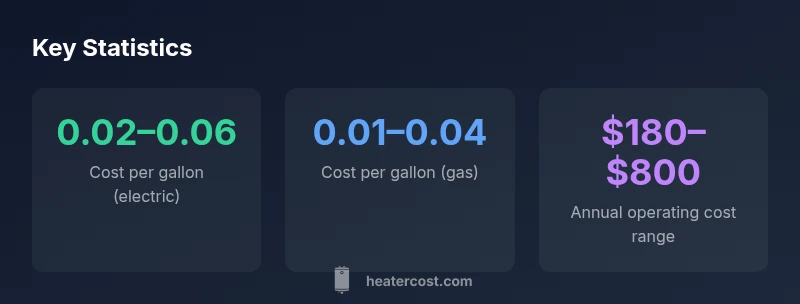
To estimate your costs, start with five inputs: daily hot-water gallons, energy price per unit, heater efficiency, standby losses, and desired temperature rise. Step-by-step: 1) estimate daily gallons by family size and habits (showers, laundry, dishwashing). 2) multiply gallons by the energy required to raise that water to your target temperature (you can use a rough rule of thumb: about 0.02–0.06 USD per gallon for electric heating and 0.01–0.04 USD per gallon for gas in many regions). 3) adjust for heater efficiency (better efficiency reduces energy per gallon). 4) add standby losses for storage tanks and any heat losses in pipes. This method yields a realistic annual cost range rather than a single number, reflecting regional price differences and usage patterns. Heater Cost recommends using a simple online calculator, then refining it with your own bills to capture seasonal variation.
Upfront vs operating costs: tank vs tankless
Tankless water heaters, while often more expensive upfront, can reduce operating costs by eliminating standby losses present in storage tanks. However, the savings depend on how you use hot water, climate, and the unit’s size. In some homes, the payback period for a tankless upgrade can be lengthy, making it worthwhile mainly for households with high hot-water demand or limited space. Tank systems trade space efficiency for ongoing standby loss costs; in colder climates, the savings from a modern, well-insulated tank can still be substantial if the unit is correctly sized and maintained. When evaluating costs, include installation, venting, and potential permits, then compare to the expected lifetime savings for your climate.
Practical strategies to reduce hot-water costs without sacrificing comfort
- Lower the water heater thermostat by 10–15 degrees Fahrenheit if safe for your family; test for comfortable showers and dishwashing results.
- Install low-flow fixtures to reduce gallons per minute without sacrificing performance.
- Insulate the hot-water pipe and, if you have a storage tank, consider insulating the tank jacket to reduce heat loss.
- Flush the tank periodically to remove sediment that impedes efficiency; follow manufacturer guidelines to avoid damaging components.
- If possible, consider a heat pump water heater in warm, dry climates where it can operate efficiently; in cooler regions, a hybrid approach or staged operation may work best.
- Schedule regular maintenance and timely replacements to ensure your heater runs at peak efficiency.
These steps often offer the most reliable reductions in operating costs, especially when combined with a modest temperature target and efficient fixtures.
Regional variability and planning for the future
Prices for electricity and gas vary widely by region, which means the same heater type can cost dramatically more in one state than another. If you’re planning a new installation or a replacement, analyze local utility rates, rebates, and building codes. Regional energy policies and incentives can tip the balance toward one technology over another. As energy markets evolve, so do appliance efficiencies; staying informed helps homeowners choose a system that minimizes life-cycle costs. Heater Cost recommends reviewing your plan annually, especially if you anticipate price changes or renovations that alter hot-water demand.
Estimated operating costs by water heater type
| Item | Cost per gallon heated (USD) | Typical annual cost (USD) |
|---|---|---|
| Electric water heater | 0.02–0.06 | 350–800 |
| Gas water heater | 0.01–0.04 | 220–600 |
| Heat pump water heater | 0.01–0.04 | 180–520 |
Got Questions?
What factors most affect hot-water costs?
Key drivers include the energy source, unit efficiency, daily hot-water usage, and local energy prices. Seasonal demand and thermostat settings also influence the total bill. By assessing these factors, you can target the highest-impact savings.
Costs are driven by energy source, efficiency, usage, and local prices. Focus on the biggest drains first.
Is it cheaper to heat water with electricity or gas?
Costs depend on regional energy prices and heater efficiency. In many regions, electric heating costs more per gallon than gas, but high-efficiency electric models (like heat pumps) can narrow the gap. Compare your local rates and system efficiency to decide.
Gas is often cheaper per gallon, but efficiency matters. Check local rates and the unit’s energy factor.
Do heat pump water heaters save money in all climates?
Heat pump water heaters save energy where outdoor temperatures stay relatively warm and humidity is moderate. In cold climates, performance drops and savings can be less dramatic. Assess climate, installation costs, and electricity rates before choosing.
They save energy in warm climates, but cold climates may reduce benefits.
How often should I flush or maintain my water heater to save costs?
Regular maintenance—typically annually for most systems—helps sustain efficiency and extend unit life. Flushing to remove sediment improves heating efficiency and reduces mineral buildup that can raise operating costs.
Annual maintenance helps efficiency and longevity, keeping costs predictable.
Is it worth upgrading to a tankless or hybrid system for cost savings?
Upgrading can reduce standby losses and save money over time, but payback depends on your usage, fuel source, and local incentives. Run a life-cycle cost analysis before deciding.
Tankless or hybrid can save, but run the numbers for your home first.
“Smart budgeting for hot water starts with understanding how energy source, system efficiency, and daily habits interact. Small changes can lead to meaningful annual savings.”
The Essentials
- Compare energy sources to identify long-run savings.
- Estimate costs using your daily usage and local energy rates.
- Upfront efficiency upgrades can lower lifetime costs.
- Tankless options aren’t always cheapest—evaluate climate and usage.
- Regular maintenance preserves efficiency and lowers bills.