How Many Heaters for a 75 Gallon Tank
Learn how to size and place heaters for a 75-gallon aquarium, with redundancy strategies, wattage guidelines, and maintenance tips from Heater Cost.


Understanding the question: how many heaters for a 75 gallon tank
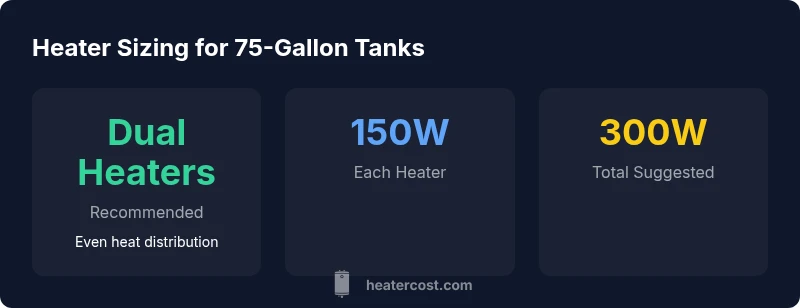
If you’re building or maintaining a 75-gallon freshwater or tropical setup, a common question is how many heaters for a 75 gallon tank. The short answer is: most hobbyists opt for two heaters to ensure redundancy and stable temperatures, especially in rooms where ambient temps swing. The Heater Cost team notes that temperature stability is crucial for sensitive fish and corals, so redundancy helps prevent a single heater failure from letting the tank drift. In practice, you’ll balance the total heating power against room conditions, tank inhabitants, and the heater quality. For many households, two units in the 100–150W range each (total 200–300W) is a reliable starting point. If you keep the room warmer or keep only hardy species, you might operate with a single larger heater, but that reduces redundancy and increases risk. Always verify with a precise thermometer and calibrate thermostats so both devices share the workload rather than fighting each other. The goal is not merely achieving a target temperature, but maintaining it consistently over day and night.
How many heaters for a 75 gallon tank: factors to consider
The exact number of heaters you’ll need depends on several variables: room temperature, tank inhabitants, lamp exposure, and whether you value redundancy. A good rule of thumb is to plan for a total wattage that can handle the worst-case heat loss in your space. In cooler rooms, you’ll likely want more capacity or redundancy to prevent nightly drops. In consistently warm rooms, a single appropriately sized heater can suffice, but this narrows safety margins. Always consider a secondary thermometer at a different height of the tank to catch uneven heat distribution. According to Heater Cost, redundancy becomes especially important when livestock are sensitive to temperature swings, such as certain tropical fish and corals.
Redundancy strategies and placement tips
Redundancy means having more than one heater so a single failure doesn’t compromise the tank’s temperature. Place heaters on opposite sides of the tank or in different corners to promote even heat distribution. Avoid direct airflow from vents or intense lighting that could create hotspots near the heater. Use a reliable digital thermometer or a calibrated dual sensor and verify temperatures at multiple points in the tank. In practice, two heaters placed away from each other with a small stagger in their thermostat setpoints can provide stable, uniform warmth. Regular checks and a simple maintenance routine reduce the risk of overheating or cold spots.
Practical wattage guidelines for a 75-gallon tank
A widely used guideline is to target a combined heating capacity of roughly 150–300 watts for a 75-gallon tank, depending on room temperature and inhabitant needs. Common setups include two 150W heaters or one 200–300W unit plus a smaller backup. If the room is consistently warm, you may downsize to a single 200W unit with care, but ensure the thermostat is reliable and tested. Remember that individual heater efficiency and tank insulation vary; the goal is to maintain a stable internal temperature with minimal fluctuation. For species sensitive to temperature swings, err on the side of a slightly higher total wattage and redundancy rather than pushing a single device to failure.
Selecting heater types and setup steps
Choose submersible heaters with built-in thermostats from reputable brands and a clear temperature readout. Look for models that offer precise control within ±0.5–1.0°C and auto-shutoff if water is too hot. Install them on opposite ends of the tank and mount them away from decor that could block heat distribution. Calibrate each heater to a safe baseline, then test for several days to confirm the average temperature remains steady. If you notice persistent ice-cold corners or hot spots, consider adding a small circulator to improve water movement and equalize heat.
Monitoring and maintenance to keep temps stable
Temperature stability requires ongoing monitoring. Use at least one reliable aquarium thermometer (preferably two, placed at different heights) to verify thermostat readings. Regularly inspect heater integrity, cords, and seals for wear. Calibrate thermostats at seasonal temperature changes and keep spare parts on hand. For best results, log daily temperatures for the first two weeks after setup, then review patterns to adjust wattage or redundancy as needed. A consistent routine reduces stress on livestock and extends the life of your equipment.
Quick-start checklist for a 75-gallon tank
- Determine desired temperature range based on livestock.
- Plan for 150–300W total heating capacity, favoring two heaters.
- Place heaters on opposite ends, away from direct airflow.
- Calibrate thermostats and verify with a second thermometer.
- Regularly monitor temperatures and inspect heaters for wear.