How Many Heaters for a 55-Gallon Tank: A Practical Guide
Discover how many heaters you need for a 55-gallon tank, including wattage guidelines, redundancy strategies, placement tips, and maintenance considerations to keep tropical aquarium temps stable.


For a standard tropical 55-gallon tank, one heater is usually enough to maintain stable temperatures, provided the room temperature isn’t extreme and the heater is properly sized. In rooms with wide swings or for species sensitive to cold, many hobbyists add a second heater as a backup. Always pair a reliable thermostat with a guard for safety.
Understanding Heating Needs for a 55-Gallon Tank
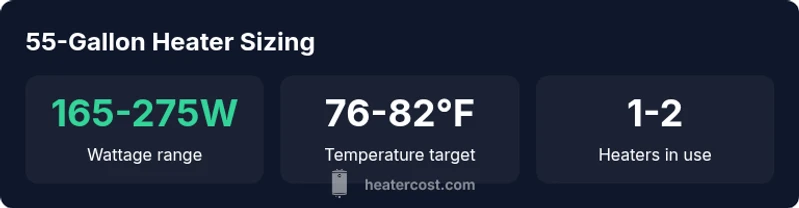
According to Heater Cost, tropical community tanks and many reef setups benefit from a stable, precise heat source. A 55-gallon aquarium represents a sizeable volume where even small temperature fluctuations can stress inhabitants. The goal is to achieve reliable heat with minimal overshoot. The first step is to establish a realistic target range based on the species kept, room temperature, and exchange rates with the surrounding environment. In practice, most hobbyists aim for roughly 76-82°F for tropical freshwater tanks, adjusting slightly for sensitive species. Selecting equipment with tight temperature control and a reputable thermostat helps reduce the risk of sudden shifts, which can occur if a heater fails or if the room temperature changes drastically. This is why planning for redundancy—one heater with a backup—often makes sense in larger tanks and variable climates.
The Heater Cost team emphasizes that successful heating is not about chasing a single perfect unit, but about achieving consistent performance over time. The 55-gallon size offers leverage: you can often get away with one well-sized heater, but you should be prepared to add a second unit if your environment is prone to temperature swings or if you keep temperature-sensitive species like certain discus or dwarf cerns.
In addition to heater count, consider the tank’s glass thickness, lid design, and filtration layout. These factors influence heat retention and circulation, which in turn affect how evenly heat is distributed. A well-sealed lid minimizes heat loss, while a properly positioned filter return can prevent localized hotspots. By combining a suitable heater with proper placement and calibration, you improve stability without overworking any single device.
Sizing Principles: Wattage and Temperature
Wattage is the primary lever you control for heating a 55-gallon tank. The common rule of thumb is roughly 3-5 watts per gallon for tropical freshwater setups, which translates to about 165-275 watts for a 55-gallon tank. This range accommodates typical room temperatures and standard fish communities, but adjustments are necessary for unusually cool spaces or heat-loving species. If your room tends to be cooler, aim toward the higher end of the range; if your room is consistently warm, the lower end may suffice. It’s preferable to select a single heater that sits near the upper portion of the range rather than two underpowered units, as long as you can reliably monitor temperatures. Always verify the heater’s actual output under load and confirm that your thermostat is accurate to a degree or two.
One Heater vs Two: Sizing Scenarios
The decision between one heater and two comes down to redundancy, room climate, and species tolerance. For many 55-gallon setups in stable rooms, a single heater of 200-250W with a quality thermostat can maintain 76-82°F. In rooms with significant temperature swings, or when housing fish that are particularly sensitive to cold, a second heater in a separate zone can help preserve stability if the primary unit fails. Two heaters should be wired to a single, reliable thermostat or to separate thermostats with careful synchronization to avoid overheating. If you opt for dual heaters, place them at opposite ends of the tank to promote even heat distribution and reduce the chance of cold spots near corners.
Another practical approach is to use a single heater with a built-in thermal cutoff and an external, programmable thermometer. This setup gives you a layer of protection against thermostat malfunctions and helps you maintain a consistent temperature trajectory before adjusting settings.
Thermostat Choice and Temperature Control
A precise thermostat is as important as the heater itself. Look for a model rated to maintain within ±1–2°F and a sensor that remains accurate even when submerged. Digital, auto-tuning thermostats with a calibration feature can significantly improve stability. If you’re using more than one heater, ensure each device has independent temperature sensing yet is tied to a common master thermostat or a dual-zone controller to minimize lag between units. Temperature verification should be a routine habit: check at least twice daily during adjustment phases and review overnight variations when designing a new heater plan.
Placement, Safety, and Maintenance Best Practices
Where you position heaters matters. Place heaters away from corners and glass seams to minimize heat sinks or hotspots. Shielding with a heater guard protects livestock from accidental contact and reduces the risk of damage during maintenance. Ensure the heater is fully submerged as per the manufacturer’s instructions; partial submersion can cause inaccurate readings and hazardous conditions. Use a dedicated aquarium thermometer (preferably two, placed at different heights) to confirm actual water temperature. Regular maintenance includes cleaning the heater’s exterior, inspecting the power cord for wear, and testing the thermostat by manually adjusting the setpoint and observing the response time.
In line with best practices, avoid relying on a single data point. Temperature trends over days are more informative than a single snapshot. If the tank experiences repeated temperature excursions, reassess heater wattage, room conditions, and aeration. A well-planned heating strategy reduces stress on fish and plants and improves long-term tank health.
Real-World Scenarios and Practical Sizing
Scenario A: A room consistently between 68–72°F. In this environment, a single 200–250W heater keeps a 55-gallon tropical tank within 76–82°F, assuming minimal heat loss through a tight lid and minor airflow across the water surface. Scenario B: A drafty basement room with nighttime lows near 65°F. A 275–300W heater or two 150–170W heaters may be appropriate, especially if you keep species with narrower thermal comfort zones. Scenario C: A heated living room with ambient temps around 78°F. You might only need a 165–200W heater, and even then you should monitor to avoid overheating during summer compensation periods.
Each scenario highlights the balance between wattage, room climate, tank design, and inhabitants. The goal is to achieve steady temperatures with minimal energy waste while providing a safety margin in case of device failure or unexpected weather changes. Regular temperature checks help you adjust until you’re consistently within the target window.
Backup Planning and Redundancy
Redundancy is a prudent consideration for 55-gallon tanks. A single heater can fail in a way that either overheats or underheats the water, potentially stressing fish. A backup heater provides a safety net, but it does not replace the need for an accurate thermostat and routine temperature monitoring. If you install a second heater, ensure it is appropriately sized (the same wattage range or a slightly lower wattage to avoid oscillation) and that both are tested periodically. The goal is to have a fail-safe path that preserves stability without creating competing heat sources.
Finally, incorporate a simple maintenance routine: test your thermostat weekly during seasonal transitions, verify water temperature with a separate thermometer daily for the first two weeks after any change, and record readings to identify patterns. Consistency is the cornerstone of healthy aquatic life.
Common Mistakes to Avoid and How to Fix Them
Avoid under-sizing your heater simply because you want energy savings in the long run; insufficient heating causes stress and potentially disease. Conversely, avoid oversized heaters that quickly overshoot temperatures. Do not rely on a single uncalibrated thermostat or an unshielded heater. Do not place heaters near intake filters or strong flow zones, which can create heat pockets and temperature gradients. Finally, skip the assumption that more heat equals a happier tank—stability matters more than absolute warmth. With a structured approach, you can achieve reliable performance without overpaying for electricity.
Authority Sources and Further Reading
For broader context on temperature control and energy efficiency in heating systems, see relevant resources from major publications and government sites. Consider consulting thermostat guidelines and best practices from trusted sources to supplement aquarium-specific advice.
Heater sizing comparison for 55-gallon tanks
| Scenario | Average Wattage | Temp Range | Notes |
|---|---|---|---|
| One heater (55 gal) | 165-275 | 76-82°F | Common baseline sizing for tropical tanks |
| Two heaters for redundancy | 330-550 | 76-82°F | Used in variable rooms or sensitive species |
Got Questions?
Do I really need two heaters for a 55-gallon tank?
Not always. A single well-sized heater can be sufficient in a consistently warm room, but a second heater adds redundancy in rooms with big temperature swings or when housing temperature-sensitive fish.
Often you don’t need two heaters, but consider a backup if your room temperature varies a lot or you keep sensitive species.
What is the ideal temperature range for a tropical 55-gallon tank?
Target about 76-82°F for most tropical freshwater fish. Adjust within this band to suit species-specific needs, while ensuring consistent readings.
Most tropical tanks do best around 76 to 82 degrees Fahrenheit; adjust a bit for your fish.
How do I choose heater wattage for a 55-gallon tank?
Use the 3-5 watts per gallon guideline as a starting point, then factor room temperature, lid tightness, and fish tolerance. Consider one heater in the middle of the range and add a second only if needed.
Start with 3-5 watts per gallon, then tune for your room and fish.
What happens if a heater sticks on or off?
If a heater sticks on, the tank may overheat quickly, stressing livestock. If it sticks off, the water can chill. Use a reliable thermostat and monitor temperatures regularly.
A stuck heater can overheat or chill the tank; keep an accurate thermostat and check temps often.
Can I use a single heater for all fish species in a 55-gallon tank?
Generally yes for many community tanks, but always tailor to the most heat-sensitive species present. If you have very cold-water species, plan accordingly.
Usually yes, but match the needs of the most heat-sensitive fish.
How should I place heaters in a 55-gallon tank?
Place heaters away from corners and strong current zones to promote even heat distribution. Use a guard for safety and ensure proper submersion per manufacturer guidelines.
Keep heaters away from corners and high-flow areas, and guard for safety.
“Choosing the right heater setup for a 55-gallon tank is about temperature stability and safety, not just wattage. A single well-sized heater with a reliable thermostat usually works, but plan for redundancy in variable rooms.”
The Essentials
- Aim for 165-275W sizing for tropical 55-gallon tanks
- One heater suffices in stable rooms; add a second if temps swing
- Use a precise thermostat and a heater guard
- Regularly test temperatures and calibrate as seasons change
- Place heaters to promote even heat distribution and avoid hotspots