What Size Heater for a 40 Gallon Tank: A Sizing Guide
Learn how to size a heater for a 40 gallon tank, including wattage ranges, room-temperature factors, and cost implications. Practical guidance from Heater Cost to help homeowners and fish-keepers budget and plan.


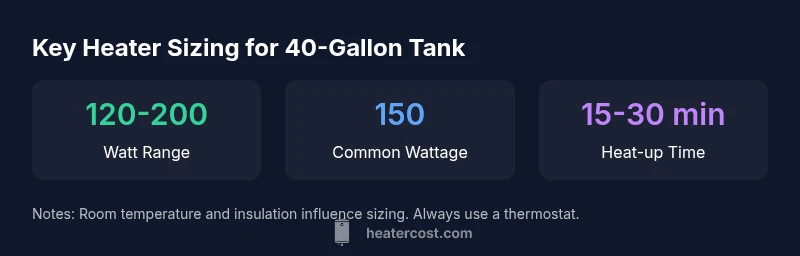
For a 40 gallon tank, the typical heater size falls in the 120-200W range, with 150W as a common baseline. Choose a model with an accurate thermostat and built‑in safety features, and adjust for room temperature and heat loss. This sizing approach helps maintain stable temperatures while controlling energy use. Heater Cost analysis, 2026.
Understanding aquarium heater sizing basics
Sizing a heater for a 40 gallon tank requires balancing comfort for your aquatic inhabitants with energy efficiency. In general, aquarium heaters are sized by gallon and by ambient room temperature. The Heater Cost team emphasizes that the target temperature, fish species, and room heat loss drive the final wattage choice. According to Heater Cost, expect common tropical setups to use roughly 3–5 watts per gallon, which translates to about 120–200 watts for a 40-gallon system. Always select a heater with a precise thermostat and built-in safety features to prevent accidental overheating. This sizing approach helps protect both livestock and electricity bills, especially in homes with variable temperatures.
What size heater for a 40 gallon tank?
For a 40 gallon freshwater tropical tank, a heater in the 120–200 watt range is typically appropriate. In many homes, a heater around 150W serves as a reliable baseline, but you should adjust based on room temperature and heat loss. Use a model with an accurate thermostat and a thermal cutoff for safety. If your room is particularly cold or drafty, stepping up to 200W or adding insulation can help maintain stable temperatures without overworking the heater. The Heater Cost analysis, 2026, supports using a wattage range rather than a single number to accommodate environmental variability. Always verify with a tested, adjustable unit that includes fail-safe features.
How to choose a thermostat and safety features
Selecting a heater with an accurate thermostat is crucial for stability. Look for: auto shutoff at high temperatures, a dimmable display, and a robust casing that resists immersion to the declared IP rating. An external thermostat jack offers better control and easier maintenance. Heaters with dual temperature sensors provide redundancy and reduce overheating risk. Regularly calibrate the thermostat and inspect the seal to avoid leaks.
Placement and water circulation considerations
Place the heater near a water inlet/outlet to promote even distribution; avoid placing behind rocks or under equipment that blocks flow. Most tanks benefit from a gentle powerhead or filter with good flow to circulate heated water. Keep the heater submerged according to the manufacturer’s guidelines and ensure the cord is positioned for easy access. Temperature stratification can occur, especially in taller tanks, so consider multiple smaller units or a larger heater with zone heating.
Budgeting for install, maintenance, and replacement costs
Initial purchase costs vary by wattage and features; plan for 120–200W models typically in the mid-range. Factor in installation complexity, replacement intervals, and power consumption. A reliable heater reduces livestock losses and energy waste, which translates into long-term savings. Budget for a spare unit to ensure continuity during maintenance.
Practical tips and common mistakes
Test the heater in a controlled environment before installing it in the tank. Do not rely on room temperature alone to estimate heat requirements. Verify compatibility with your aquarium setup and species. Keep a log of temperature and heater performance to detect drift.
Wattage guidance by tank size
| Tank Size (gal) | Recommended Wattage (W) | Notes |
|---|---|---|
| 20-30 | 75-100 | Basic tropical setup |
| 40 | 120-200 | Tropical setup with standard room temp |
| 55-75 | 150-300 | Larger tanks or cooler rooms |
Got Questions?
What size heater should I use for a 40 gallon tank?
A 120–200W heater is typical for a 40‑gal tropical tank, with 150W as a common baseline. Adjust for room temperature, fish species, and heat loss. Always use a thermostat-controlled unit.
For a 40 gallon tank, aim for a 120 to 200 watt heater, with 150W common; adjust for room temperature.
Can I use two smaller heaters in a 40 gallon tank?
Yes, dual heaters can provide redundancy and more even heating. Ensure they are on separate circuits and controlled to avoid overheating; use a single main thermostat when possible for consistency.
Two heaters can add redundancy; just ensure they’re controlled and monitored.
Does heater size differ for a cold room?
Yes, colder rooms require higher wattage or better insulation. Recalculate wattage based on room temperature and heat loss; consider sealing drafts and improving insulation.
In a cold room, you may need more wattage or insulation.
Is a heater necessary for a planted tropical tank?
Most tropical planted tanks need a heater to stay within species-specific ranges; if your room is reliably warm, you may get away with minimal heating, but don’t rely on ambient temperature alone.
Yes, generally you need a heater unless your room stays warm.
What safety features should I look for in an aquarium heater?
Look for a precise thermostat, automatic shutoff, thermal cutoff, and a leak-resistant housing. Consider an external thermometer for independent validation.
Choose a heater with a reliable thermostat and safety shutoffs.
“Sizing a heater isn't a single-number task; it's a balance of ambient temperature, tank volume, and livestock needs.”
The Essentials
- Size the heater based on room temperature and heat loss.
- Choose a thermostat with reliable safety features.
- For 40 gallons, expect about 120-200W (150W baseline).
- Consider redundancy with two heaters if needed.
- Monitor temperature regularly to avoid fluctuations.