What Size Heater for a 5-Gallon Tank? A Practical Guide
Learn how to size a heater for a 5-gallon tank with practical guidelines, safety tips, and a step-by-step approach to selecting watts and placement.


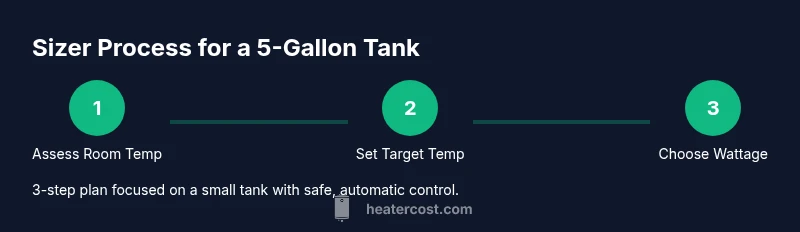
To size a heater for a 5-gallon tank, aim for a small, adjustable heater in the 25–50 watt range. If your room runs cooler, lean toward the higher end; if it’s warm, the lower end may suffice. Ensure the heater has a reliable thermostat, automatic shutoff, and a guard to prevent fish injury. Check manufacturer guidelines for your specific tank.
What size heater for a 5-gallon tank? Key factors
If you’re asking what size heater for a 5 gallon tank, the answer depends on several factors beyond just the tank’s volume. Ambient room temperature, desired water temperature, tank stocking (fish, plants, invertebrates), and the presence of heat sources all influence the required wattage. According to Heater Cost, reliable sizing begins with a conservative wattage and a thermostat that holds a stable set point. In most homes, a 5‑gallon aquarium benefits from a compact, adjustable heater that can be fine-tuned to maintain your target temperature without overheating. A well-chosen heater reduces temperature swings and stress on aquatic life, which translates to better health and color for your fish and plants. As you plan, record your room temperature and desired water temperature, then compare those values against the heater’s thermostat range to ensure a comfortable margin for seasonal changes.
Practical sizing guidelines for small tanks
For a 5‑gallon tank, you typically start with a small heater in the 25–50 watt range and confirm the setup with a calibrated thermometer. The exact wattage depends on the room’s ambient temperature, how well-insulated the tank is, and whether you keep fish that prefer warmer or cooler water. If your space is consistently cool, a heater toward the higher end of the range may be necessary. In a warm or sunlit room, the lower end often suffices. The Heater Cost team found that adjustable models with a clear temperature dial and automatic shutoff provide the most reliable control, reducing the risk of overheating for sensitive species. After installation, monitor temperatures for 24–48 hours and adjust if needed.
How ambient temperature shapes heater choices
Ambient room temperature directly affects how much heat must be added or retained in the water. In cooler rooms (below typical indoor averages), a heater on the high end of the recommended wattage range helps prevent the water from dropping below the target. In warmer rooms, the heater may need to be kept at a lower setting or even temporarily turned off during the day. A heater with a thermostat that maintains a precise set point helps prevent gradual drift, which is crucial for small tanks where even small fluctuations can stress inhabitants. The Heater Cost analysis emphasizes using a heater that stabilizes within a narrow range and includes a protective guard to reduce accidental contact.
Features to look for in a tiny aquarium heater
When selecting a heater for a 5-gallon tank, prioritize these features: 1) adjustable thermostat with a visible dial or digital readout, 2) automatic shutoff if water temperature exceeds the set point, 3) isothermal or silicone tubing design to minimize heat loss, 4) a durable, aquarium-safe housing with a guard to protect fish, and 5) compact size that fits comfortably within the tank’s decor. A model with a safety feature that includes an overheat cut-off and an easily accessible power switch can prevent risks during routine maintenance. The Heater Cost team notes that basic safety features are often overlooked but essential for long-term reliability.
Safe installation, placement, and calibration tips
Proper placement ensures even heating and protects the heater from accidental knocks or drafts. Place the heater horizontally along the back wall or near a corner where water flow carries warm water toward the mid- to upper-water column without placing it directly under the filter outlet. Always power-test the heater outside the tank first to confirm the thermostat responds as expected, then run a 24–48 hour stabilization period before final adjustments. Calibrate using a trusted aquarium thermometer placed away from the heater to avoid skewed readings.
Maintenance, calibration, and long-term monitoring
Regular maintenance maintains accuracy and safety. Check the heater’s seal and housing for cracks, verify the thermostat accuracy against a high-quality thermometer, and replace batteries in any built-in display if applicable. Record daily temperatures for a week to identify any drift or seasonal variation. If readings drift more than 1–2 degrees Fahrenheit over several days, recalibrate or replace the unit. Consistent monitoring helps prevent temperature-related stress for fish and plants.
Quick reference: wattage ranges and a lightweight calculator
A practical starting point for a 5‑gallon tank is the 25–50W range, adjusted for room temperature and species needs. If you want a quick mental model, track your target water temperature and the room’s baseline temperature, then consult the heater’s temperature differential and power rating to estimate the expected water temperature. While a calculator isn’t required, keeping a simple log makes it easy to see how ambient changes affect the tank and when to adjust. The overall goal is a stable, species-appropriate water temperature without frequent changes.
Real-world scenarios and monitoring
In real households, fluctuating temperatures are common. On cool nights, you may need to increase wattage briefly, while on sunny afternoons, you might temporarily reduce heat input. Regular checks with a thermometer and a temperature log help you identify seasonal patterns. For planted tanks, consider the added heat load from lighting and plant metabolism. If you notice persistent temperature swings or uneven heating, reassess placement, insulation, or consider a slightly higher wattage heater with a precise thermostat to minimize fluctuations.
Tools & Materials
- Adjustable aquarium heater (25–50W)(Choose a model with adjustable thermostat and safety shutoff; look for 0.5–1.0°C accuracy if available.)
- Aquarium thermometer (digital preferred)(Place away from heater to avoid reading artificial warmth near the element.)
- Heater guard or clip(Helps prevent fish from contacting the heating element.)
- Thermometer calibration tool(If available, use to verify thermometer accuracy.)
- Notepad or app for temperature logging(Track readings 24–72 hours after setup.)
- Surge-protected power strip(Safer power arrangement and prevents overloading a single outlet.)
Steps
Estimated time: Estimated total time: 25–60 minutes for setup, plus a 24–48 hour stabilization period
- 1
Define target water temperature and room conditions
Decide the water temperature you want for the tank based on species (e.g., 76–78°F for most tropical fish). Measure the room temperature where the tank sits to estimate how much heat will be required and how often the heater will need to run.
Tip: Document both target temp and room temp to refine wattage choices. - 2
Estimate initial wattage range for the 5-gallon tank
Start with a conservative range (e.g., 25–50W) and select a model at the upper end if the room is cooler or if the species requires warmer water. Avoid jumping to very high wattage for a small tank, as overheating risk exists.
Tip: Choose a heater with a clear thermostat scale for easier adjustment. - 3
Select a heater with essential safety features
Prioritize automatic shutoff, a robust housing, and a visible, easy-to-read temperature control. Safety features reduce the risk of overheating and protect sensitive inhabitants.
Tip: Prefer models with a protective guard and short circuit protection. - 4
Install the heater correctly and safely
Position the heater so warm water circulates without creating hot spots, ideally along the back wall away from direct water flow. Do not place it directly under the filter outlet or near the glass edges.
Tip: Secure with a clip or stand to prevent movement during maintenance. - 5
Test and calibrate after setup
Plug in and monitor with a calibrated aquarium thermometer. Allow 24–48 hours for stabilization before final adjustments.
Tip: Keep a temperature log and adjust by small increments (1–2°F) as needed. - 6
Document settings and monitor long-term
Record the final thermostat setting, target temperatures, and daily fluctuations. Regular checks help catch drift early and reduce stress on aquatic life.
Tip: Review the log monthly or after seasonal changes.
Got Questions?
What size heater do I need for a 5-gallon tank?
A good starting point is a small adjustable heater in the 25–50W range, depending on room temperature and desired water warmth. Verify with a calibrated thermometer and adjust as needed.
Start with a 25–50W adjustable heater and check the water with a thermometer to fine-tune the temperature.
Can I use a larger watt heater and rely on room temperature?
Relying on room temperature is unsafe for small tanks. Use a thermostat-controlled heater appropriate for the tank size to maintain a stable temperature.
No, don’t rely on room temperature; use a thermostat-controlled heater to keep a stable temperature.
Where should I place the heater in a 5-gallon tank?
Place the heater on the back wall or side so that warm water circulates without blocking filters. Keep it away from direct corners and avoid wall contact.
Put the heater on the back wall where warm water can circulate freely, away from glass edges.
How long until my tank stabilizes after installing a heater?
Allow 24–48 hours for the temperature to stabilize. Check with a thermometer and adjust the thermostat gradually.
Usually 24 to 48 hours for the temperature to settle; monitor with a thermometer during this period.
Do all heaters require calibration?
Not all require calibration, but it’s wise to test the thermostat against an accurate thermometer and recalibrate if readings drift.
Test the thermostat against a good thermometer and recalibrate if readings drift.
Watch Video
The Essentials
- Start with 25–50W for a 5-gallon tank; adjust based on room temp.
- Use a calibrated thermometer and stable thermostat for accuracy.
- Place heater to promote even heating and avoid direct exposure to glass.
- Test for 24–48 hours before finalizing settings.
- Choose heaters with automatic shutoff and a safety guard.