How Big Is a 40 Gallon Water Heater: Size, Dimensions, and Space
Learn the typical dimensions of a 40 gallon water heater, including tall vs short models, how to measure your space, and installation tips for optimal fit and efficiency.


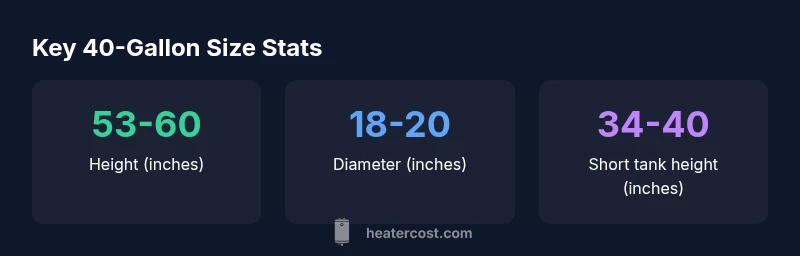
How big is a 40 gallon water heater? Most residential tanks are vertical cylinders about 53–60 inches tall and 18–20 inches in diameter. Short models exist at roughly 34–40 inches tall with the same diameter. Actual dimensions vary by manufacturer, venting, and whether the unit is tall or short, so check the label for exact measurements.
Physical dimensions: tall vs short 40-gallon tanks
When you ask how big is a 40 gallon water heater, the first thing to note is that there are two common form factors: tall- and short-model tanks. Tall units are the standard vertical cylinders designed to maximize storage in space-limited corridors or utility rooms, while short models provide a lower height footprint for rooms with limited vertical clearance. Typical tall 40-gallon water heaters stand about 53–60 inches tall and 18–20 inches in diameter. Short models hover around 34–40 inches tall with the same 18–20 inch diameter. The width (diameter) is the most consistent dimension across both forms, because capacity is dictated by internal tank volume and the need to accommodate standard heating elements and insulation. The height difference is driven by design choices like the location of the cold inlet and hot outlet fittings, the presence of a draft hood or vent, and the overall tank style (standard vs. compact). Insulation thickness and the outer shell add modestly to the exterior size but do not dramatically change the footprint. For planning purposes, assume a maximum width of 20 inches and a height window of roughly 34–60 inches depending on the model you select.
How to measure your space for a 40 gallon heater
Before purchasing, measure height, width, and depth of the proposed location. For tall tanks, verify ceiling clearance; for short tanks, confirm that the closet or alcove can accommodate the unit. Record door widths, stair clearance, and pathways you’ll use to move the appliance during installation. Inspect nearby pipes, electrical outlets, and venting routes. A practical rule of thumb is to allow at least 1 inch of clearance on each side and roughly 12 inches in front for service access; depending on local codes, more space may be required. If you’re installing a gas unit, ensure proper venting and combustion air intake, which can affect the footprint layout.
Why the footprint matters: installation layout and access
The footprint is not just about looks—it's about safe installation and easy maintenance. If a water heater sits in a tight corner, service access becomes a daily challenge and potential safety risk. Gas models require venting clearance, draft hood positioning, and dedicated combustion air; electric models demand space for replacement elements and wiring. The location should allow safe maintenance, outlet access, and unrestricted drainage, if you need to flush the tank. Additionally, consider future space needs for a recirculation pump, thermostat, or expansion tank, which can influence available width and height.
Real-world space scenarios: kitchen, utility room, and basement
In a typical single-family kitchen or utility room with 24–36 inches of width, a tall 40-gallon model may fit behind a cabinet or utility panel, provided there is sufficient ceiling height. In basements or garages with higher ceilings, a tall tank often works well, leaving room for a drywall chase and future plumbing upgrades. In tight closets, a short 40-gallon unit can save vertical space, but you’ll still need adequate depth clearance for connections and condensate drain lines. Always verify the model’s specific clearance requirements from the manufacturer label and install instructions.
Choosing between tall and short 40-gallon models
Tall tanks maximize capacity without increasing width, ideally suited for spaces with high ceilings. Short tanks offer a lower profile, which helps in low-ceiling basements or closets where headroom is limited. If you plan to replace an old unit, measure current clearance and compare against both options. If you have existing exhaust or vent ducting, you’ll want to ensure compatibility with the new unit’s venting arrangement. Energy efficiency improvements are possible across both forms through insulation and high-efficiency burners.
Installation clearance, connections, and safety considerations
When installing, verify that the clearances around the tank meet code and manufacturer requirements. Check that inlet/outlet pipes are accessible and replaceable, and ensure your electrical or gas supply lines are properly sized and protected. Use appropriate seismic straps if you live in a quake-prone area. For gas units, confirm that the vent pipe is unobstructed and correctly sloped for condensate drainage. Electric models should be placed near a dedicated circuit and protected by a proper disconnect switch.
Maintenance, replacement timelines, and how size affects service
Size influences access—larger tanks demand more space for inspection and flushing. Most homeowners perform a routine tank flush every 1–3 years to remove mineral buildup; the frequency depends on water hardness and usage. Replacement decisions often come down to efficiency, age, and the cost of upgrades to better-insulated models. When planning maintenance, consider the time required to shut off utilities, drain the tank, and replace an anode rod, and ensure a safe workspace for DIY tasks or professional service.
Dimensions for common 40-gallon water heater configurations
| Model Type | Height (inches) | Diameter (inches) | Notes |
|---|---|---|---|
| Tall 40-Gallon | 53-60 | 18-20 | Standard vertical unit with greatest capacity in height-limited spaces |
| Short 40-Gallon | 34-40 | 18-20 | Lower-profile option for tight ceilings |
| Compact/Appliance-style | 36-42 | 18-20 | Variant with integrated cabinet or closet width |
Got Questions?
How big is a 40 gallon water heater in inches?
Most 40 gallon tanks come in two heights: tall around 53–60 inches and short around 34–40 inches. The diameter is typically 18–20 inches. Always confirm exact measurements on the product label.
Most 40 gallon heaters are either tall (about 53–60 inches) or short (about 34–40 inches) with a diameter of roughly 18–20 inches.
Do 40 gallon heaters come in different shapes?
The main difference is height; diameter stays similar. Manufacturers offer tall and short variants, and some compact designs exist with the same capacity.
There are tall and short options; check the model specs for exact dimensions.
Will a 40 gallon heater fit in my closet or cabinet?
Closets or cabinets can fit a 40 gallon unit if there is sufficient height and depth for the model chosen. Check clearances for pipes, venting (gas), and service access.
Yes, if your space is tall or deep enough; measure and compare to the unit’s specs.
What factors influence whether 40 gal is enough for my home?
Hot-water demand, household size, and peak usage determine suitability. 40 gallons is common for small households; larger households may need bigger capacity or multiple heaters.
It depends on your usage—talk to a pro to size correctly.
Are there energy and efficiency differences between tall and short 40 gallon heaters?
Efficiency is more about insulation and burner design than height. Both tall and short models can be high efficiency if well insulated.
Energy efficiency depends on insulation, not height; look for good insulation and efficiency ratings.
What maintenance affects size choice?
Maintenance access affects layout more than the tank height itself. Plan space for regular flushing and component checks.
Maintenance matters for access; plan space accordingly.
“Size isn’t just about gallons; it’s about access, safety, and ventilation. A properly sized 40-gallon heater fits your space and daily hot-water needs.”
The Essentials
- Measure your space before buying to match height and width.
- Choose tall vs short based on ceiling height and closet depth.
- Account for maintenance clearance and venting in layout decisions.
- Energy efficiency improvements are possible equally in tall and short models.