How Big Is a Tankless Water Heater? Sizing Guide 2026
Learn typical dimensions and installation space needs for tankless water heaters, with practical sizing guidance for homes of all sizes.


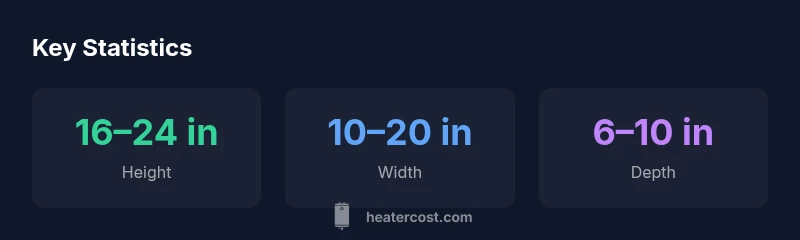
Most wall-mounted tankless water heaters are about 16–24 inches tall, 10–20 inches wide, and 6–10 inches deep. They have no stored water, so size reflects flow capacity and venting needs rather than tank volume. Expect additional clearance for vent piping and service access, with exact dimensions varying by model and installation.
Size factors that drive tankless unit dimensions
When you ask how big is a tankless water heater, the answer starts with your expected hot-water flow. Tankless models are rated by gallons-per-minute (GPM) or by water heating capacity and by venting requirements. The bigger your household and the more simultaneous hot-water uses, the higher the required heating capacity, which generally increases the unit’s size. In practice, dimensions vary widely by brand and installation type. Indoor gas models typically require a bit more vertical space for venting, while electric models can be narrower but still demand space for service panels and access. Most reputable units are wall-mounted and share a compact footprint compared with storage tanks, but their exact height, width, and depth depend on the heat exchanger design and the number of heating elements. When budgeting, consider room for condensate drainage lines, shutoff valves, and space to maneuver for maintenance. In short, the dimension is driven by capacity and venting as much as by any stored-water considerations.
Tip: Always verify the specific model’s footprint in the product specs before planning a layout.
How to estimate the right size for your home
To determine the correct size, you start with peak hot-water demand rather than storage. Compute the number of major outlets likely in simultaneous use (showers, faucets, laundry) and assign typical GPM per use. For a family of four with two baths, you might see ~3–6 GPM during peak, while a smaller apartment might stay under 3 GPM. Gas models require heavier venting and larger heat exchangers, electric models rely on high-amperage circuits. Manufacturers publish a First-Hour Rating (FHR) and continuous GPM ratings; match these to your household pattern. Also factor in climate (incoming cold water increases required temperature rise) and efficiency. If you’re between sizes, choose the larger option to avoid running out of hot water during morning routines. Finally, check space constraints: wall studs, ventilation clearance, and service clearances affect what can be installed in your preferred location. In many homes, a sizing conversation with a qualified pro ensures you select a unit that meets both demand and space constraints.
Practical approach: map your morning hot-water usage and compare it against the unit’s spec sheet.
Common dimensions by brand and model
There is no universal standard; the dimensions vary by model to support different capacities. As a rough guide, many wall-mounted tankless heaters fall in the range of 16–24 inches tall, 10–20 inches wide, and 6–10 inches deep. Ultra-compact electric units may be closer to 14 inches tall, while higher-flow gas units approach 24 inches tall with wider housings. Brands that emphasize efficient venting and compact manifolds may cluster around the smaller end for a given GPM, whereas premium models with dual heat exchangers can be larger. When evaluating options, compare the install kit included (venting, piping, mounting brackets), as this can influence the overall footprint. Remember that venting orientation (vertical vs horizontal) and the vent length add to the space required above and around the unit. In any case, confirm the exact measurements from the product spec sheet and plan for at least several inches of clearance on all sides for service. If you’re constrained by a tight closet, look for models advertised as compact or “slimline” with verified dimensional data.
Impact on installation space and venting requirements
Space planning matters. Gas tankless heaters require a dedicated vent run, while electric models may skip venting altogether but still need a dedicated electrical circuit and space for access. The installation footprint is not just the unit; include the vent piping, intake air, condensate drain, shutoffs, and service clearances. For most homes, wall-mounting a unit in a utility closet or garage reduces floor-space pressure but still demands vertical clearance for venting. If you plan to install outdoors, check weather protection, freezing risk, and UV exposure; exterior units may require additional enclosures. Consider future revisions, such as expanding to multiple bathrooms or adding recirculation pumps, which can alter the required GPM and thus the size. The key is to model the entire space the system will occupy, including any cabinets or shelves placed around it. The result should be room for service access and safe, code-compliant venting.
Compare tankless vs traditional tank storage and footprint
Traditional 40–50 gallon storage water heaters are bulky: think tall cylinders and a wide profile. In contrast, most electric and gas tankless units deliver hot water on demand in a compact wall-mount chassis. The footprint difference is dramatic: you gain back several square feet of usable space, and you avoid the risk of stagnant water in a tank. However, the trade-off includes venting complexity for gas models and higher upfront costs for high-flow electric units. If your plan is to retrofit a closet or small utility area, you’ll appreciate the wall-mount design, provided there is adequate venting and electrical capacity. For households with high simultaneous demand, you may still need more compact layouts across multiple units, or staged installation with a larger model. In a quality sizing project, you’ll compare the complete installation envelope—not just the heater’s outer dimensions—so you can confirm there’s no interference with doors, shelves, or appliances nearby.
Practical steps to measure and order the right unit
- Step 1: Measure the installation space; record height, width, and depth, plus the required clearance all around the unit.
- Step 2: List venting and electrical requirements; count the number of dedicated circuits in your service panel and verify vent length constraints.
- Step 3: Estimate peak flow; use a simple shower-laundry approach or consult a HVAC pro to estimate GPM needs.
- Step 4: Compare product specs; gather the unit’s dimensions, vent type, gas line size, and service clearance.
- Step 5: Contact local codes; ensure your design meets clearance and venting rules.
- Step 6: Plan for maintenance; allocate space for service panels, condensate lines, and shut-offs for future service.
This approach helps you avoid ordering a unit that doesn’t fit the intended space while ensuring adequate hot water supply. It’s wise to map the entire installation envelope and use a virtual or paper layout to verify fit before purchase.
Choosing the right venting solution for gas vs electric
Gas tankless heaters require a venting path to exhaust combustion byproducts, with options including concentric or standard venting. The number of elbows and length of the run influence backpressure and efficiency; your layout may require additional support brackets or intake piping. Electric units do not produce combustion gases, so venting is not required; instead, ensure safe and compliant electrical installation with appropriate breakers and wire gauge. Always follow manufacturer recommendations on venting configurations and distances, and check local building codes. When space is limited, look for models designed to vent horizontally through an exterior wall or to combine with a sealed chase. If you’re unsure, consult a licensed plumber or HVAC contractor; mistakes in venting can create backdraft or moisture problems and may void warranties.
Maintenance and future-proofing space considerations
Even though tankless heaters are compact, you still need regular maintenance. Plan for periodic flushing to prevent mineral buildup, and ensure access space remains clear for service. Consider future expansion: if you anticipate adding more bathrooms or upgrading to higher flow rates, you may want to reserve space for a second unit or to install a larger capacity unit later. Keep the install area dry and well-ventilated, and use corrosion-resistant fittings in damp spaces. Record the exact model number, serial, and warranty terms in your home files, so replacements are straightforward if you need to move or upgrade. Finally, be aware that some locations require permits or inspections; check local rules before installation.
Size and footprint comparison
| Aspect | Tankless footprint | Tank footprint |
|---|---|---|
| Typical footprint (H×W×D) | 16–24 in tall × 10–20 in wide × 6–10 in deep | 60 in tall × 18–20 in diameter |
| Storage capacity | 0 gallons | 40–50 gallons |
| Vent/clearance | Gas models require venting; plan for 6–12 inches clearance around unit | No special venting; follow local codes |
| Weight (unit only) | Varies by model | Varies by model |
Got Questions?
What is the typical footprint of a tankless water heater?
Most wall-mounted tankless heaters are compact, generally around 16–24 inches tall, 10–20 inches wide, and 6–10 inches deep. Exact dimensions vary by model.
Most tankless heaters are compact wall-mounted units, typically about 16 to 24 inches tall, 10 to 20 inches wide, and 6 to 10 inches deep.
Do tankless water heaters need venting?
Gas models require venting; electric models generally do not. Always follow local codes and manufacturer instructions.
Gas models need proper venting; electric ones usually don’t.
Can a tankless water heater fit in a small closet?
Yes, many models fit in compact spaces, but you must account for venting, electrical needs, and service access.
Yes, many fit in small closets, just plan for venting and service space.
How big is the storage inside a tankless unit?
Tankless heaters have zero stored hot water capacity; they heat on demand as water flows through.
They don’t store hot water at all; they heat on demand.
What factors affect the required size?
Peak flow demand, venting requirements, and installation constraints are the main drivers of unit size.
Peak demand and venting steer the size more than any storage needs.
Are there ultra-compact tankless options?
Yes, there are compact models, but they may offer lower maximum flow; verify GPM for your household.
Yes, but check the flow rate to meet your needs.
“Size decisions for tankless water heaters hinge on peak demand and venting constraints, not storage capacity.”
The Essentials
- Know typical dimensions before buying to ensure proper mounting.
- Expect roughly 16–24 in tall, 10–20 in wide, and 6–10 in deep.
- Remember tankless units have zero stored water capacity.
- Plan for venting and at least 6–12 inches of clearance.
- Compare with tank models to gauge overall space needs.