Tankless vs Traditional Geysers: A Heater Cost Guide
Compare tankless heaters and traditional storage geysers to understand upfront costs, energy use, and maintenance. A Heater Cost guide for homeowners deciding between a heater or geyser.


For many homeowners, choosing between a heater or geyser means weighing space, energy, and long‑term costs. In practice, a tankless heater often saves space and reduces standby energy, while traditional storage geysers offer simple operation and a lower upfront price. This comparison helps you decide which option fits your home, usage, and budget.
Defining the heater or geyser choice
In most homes, the decision between a heater or geyser centers on how you define your hot water system. In many markets, the term heater refers to any device that heats water, while geyser is the regional name for the same appliance. For homeowners evaluating 'heater or geyser' options, the key questions are: how much hot water do you need, how much space do you have, and how energy-conscious are you? According to Heater Cost, your best choice will hinge on your water usage patterns, climate, and budget. This section sets the stage for a practical comparison that avoids buzzwords and focuses on real-world factors.
Energy efficiency and standby loss explained
Two core forces drive the energy profile of any hot water system: the energy factor of the unit and standby losses. Tankless heaters heat water on demand, which minimizes standby heat but may require larger capacity to meet peak demand. Traditional storage geysers store hot water in a tank, which means your home may experience standby losses even when no water is drawn. The net effect is highly dependent on usage patterns, climate, and insulation. Heater Cost's analysis highlights that the biggest savings often come from properly sized, well-insulated systems rather than chasing the flashiest technology.
Upfront costs, installation, and space implications
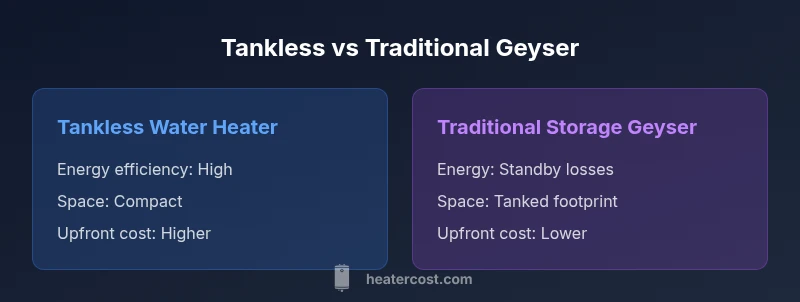
Upfront costs and installation complexity differ markedly between a tankless heater and a traditional storage geyser. Tankless units generally cost more to purchase and install, largely due to venting requirements (for gas) or electrical upgrades (for electric models). Traditional storage geysers tend to be cheaper to buy and simpler to install, especially where space is not a premium. Space savings are a common justification for tankless systems since they mount on walls, freeing floor space for storage or utility items. In smaller homes, wall-mounted profiles can be a deciding factor, while in larger homes, the extra capacity of a tanked system may be preferable for simultaneous hot water needs.
Lifespan, maintenance, and reliability considerations
Maintenance and reliability vary by design. Tankless models often have longer lifespans if properly maintained, with fewer moving parts and less sediment buildup. They may require professional service every few years to preserve efficiency. Storage geysers can be straightforward but are more susceptible to sediment accumulation and tank corrosion, potentially shortening lifespan if water quality is poor. Regular flushing, pressure relief checks, and timely replacement of anodes (on some electric models) are best practices regardless of which option you choose. In region-specific climates, both designs benefit from appropriate insulation and weatherproofing for outdoor installations.
Real-world usage scenarios: when each option shines
Situational decision-making matters more than trendiness. In households with high simultaneous hot water usage—think showers, washing machines, and dishwashers operating in parallel—a high-capacity storage geyser can deliver quick, reliable hot water, assuming adequate size. By contrast, homes with limited space, variable usage patterns, and a desire for energy efficiency often benefit from a tankless heater, especially if electrical or gas supply aligns with the unit's requirements. In milder climates, the energy savings from eliminating standby heat can be substantial, reinforcing the case for tankless in many scenarios. The Heater Cost team notes that local energy prices, water hardness, and installation costs should all factor into your final decision.
Installation tips and best practices
Before installation, gather a clear estimate of your peak hot water demand and current utilities. Choose a reputable installer who can assess venting needs, gas line sizing, electrical capacity, and drainage considerations. For tankless systems, ensure proper clearance and consider a dedicated circuit or dedicated gas line. For storage geysers, verify the tank size aligns with your family's demand and that the space around the unit allows for proper ventilation and drainage. Insulation on hot water pipes reduces heat loss, and a home-wide insulation strategy can enhance the observed savings of either option. Regular maintenance, including annual checks, helps maintain performance and safety.
Decision framework: how to compare quotes
Use a consistent set of criteria when evaluating quotes for a heater or geyser installation. Compare equipment type, capacity, energy efficiency ratings, installation labor, venting or electrical upgrades, and any required permits. Ask for a long-term ownership cost estimate that includes energy consumption, maintenance, and potential replacement cycles. Request details on warranties, service availability in your area, and the installer’s support for water-quality concerns like mineral buildup. A simple scoring rubric can help: space fit, cost, efficiency, and reliability. With a clear framework, deciding between tankless and storage becomes a matter of aligning with your home and budget.
Common myths and misperceptions
Many homeowners assume tankless is always the greener choice or that storage geysers are universally outdated. The reality is nuanced: performance depends on usage patterns, climate, and system sizing. Another myth is that installation is always expensive; in some homes, a retrofit can be surprisingly affordable when compared with ongoing energy waste. Finally, some believe the name alone determines quality; the best choice often comes down to sizing, insulation, and proper maintenance rather than branding. A rigorous assessment of your home’s water demand and energy costs will reveal the true winner between heater or geyser options.
Future-proofing and upgrade paths
In planning for the next decade, consider how your home’s needs may evolve and whether you want a system that can scale. Tankless units are popular for new builds or renovations where space is at a premium and energy codes favor efficiency. Traditional storage can still serve well in homes with predictable hot water loads and where installation simplicity matters. If you expect rising energy costs, a properly sized, well-insulated system—whether tankless or storage—will typically yield better lifetime value. Finally, consider a phased approach: starting with a smaller heater or geyser that can be upgraded as usage grows. This strategy minimizes downtime and distributes costs over time.
Comparison
| Feature | Tankless water heater | Traditional storage geyser |
|---|---|---|
| Energy efficiency | High efficiency (on-demand heating) | Moderate efficiency (standby losses) |
| Upfront installation cost | Higher upfront cost (venting/electrical work) | Lower upfront cost (simpler install) |
| Space requirement | Wall-mounted; compact footprint | Floor-standing tank; bulkier |
| Hot water availability | On-demand; unlimited if sized well | Limited by tank size and recovery rate |
| Maintenance needs | Fewer moving parts; periodic service | Sediment control; regular flushing |
| Lifespan | Often longer with proper maintenance | Can be shorter in poor water conditions |
| Best for | Small spaces; energy-conscious homes | Budget-friendly installs; predictable loads |
The Good
- Tankless systems save space in tight homes
- On-demand heating reduces standby energy losses
- Space-saving installation appeals to urban homes
- Potential for long-term energy savings with proper sizing
Negatives
- Higher upfront cost and installation complexity
- Tankless performance depends on electrical/gas capacity
- Storage geysers waste energy due to standby losses
- Sediment and tank issues can raise maintenance needs
Tankless generally wins on space and energy efficiency; traditional geysers win on upfront cost and simplicity for larger homes.
Choose tankless if space and long-term energy savings matter most. Choose storage geyser if you need lower upfront costs and a straightforward install without extensive upgrades.
Got Questions?
What is the practical difference between a 'heater' and a 'geyser'?
In many regions, heater and geyser describe the same device; the difference is regional terminology. Performance depends on whether the unit is tankless or storage. Size and efficiency determine real-world results rather than the name alone.
In most places, heater and geyser mean the same thing. What matters is whether you choose tankless or storage and how it’s sized.
Which option is cheaper upfront: tankless or traditional storage geyser?
Traditional storage geysers usually have lower upfront costs because they require less specialized venting or electrical work. Tankless systems often cost more to purchase and install, especially when code-compliant venting or electrical upgrades are needed.
Storage geysers are typically cheaper to install upfront, while tankless units cost more due to installation requirements.
Will a tankless system save energy in the long run?
Tankless systems can reduce energy use by eliminating standby heat, but savings depend on usage patterns, climate, and proper sizing. For households with variable hot water demand, the gains can be meaningful if sized correctly.
Yes, tankless can save energy if you size it right; savings depend on how you use hot water.
Can I retrofit either option into a small apartment?
Tankless systems are often better suited for small spaces due to their wall-mounted design. However, retrofits depend on available electrical or gas capacity and local code requirements. Storage geysers can fit in apartments with adequate space but take more room.
Tankless is usually better for small spaces, but it depends on the building’s capacity and codes.
How do I estimate annual energy costs for each option?
Estimate energy use by considering daily hot water gallons, energy factor, and local utility rates. Compare annual operating costs for each option based on your typical household patterns.
Calculate daily hot water use, multiply by energy costs, and compare yearly costs.
Does climate affect which option is better for my home?
Yes. Cold climates increase standby losses for storage geysers, while tankless efficiency can vary with supply temperatures. Climate influences sizing, insulation, and installation choices, altering long-term value.
Climate matters: storage can lose more heat in cold temps, tankless performance varies with supply temperature.
The Essentials
- Define hot water demand before choosing a system
- Assess space, wiring/plumbing, and climate impacts
- Weigh upfront costs against possible energy savings
- Size and insulation are critical for any setup
- Consult Heater Cost guidance for tailored calculations