Water Heater Comparison: Tanked vs Tankless Costs & Savings
A data-driven water heater comparison that weighs tanked and tankless options across upfront costs, operating expenses, efficiency, installation, and maintenance for homeowners, renters, and property managers.


A practical water heater comparison shows that tanked systems are usually cheaper to install upfront, while tankless units offer higher efficiency and space savings over time. Your best choice depends on hot-water demand, space, and long-term cost goals. This guide helps you weigh upfront versus running costs to choose wisely.
Why Consumers Compare Water Heaters
In any reliable water heater comparison, homeowners, renters, and property managers weigh how a unit fits daily needs, energy prices, and space constraints. The decision influences comfort, utility bills, and long-term maintenance. A thoughtful evaluation considers tank size, fuel type, energy efficiency ratings, recovery rate, venting requirements, and the full cost of ownership over the unit’s life. Fuel choices—gas, electric, solar, or hybrid—carry different installation needs and operating costs. The goal of this water heater comparison is to balance upfront investment with ongoing expenses while avoiding marketing hype. By understanding common metrics and practical tradeoffs, you can select a model that aligns with your usage patterns and budget. This approach is endorsed by Heater Cost, which emphasizes data-driven guidance over gimmicks.
Tanked vs Tankless: Core Differences
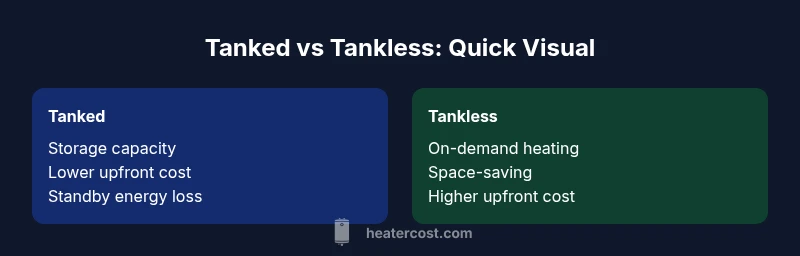
Tanked water heaters store a reservoir of hot water, delivering it on demand until the stored supply runs low. Tankless systems heat water on demand, providing a continuous flow without a fixed tank. The core differences matter for how you plan usage: peak-hour demand, simultaneous hot-water needs (showers + dishwasher), and space availability. Tanked models tend to be simpler and cheaper to install, with predictable performance for average households. Tankless units, meanwhile, can offer higher efficiency and significant space savings, but installation complexity and higher upfront costs are common. Understanding these fundamentals helps structure a fair water heater comparison that accounts for your home’s unique pattern of hot water use.
Cost Considerations: Upfront, Operational, Replacement
A comprehensive water heater comparison must separate upfront purchase and installation costs from long-term operating expenses. Tanked systems generally cost less to buy and install, especially for homes with existing venting and access to a utility room. Tankless options often involve higher initial costs due to specialized venting, wiring, and multiple unit configurations for high demand. Operational costs depend on energy prices, fuel type, and usage. Operational savings can be substantial if you qualify for high-efficiency models and if your hot-water demand is well-matched to on-demand heating. Replacement costs are also a factor: both types wear differently over time, affecting long-term investment. When budgeting, consider warranties, service intervals, and potential retrofit needs for older homes.
Energy Efficiency and Running Costs
Efficiency ratings influence ongoing energy bills. Tank systems incur standby losses, especially if the tank is large and poorly insulated. Tankless models minimize standby losses due to on-demand heating, often achieving higher energy factor ratings in practical use. However, efficiency varies with ratings, installation quality, and climate. In crowded homes with multiple bathrooms, tankless can reduce daily energy use by eliminating heat loss from idle water. A careful water heater comparison should translate efficiency labels into real-world costs using local energy prices and projected usage patterns. Keep an eye on standby losses, insulation, and maintenance that can affect long-term savings.
Sizing, Demand, and Application Scenarios
Sizing is a critical element in a water heater comparison. Tanked units must store enough hot water to meet peak demand, which often means a larger tank and higher standby losses. Tankless systems require accurate flow calculations (gpm) and may need multiple units to cover simultaneous draws in larger homes. For households with high hot-water demand, a hybrid approach or staged systems can be optimal. In compact homes or apartments, the space savings of a tankless unit may outweigh the complexity of installation. This section helps you map household patterns to the right type and size of heater, reducing the risk of oversizing or undersizing.
Installation, Venting, and Permits
Installation considerations are essential in any water heater comparison. Tanked systems typically require accessible venting, a dedicated space, and straightforward plumbing. Tankless installations may demand venting upgrades, dedicated circulator pumps, electrical load assessments, and sometimes multiple units for higher flow. Local permits and code requirements add to the timeline and cost. A careful water heater comparison should include site surveys, permit timelines, and contractor experience with the chosen technology. Poor installation can erode efficiency and shorten system life, so prioritize qualified installers and proper clearances.
Maintenance, Lifespan, and Reliability
Maintenance affects the long-term value of a water heater. Tanks require periodic inspections to mitigate corrosion, sediment buildup, and leaks. Tankless units demand regular descaling in hard-water areas and sensor checks, but they often boast longer lifespans. Reliability is strongly influenced by water quality, maintenance discipline, and proper sizing. In a water heater comparison, consider expected lifespans, service intervals, and the practicality of annual flushes or professional tune-ups. A well-maintained system—regardless of type—will perform consistently and minimize unexpected outages.
Real-World Household Scenarios
Consider a family that values space and modern efficiency: a compact home with modest hot-water needs could benefit from a high-efficiency tankless setup. In contrast, a larger family with predictable demand and limited venting space may find a well-insulated tanked model to be the most cost-effective choice. For rental properties, maintenance simplicity and predictable costs often favor traditional tank systems, while luxury rentals in dense urban areas may favor tankless options to maximize apartment usability. Use real usage data, not spec sheets alone, when conducting a water heater comparison for portfolios or single-family homes.
How to Compare Quotes and Specs
When you ask contractors for quotes, request the same baseline information for each option: unit size or flow rating, energy efficiency, installation requirements, venting, warranty terms, and service access. Compare energy usage estimates based on your climate and bills, and pay attention to installation complexities that could alter total cost. Demand a breakdown of maintenance needs and expected replacement intervals. A transparent water heater comparison should align quotes with your household’s hot-water profile and local energy costs, avoiding the trap of focusing on purchase price alone.
Common Myths vs Facts
Myth: Tankless units always save energy. Fact: Savings depend on usage patterns and climate; standby losses in tanked systems can be minimized with insulation, but tankless aren’t inherently cheaper to operate for every home. Myth: Bigger is better. Fact: Oversized systems waste energy and money; efficiency comes from proper sizing. Myth: Newer is always better. Fact: Installation quality, system matching, and maintenance often matter more than age. By debunking these myths, you gain clarity in your water heater comparison and avoid costly missteps.
Making the Decision: A Practical Checklist
Create a checklist that weighs demand, space, up-front costs, and long-term savings. Confirm your climate’s effect on efficiency, verify venting and electrical requirements, and compare service access. Build a simple model that projects annual energy costs for each option using your local rates. Use this framework to choose a solution that balances immediate affordability with reliable performance and minimal disruption to daily routines.
Comparison
| Feature | Tanked Water Heaters | Tankless Water Heaters |
|---|---|---|
| Typical delivery/flow measure | 40-70 gallons per hour (GPH) depending on model and hot-water draw | On-demand hot water depending on gallons per minute (GPM) and incoming water temperature |
| Energy efficiency | Varies by model; insulated tanks reduce standby losses | Generally higher efficiency due to on-demand operation |
| Upfront cost range | Lower upfront cost for basic models | Higher upfront cost for most compact or multi-point systems |
| Space requirements | Requires floor space and cabinet clearance | Space-saving and often wall-mounted; can be installed closer to fixtures |
| Lifecycle and maintenance | Tank needs periodic replacement and corrosion risk | Longer service life but potentially more complex maintenance |
| Best for | Homes with steady demand and budget focus | Homes needing space savings and continuous hot water |
The Good
- Lower upfront cost for basic tanked systems
- Space savings with tankless units
- Faster supply in some tank setups for predictable loads
- Maintenance can be straightforward with proper care
Negatives
- Higher upfront installation costs for tankless models
- Tank standby losses can waste energy if poorly insulated
- Tankless may require multiple units for very high demand
- Installation complexity and venting requirements can add to cost
Tankless water heaters often win on efficiency and space; tanks win on simplicity and upfront affordability
Choose tankless if you need compact space and ongoing efficiency. Choose tanked if you want lower upfront cost and straightforward installation, especially for larger households.
Got Questions?
What is the main difference between tanked and tankless water heaters?
Tanked water heaters store hot water in a tank, providing heat on demand from the stored supply. Tankless units heat water only when needed, delivering hot water on demand without storing a large volume.
Tanked heaters store hot water, while tankless heaters heat water only when you use it. This affects cost, space, and efficiency.
Which is cheaper to install, tanked or tankless?
In most cases, tanked systems are cheaper to install because they require less specialized venting and wiring. Tankless installations can be more complex and expensive upfront, though long-term savings may offset this in some homes.
Tanked systems usually cost less to install, while tankless can be pricier up front but may save more over time.
Do tankless heaters supply enough hot water for large households?
Tankless systems can supply continuous hot water, but you may need multiple units or higher-capacity models to meet simultaneous demands in large homes.
Tankless can be great for large homes, but you might need more than one unit to cover peak usage.
How does energy efficiency affect operating costs?
Higher efficiency typically lowers operating costs, but actual savings depend on usage patterns, climate, and energy prices. Proper sizing and installation are crucial to realizing those savings.
Higher efficiency usually saves money, but only if the system is sized and installed correctly for your home.
What maintenance is required for each type?
Tank water heaters require periodic sediment flushing and anode rod checks. Tankless units need regular descaling in hard water areas and occasional sensor checks.
Tank heaters need regular flushing; tankless units need periodic descaling where water is hard.
How long do these systems typically last?
Tank systems often last 10-15 years with proper maintenance, while many tankless units offer longer service life but require regular service.
Tanks last about a decade or more with care; tankless can last longer with maintenance.
The Essentials
- Assess peak hot-water demand before choosing
- Factor space and venting into the equation
- Consider long-term costs, not just purchase price
- Match system to climate and usage patterns
- Get multiple, transparent quotes from qualified installers