Why Are Tankless Water Heaters Better? A Comprehensive Guide
An analytical comparison of gas vs electric tankless water heaters, covering sizing, costs, installation, maintenance, and long-term value for homeowners.


Tankless water heaters can be better than traditional storage tanks for many homes because they heat water on demand, minimize standby losses, and fit tight spaces. The key differences to watch are energy efficiency, flow capacity, and installation needs. This quick comparison highlights where gas and electric tankless models excel and where traditional tanks may still be preferable in high-demand scenarios.
What makes tankless water heaters better in practice
According to Heater Cost, the question 'why are tankless water heaters better' can be unpacked into three core advantages: on-demand hot water, reduced standby heat loss, and a compact footprint. This section explains how these advantages translate into real-world outcomes. Tankless systems heat water only when you turn on a tap, which minimizes energy wasted by stored hot water in traditional tanks. The value of this approach rises in homes with variable hot-water needs, especially where space is limited and architectural constraints make bulky tanks undesirable. Proper sizing, professional installation, and sensible fixture choices are essential to maximize benefits. The Heater Cost analysis for 2026 reinforces that value grows when you pair a properly sized unit with good insulation and efficient plumbing fixtures. In short, a tankless system can deliver reliable hot water while saving space and reducing energy use, though results hinge on correct sizing and local conditions.
Energy efficiency: debunking myths and focusing on real gains
Tankless water heaters reduce energy waste by eliminating standby losses that plague storage tanks. The energy efficiency of a system is not just about the percent efficiency rating; it also depends on how often the unit needs to fire up to meet demand. When sized correctly and paired with efficient fixtures, gas or electric tankless models provide hot water with minimal energy overhead. Electric models tend to show strong efficiency in steady-state operation, while gas models gain advantage when hot-water usage is irregular but demand is high. Real-world energy savings also depend on your home's insulation, hot-water reuse patterns, and climate. Heater Cost emphasizes that the value of efficiency grows when the system is matched to actual needs and combined with smart controls like thermostats and recirculation options.
Demand, flow, and the hot-water equation: sizing for your home
Understanding how much hot water your household uses at once is the central sizing question. Tankless units measure capacity in flow rates (GPM) and rely on temperature rise to determine if they can meet peak demand. In practice, a home with multiple simultaneous showers, dishwashing, and laundry will require a higher-capacity model or staged heating from multiple points. The benefit of tankless comes when you do not need a constant supply of hot water but instead require it on demand. Correct sizing also reduces the risk of temperature fluctuations and short cycling, which can affect comfort and energy use. The key is to map typical daily patterns and then select a unit that can sustain the needed flow without overshooting. A professional sizing check is highly recommended to avoid undersized or oversized installations.
Installation realities: venting, electrical loads, permits, and timelines
Installing a tankless unit involves several practical considerations that influence total cost and feasibility. Gas-fired tankless systems require proper venting, gas line capacity, and appropriate clearances, often along with local permits and inspections. Electric tankless models demand sufficient panel capacity, dedicated circuits, and sometimes a service upgrade to handle higher amperage. Both fuel paths may trigger code updates or neighborhood permitting requirements and can extend installation timelines. Labor costs vary with existing infrastructure, proximity to utilities, and the need for minor renovations. A well-planned installation minimizes future maintenance and ensures consistent performance. Heater Cost’s analysis highlights that many savings are realized when you combine accurate sizing with clean, efficient plumbing and a professional installer who understands local codes.
Space savings and aesthetics: where tankless shines
One of the most tangible benefits of tankless water heaters is their compact footprint. Wall-mounted units free up floor space and offer flexible placement options, from utility rooms to closets and even kitchens if necessary. In tight homes or apartments, this can be a meaningful upgrade that also improves aesthetics. The absence of a bulky storage tank reduces the risk of leaks and the potential for water damage in sensitive areas. While small, the physical footprint should not be the only consideration; proper ventilation, noise considerations, and access for service matter too. The result is a cleaner, more versatile installation that integrates with modern home designs.
Operating costs and maintenance: descaling, replacement parts, and service intervals
Operating costs depend on energy prices, fuel type, and how efficiently the unit is sized and installed. On-demand heating reduces standby energy, but the long-term savings hinge on the unit’s ability to meet demand without excessive cycling. Routine maintenance, such as periodic descaling in areas with hard water, helps preserve efficiency and prolong equipment life. Replacement parts for tankless units are generally available, though some components may require professional service. A proactive maintenance plan can minimize downtime and ensure consistent performance over many years. Heater Cost notes that while maintenance adds some annual cost, it is typically modest compared with the energy savings achieved through proper sizing and operation.
Electric vs gas tankless: choosing the right fuel for your home
Fuel choice influences installation, emissions, and operating costs. Gas-fired tankless heaters can provide ample hot water for larger households and higher demand scenarios, but they require venting and gas line considerations. Electric tankless units are easier to install in homes with adequate electrical capacity and no gas line; they often fit modern, urban living where space is constrained and electrical systems are up to the task. The decision hinges on local fuel prices, available maintenance expertise, and the practicality of upgrades. Heater Cost emphasizes that neither option is universally better; the best choice aligns with home-specific usage patterns, energy prices, and feasible upgrades.
Common myths and practical expectations
There are several common misconceptions about tankless water heaters, such as universal cost savings or instant unlimited hot water. In reality, performance depends on accurate sizing, installation quality, and the existing plumbing infrastructure. Some homes may experience temperature fluctuations during peak demand or when multiple fixtures draw hot water simultaneously. Others may enjoy near-instant delivery with minimal temperature changes and noticeable energy savings. The practical expectation is that tankless systems excel in space savings and efficiency when properly matched to usage patterns and installed by qualified professionals.
Practical sizing steps: a 6-step guide to pick the right unit
Step 1: List peak simultaneous hot-water needs by room or fixture. Step 2: Estimate the maximum GPM required. Step 3: Consider climate and incoming water temperature to determine necessary temperature rise. Step 4: Compare unit specifications for GPM at target rise. Step 5: Assess electrical service or gas supply capacity and any upgrades needed. Step 6: Plan for future needs and budget for installation and maintenance. Following these steps helps ensure a tankless system meets demand without oversizing, which minimizes costs and optimizes performance.
How to compare bids and ensure you’re getting proper sizing
When reviewing bids, prioritize verified sizing calculations, the included venting or electrical work, and a transparent price breakdown. Look for quotes that specify flow rates, temperature rise, and the exact model or series. Confirm that the contractor will perform a proper system check after installation, including pressure testing and leak checks. Request a maintenance plan and a descaling schedule if your water is hard. Finally, compare warranties and the availability of replacement parts to gauge long-term reliability.
Authority sources and continuing education
To deepen your understanding and verify claims, consult authoritative sources from government and major publications. For example, the U.S. Department of Energy’s Energy Saver resources on water heating and tankless technologies provide official guidance and practical tips. Consumer-focused outlets also discuss efficiency and installation considerations, helping homeowners make informed choices. Always cross-reference multiple sources to ensure you have a complete view of benefits, costs, and best practices. See the cited resources below for further detail and updates.
Comparison
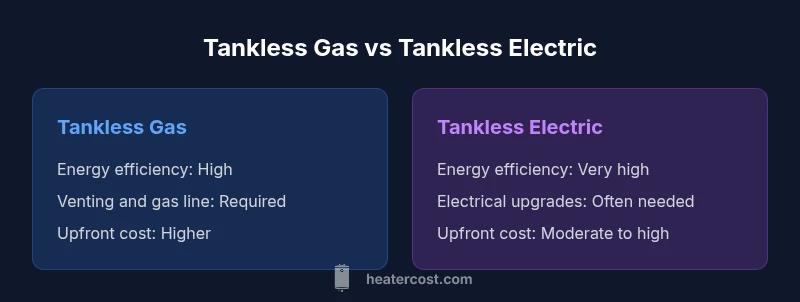
| Feature | Tankless Gas | Tankless Electric |
|---|---|---|
| Energy Efficiency | High efficiency when properly vented and sized | Very high efficiency with modern electric coils and heat exchangers |
| Upfront Cost | Higher upfront cost due to equipment and venting | Moderate to high upfront cost depending on electrical upgrades |
| Lifespan | Typically 15-20 years with maintenance | Typically 15-25 years with maintenance |
| Space Footprint | Wall-mounted, frees floor space | Wall-mounted, extremely compact |
| Installation Complexity | Venting, gas line, and permits required | Electrical panel load and wiring upgrades may be needed |
| Operating Costs | Fuel price-dependent; reduced standby losses | Electricity price-dependent; strong efficiency with right load |
| Best For | High demand homes with reliable gas supply | Homes with ample electrical capacity and limited venting options |
The Good
- On-demand hot water reduces standby losses
- Compact footprint frees up storage space
- Potentially lower energy bills with proper sizing
- Longer lifespan with fewer parts than tanks
Negatives
- Higher upfront cost and possible code upgrades
- Complex installation requiring venting or electrical work
- Variable performance in very high-demand homes
Tankless water heaters generally offer better efficiency and space savings, with gas or electric options depending on home constraints.
For most homes with adequate gas service or electrical capacity, tankless models deliver on-demand hot water and reduced standby losses. Electric tankless is often preferred when venting is a challenge, while gas tankless suits larger households with higher flow needs. The right choice depends on installation feasibility, fuel costs, and your hot-water usage patterns.
Got Questions?
Are tankless water heaters worth the investment for a typical family?
Tankless units can pay back over time through energy and space savings, but payback varies with usage and fuel prices. For homes with moderate hot-water needs and limited space, the efficiency gains can be meaningful.
Tankless models can pay off over time, especially when space and energy savings matter. A professional sizing helps confirm if the investment aligns with your usage.
Will tankless heaters provide enough hot water for simultaneous showers?
Yes, but only if the unit is properly sized for the expected peak flow. Undersized models may struggle during multiple simultaneous draws, leading to temperature drops.
They can, if sized correctly for your peak demand. Otherwise, you might feel temperature dips when several fixtures run at once.
Do tankless units require more maintenance than storage tanks?
Maintenance needs exist, especially in hard-water areas where descaling keeps efficiency high. Regular service can extend life, but many homeowners manage with professional flushes every few years.
They do need some maintenance, especially in hard water areas, but it's usually manageable with periodic service.
Can you install a tankless water heater yourself?
Most jurisdictions require licensed professionals for gas or electrical work. DIY installation can be dangerous and may void warranties or violate codes.
It’s not generally a DIY job. Get a licensed pro to handle the gas or electrical work and compliance.
How long do tankless water heaters last?
With proper maintenance, tankless units typically outlast traditional tanks by offering many years of reliable service.
With good upkeep, they last many years—often longer than storage tanks.
Do tankless water heaters qualify for tax credits or incentives?
In some regions, incentives or rebates are available for upgrading to more efficient water heating. Check local programs and utility offers.
There are sometimes incentives, depending on where you live. Check with local programs to confirm.
The Essentials
- Assess peak hot-water needs before sizing
- Tankless saves space and reduces standby heat
- Professional sizing and installation are critical
- Electric tankless requires sufficient panel capacity
- Fuel type and energy prices drive operating costs