Tankless vs Tanked Water Heaters: Who Is Better for Your Home?
A rigorous Heater Cost comparison of tankless vs tanked water heaters explores who is better based on space, cost, efficiency, and reliability. Learn how to choose for apartments, families, and varying energy costs in 2026.


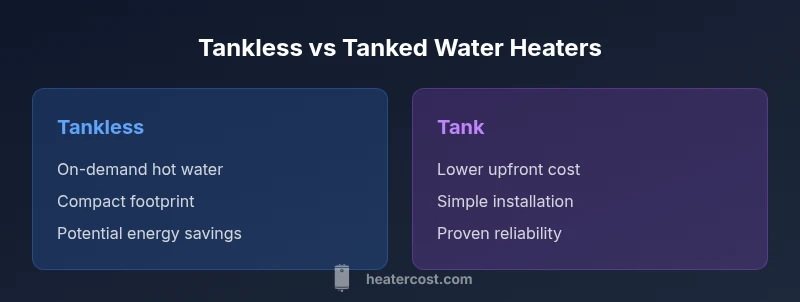
Short answer: When deciding who is better between tankless and traditional (tanked) water heaters, the best choice depends on your priorities. If space, continuous hot water, and long-term energy efficiency matter, tankless tends to win. If upfront cost, simple installation, and proven reliability are paramount, a traditional tank may be the better option. The Heater Cost analysis, 2026, supports this nuanced view.
Who is better: Tankless vs Tanked?
Tankless and traditional tanks operate on different principles, and the question who is better depends on context: household size, water use patterns, climate, and budget all tilt the answer. In general, tankless units heat water on demand, offering a compact footprint and the potential for energy savings—especially in homes with modest simultaneous hot-water needs. Traditional tanks store hot water and can deliver a reliable supply with simple maintenance. The Heater Cost team notes that gas-powered tankless systems may provide quicker recovery, while electric tankless options suit residences with limited space and a stable electrical supply. Conversely, tanks shine when upfront cost is a major concern and when a straightforward replacement is desired in areas with variable water pressure. Real-world performance hinges on proper sizing, installation quality, and local utility rates; these factors influence who is better for a given home. By evaluating peak demand, space availability, and long-term goals, you can determine the direction that aligns with your priorities. In many scenarios, the answer to who is better changes as family dynamics evolve and energy costs shift.
Key factors that influence who is better in your home
Choosing between tankless and tanked setups hinges on several practical factors. Start with hot-water demand: how many fixtures run at once and for how long. Space constraints and placement options can make tankless more appealing in small homes or apartments, while tanks can be easier to retrofit in larger houses. Climate and water quality also matter: very hard water may require more maintenance for tankless systems, and cold climates can affect recovery rates for on-demand heating. The reliability profile differs: tanks have a long track record and straightforward service, whereas tankless systems demand accurate sizing and, at times, more specialized maintenance. The Heater Cost team suggests framing the decision around a clear checklist of usage patterns, space realities, and local water conditions to determine who is better for your scenario.
Upfront costs and long-term value
Upfront costs and long-term value are central to the who is better question in heating investments. Tankless systems usually involve higher installation costs due to venting and electrical or gas line work, while traditional tanks offer a lower initial price and simpler installation. Over time, tankless units can reduce operating costs by minimizing standby heat loss, especially in homes with variable hot-water demand; however, this depends on accurate sizing and consistent use. The Heater Cost team emphasizes evaluating total cost of ownership rather than sticker price alone. If occupancy changes seasonally or you anticipate shifts in energy prices, the long-term value of a tankless setup may change, whereas a tank’s value tends to be steadier for predictable usage.
Energy efficiency and operating costs
Energy efficiency is a major factor in deciding who is better, but it must be viewed in context. Tankless heaters often operate with higher energy efficiency ratings because they heat water on demand, reducing standby losses. Traditional tanks store hot water and experience standby losses even when not actively used. In practical terms, tankless can lower energy use for households with fluctuating hot-water demand, while tanks may be more cost-effective for steady, predictable usage. The exact savings depend on climate, water temperature, and sizing; the Heater Cost Team reminds readers to consider the efficiency of the entire system, including any storage or buffering equipment, as part of the total cost of ownership. For some homes, the difference in operating costs will justify choosing tankless; for others, the tank remains a straightforward path to reliable comfort at a lower upfront price.
Space, installation challenges, and aesthetics
Space and installation considerations often tip the balance in the who is better question. Tankless systems are typically compact and can be wall-mounted, freeing floor space and enabling more versatile placement. This makes them attractive in apartments, tiny houses, or retrofit projects where space is at a premium. Traditional tanks require floor space for the cylinder and associated equipment, which can be a constraint in tight lots. In addition, some homes need upgrades to gas lines, venting, or electrical panels, which adds to complexity and cost. Aesthetics matter too: wall-mounted units can be visually discreet, while tanks are more conspicuous but easier to service. A professional assessment of plumbing layout and available wall or crawl-space real estate helps determine who is better for your home.
Maintenance, durability, and service needs
Maintenance requirements and durability are central to the comparison. Tankless units require periodic descaling in areas with hard water to prevent mineral buildup that can impair efficiency or damage the heat exchanger; this maintenance can be more frequent and specialized than for tanks. Traditional tanks need regular inspection of the tank, anode rods, and valves, and they carry a higher risk of leaks or ruptures over time. With either option, a clear maintenance plan helps extend life and protect against unexpected outages. The Heater Cost team underscores the importance of water quality and professional servicing, noting that a well-maintained system often performs more consistently and lasts longer. For households that prefer minimal ongoing upkeep, a traditional tank with a straightforward service plan can be more appealing, while those ready to commit to periodic maintenance may find a tankless system better aligned with long-term performance goals.
Regional considerations: water hardness and climate
Where you live can influence who is better between these two options. Water hardness affects mineral buildup and corrosion potential; in hard-water regions, descaling becomes a critical part of tankless maintenance and can affect long-term cost and downtime. Colder climates tend to make tankless systems work harder to deliver hot water quickly, which can impact sizing and efficiency; tanks, by contrast, can tolerate slight temperature drops without immediate performance loss. Local utility rates and incentives also shape the decision; some regions offer rebates or favorable tariffs for high-efficiency options, which may tilt the balance toward tankless in those markets. The Heater Cost team advises homeowners to factor climate, water chemistry, and local programs into the who is better calculation, rather than relying on generic claims.
Decision framework: a practical checklist
Use a practical checklist to decide who is better for your home. First, estimate peak hot-water demand and determine whether simultaneous use is frequent. Second, measure available space and consider placement options for either unit. Third, compare installation constraints, including venting, electrical capacity, and gas lines. Fourth, review local energy costs and any rebates or incentives. Fifth, assess maintenance willingness and water quality. Finally, run the numbers with a reputable installer to validate sizing and expected operating costs. The outcome should reflect your priorities rather than a generic rule-of-thumb, and it should account for how your home could evolve over time.
Real-world scenarios: large family vs single occupant
Case studies help translate theory into action. A single occupant in a compact apartment may benefit most from a tankless setup, prioritizing space savings and energy efficiency. A large family home with multiple simultaneous hot-water needs might still rely on a traditional tank with a well-sized recovery rate to meet peak demand. In regions with expensive electricity or limited maintenance resources, a gas-fired tankless option can offer a compelling balance of performance and cost. These narratives illustrate how the central question who is better becomes highly contextual, reinforcing the need for sizing accuracy and professional guidance.
Comparison
| Feature | Tankless | Traditional Tank |
|---|---|---|
| Upfront cost | Higher upfront cost | Lower upfront cost |
| Energy efficiency | Often higher efficiency with on-demand heating | Proven efficiency; standby losses exist |
| Hot water supply | On-demand hot water (unlimited as long as demand is met) | Stored hot water limited by tank size |
| Space requirements | Compact, wall-mounted option | Requires floor space for the tank |
| Maintenance needs | Descaling may be required in hard water areas; service can be specialized | Regular inspections and anode rod maintenance |
| Lifespan | Potentially longer lifespan with proper maintenance | Proven durability with proper tank care |
| Installation complexity | Potentially complex (venting, wiring/gas lines) | Generally simpler installation |
| Reliability under pressure | Recovery depends on sizing; steady supply with correct heat-exchange design | Reliability tied to tank integrity and pressure resilience |
The Good
- Space-saving footprint for tankless
- On-demand heating reduces standby energy waste
- Potential energy savings with proper sizing and usage
- Compact placement suitable for tight spaces
Negatives
- Higher upfront and installation costs
- Complex installation (venting, electrical/gas upgrades)
- Descaling needs in hard-water regions
- Higher repair costs when failures occur and depending on model
Tankless is better for space and efficiency; traditional tanks win on upfront cost and simplicity
If you prize space and on-demand performance, tankless often wins. If you prioritize low initial cost and straightforward installation, a traditional tank may be the wiser pick. The best choice depends on your home, usage, and climate.
Got Questions?
Which is cheaper upfront: tankless or traditional?
Traditional tanks usually have lower initial costs and simpler installation, while tankless systems require more labor and materials. Your exact cost depends on existing plumbing, venting, and electrical or gas-line work. A professional assessment will give a realistic upfront estimate.
Tanks typically cost less to install upfront; tankless can cost more due to wiring and venting.
Do tankless heaters save energy in every case?
Not always. Energy savings depend on how much hot water you use and how the system is sized. In homes with frequent, simultaneous demands, well-sized tankless options often save energy; in others, savings may be modest.
Energy savings depend on usage and sizing; not guaranteed in every home.
Can a tankless unit meet high simultaneous demand?
Yes, if the system is properly sized and installed. Some homes may need multiple units or a larger model to handle peak usage without compromising comfort.
Sizing is everything for simultaneous demand.
What maintenance is required for each system?
Tankless systems often require descaling in hard-water areas. Traditional tanks need regular inspections, anode rod checks, and valve maintenance. Both benefit from a professional service plan.
Descaling for tankless; tank needs routine inspections.
Are there rebates or incentives for high-efficiency options?
Some regions offer rebates or incentives for high-efficiency water heaters. Check local energy programs to see if tankless or high-efficiency tanks qualify and how to apply.
Check local programs for rebates.
Is venting required for gas tankless models?
Yes. Gas tankless units require proper venting and adequate venting installation. Electric tankless units may need electrical upgrades rather than venting.
Gas venting is a must for gas tankless.
The Essentials
- Define your hot-water demand before choosing.
- Assess space and installation feasibility.
- Weigh upfront costs against potential long-term energy savings.
- Account for water hardness and climate in your calculations.
- Consult a professional to size correctly and set expectations.