Tankless Hot Water Heater vs Tank: A Practical Comparison for Homeowners
Compare tankless hot water heater vs tank storage for homes. Learn about costs, efficiency, space, maintenance, and which system fits your household best with expert guidance from Heater Cost.


Tankless hot water heater vs tank: the choice hinges on how you use hot water, your upfront budget, and long-term operating costs. This comparison explains how on-demand systems differ from storage tanks in heating method, space needs, maintenance, and performance under heavy use. By considering sizing, climate, and installation requirements, homeowners can select the option that delivers reliable hot water with the best value over time.
What are tankless and tank systems?
In the realm of domestic hot water, two main designs compete for attention: tankless hot water heater vs tank storage systems. A traditional tank stores hot water in a reservoir, staying warm through continuous energy input and delivering it when a tap is opened. A tankless system, by contrast, heats water on demand as it flows through a heat exchanger, producing hot water only when needed. This distinction drives many of the practical differences homeowners care about, including space needs, installation complexity, and long-term operating costs. According to Heater Cost, understanding these core differences is essential before sizing a system for your home. A storage tank can be perfectly adequate for modest needs, while tankless units shine in homes with variable demand and limited space. The choice also interacts with climate, water quality, and fuel type, all of which influence performance and reliability over time.
In this first section, we set the stage by defining the two categories and highlighting where each excels. The decision is rarely a simple mathematical equation; it’s about balancing usage patterns, budget horizon, and space constraints. Homeowners who value compact design, continuous supply, and improved efficiency may lean toward tankless, while those prioritizing predictable pricing and straightforward installation might prefer a traditional tank. As you move through this guide, you’ll see how each attribute translates into practical outcomes for different households.
Within the broader context of water heating options, tankless hot water heater vs tank systems present a spectrum of trade-offs. For some buyers, the allure of endless hot water and space savings is decisive; for others, the simplicity and lower upfront cost of a tank is the tipping point. Heater Cost emphasizes evaluating hot water needs, peak usage, and maintenance capabilities. This balanced view helps homeowners weigh the factors that matter most—cost, space, reliability, and ease of service—before committing to a system.
Comparison
| Feature | tankless hot water heater | tank water heater |
|---|---|---|
| Upfront cost (installation included) | $1,000–$3,500 | $600–$1,500 |
| Installation complexity | More complex (gas venting/electric upgrades may be needed) | Typically simpler (standard venting or electric hookup) |
| Energy efficiency potential | High potential with on-demand heating and proper sizing | Moderate efficiency with standby heat loss |
| Hot water delivery consistency | On-demand, unlimited supply if sized correctly | Limited by tank capacity and recovery rate |
| Lifespan and maintenance needs | Longer lifespan with descaling in hard water areas | Regular flushing recommended; shorter overall lifespan |
| Space requirements | Wall-mounted or compact units save space | Bulky tank occupies attic, garage, or utility closet |
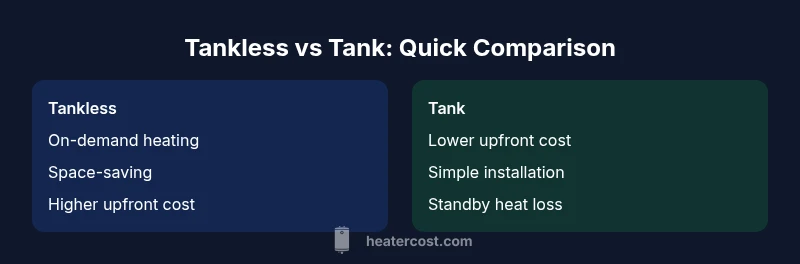
| Best use case | Ideal for small households, remodeling, or tight spaces | Cost-effective for larger households with steady demand |
The Good
- Space-saving design suits tight rooms and remodels
- On-demand heating reduces standby energy losses when sized properly
- Potential long-term energy cost savings with high-use households
- Flexible installation in multiple locations with proper venting/utility access
Negatives
- Higher upfront cost and more complex installation
- Energy efficiency depends on accurate sizing and water flow patterns
- Descaling and maintenance must be considered in hard water areas
- Repairing tankless units can be more specialized and costly
Both systems have a place; tankless is best for space-constrained homes with variable demand, while tanks excel in upfront affordability and simple, predictable performance.
If you prioritize space and potential energy efficiency, tankless wins. If upfront cost and straightforward installation matter more, a traditional tank remains a strong, sensible choice.
Got Questions?
What is the primary difference between tankless and traditional tank water heaters?
The primary difference is that tankless units heat water on demand, providing unlimited hot water when sized correctly, while tank systems store a finite amount of hot water in a reservoir. This affects space, installation, and standby energy losses.
Tankless heats on demand; tanks store hot water. Sizing and installation determine if you get steady pressure and temperature.
Do tankless units save energy in typical homes?
Tankless systems can reduce standby heat losses and improve overall efficiency, especially in homes with intermittent hot water use. Savings depend on usage patterns, climate, and proper sizing.
Tankless can save energy if you don’t have constant hot water demand, but results vary.
Is installation more expensive for tankless systems?
Yes, installation is usually more expensive due to venting, electrical upgrades, or gas line considerations. The overall cost depends on existing infrastructure and local codes.
Expect higher installation costs with tankless units because of the setup requirements.
Which system is better for small apartments?
For small apartments, a compact tankless unit often wins on space, but a small-capacity tank can be cost-effective if demand is modest and space is limited.
In small spaces, tankless units save room, but a compact tank can work if demand is light.
How long do tankless and tank heaters last?
Tankless heaters typically offer a longer lifespan with proper maintenance, while traditional tanks may require replacement sooner due to sediment and wear.
Tankless units usually last longer when well maintained; tanks may need replacement sooner.
What maintenance do they require?
Tankless systems require periodic descaling in hard water areas and routine inspections, while tanks need regular flushing to remove sediment and anode rod checks.
Descale tankless units if you have hard water; flush tanks to prevent sediment buildup.
The Essentials
- Assess your peak hot water usage before choosing
- Weigh space constraints against upfront costs
- Consider maintenance needs in your climate and water quality
- Sizing matters more than brand in achieving reliable comfort