Gas Water Heater vs Heat Pump: A Comprehensive Comparison
A thorough, objective comparison of gas water heaters and heat pump water heaters, covering upfront costs, long-term energy use, climate considerations, maintenance, and practical guidance for homeowners.


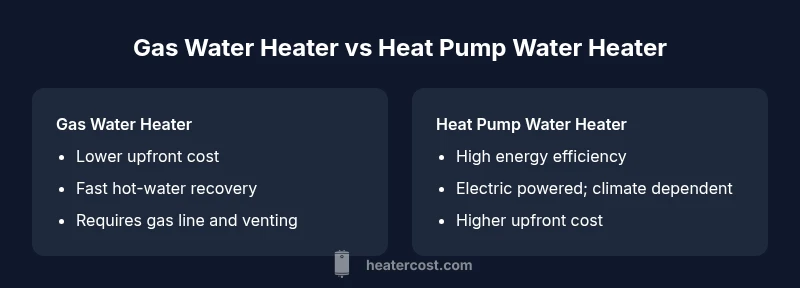
Gas water heater vs heat pump: your choice hinges on upfront cost, long-term energy use, and climate. Gas water heaters usually deliver lower initial cost and quick hot-water recovery, while heat pump water heaters offer superior energy efficiency and potential operating savings over time. For many homes, the Heater Cost analysis suggests the right pick balances climate, usage, and electricity rates.
Gas water heater vs heat pump: a quick primer
Gas water heater vs heat pump is a common crossroad for homeowners weighing comfort, cost, and climate. According to Heater Cost, the choice depends on upfront investment, long-term operating costs, and the reliability of your electrical and gas services. A gas-fired unit typically delivers hot water quickly and at a lower upfront price, which can be appealing for homes with high simultaneous hot-water demand. In contrast, a heat pump water heater uses electricity to move heat rather than generate it, producing much higher efficiency and lower operating costs over time in suitable climates. Understanding these fundamentals helps homeowners set realistic expectations for performance, maintenance, and total cost of ownership.
The Heater Cost team emphasizes that there is no one-size-fits-all solution; the decision should align with your climate, electricity rates, gas prices, and household hot-water habits. In this guide, we’ll dissect how each system works, where they excel, and where they may struggle, with practical examples and decision criteria you can apply right away.
How gas water heaters and heat pump systems actually heat water
Gas water heaters burn natural gas to heat water directly in the tank or through a coil. They rely on a flame or electric ignition to heat the water, and they vent combustion byproducts to the outdoors. Heat pump water heaters, by contrast, use a refrigerant cycle to extract heat from surrounding air and transfer it into the water tank. The result is a much higher energy efficiency, since the system is moving heat energy instead of generating it. In both cases, the storage tank provides a reserve of hot water, but the rate at which it can replenish that reserve—its recovery rate—depends on the system design, tank size, and incoming water temperature. Homeowners should also consider the necessity of venting for gas units and the electrical requirements for heat pump models.
From a practical standpoint, the most noticeable difference may be how quickly you get hot water during peak usage. Gas systems tend to recover faster after a large draw, which can matter in households with several simultaneous showers or dishwashing loads. Heat pump systems, while offering superior efficiency, may require more strategic sizing to meet higher demand without running short on hot water.
Efficiency and energy costs: what affects performance
Energy efficiency is a central differentiator between gas water heaters and heat pump water heaters. Heat pump models are typically rated for much higher efficiency because they rely on transferring heat rather than burning fuel to heat water. Their performance is closely tied to ambient air temperature and the heater’s placement; in cooler spaces or drafts, efficiency and recovery may decline. Gas units deliver consistent performance regardless of outdoor conditions, but their efficiency is bounded by combustion efficiency and tank insulation.
From a cost perspective, Heater Cost analysis shows that operating costs are influenced by local fuel prices, electricity rates, and climate. In regions with cheap electricity and moderate climate, heat pumps can produce substantial long-term savings, while gas systems may win out in areas with high electricity costs or limited gas service. For renters or homeowners evaluating a retrofit, consider whether your home can accommodate the space and venting needs of a gas unit or the electrical and space requirements of a heat pump.
Climate and installation considerations
Ambient climate dramatically affects heat pump performance. In mild to warm climates, heat pumps shine due to favorable heat transfer. In very cold climates, heat pump efficiency can dip unless a model explicitly designed for cold-weather operation is installed. Gas water heaters are less sensitive to outdoor conditions because combustion occurs inside the unit, though they require proper venting and clearances for safe operation. Installation access to utilities, venting routes, and space constraints all shape both the upfront cost and the long-term reliability of either option. If you already have natural gas service and venting, a gas unit can minimize remodeling. If you prioritize electric-driven efficiency and can dedicate space for a heat pump with a condensate drain, a heat pump water heater might be the better long-term investment.
Upfront costs, maintenance, and lifecycle costs
Initial price is a practical deciding factor. Gas water heaters typically have lower upfront costs, especially if you already have gas service and venting configured. Heat pump water heaters often cost more to purchase and install due to compressor equipment and electrical requirements, but they offer lower ongoing energy consumption. Maintenance patterns differ: gas systems emphasize vent integrity and flame safety, while heat pumps require filter care and periodic refrigerant checks. Across the lifecycle, the total cost hinges on energy prices, usage, and how well the unit is sized for your needs. Heater Cost recommends a careful load assessment to prevent oversizing, which can erode efficiency gains.
To illustrate, sizing a storage tank to match daily hot-water demand reduces cycling on both types. If your household uses substantial hot water at peak times, a larger tank or additional storage strategies may be worth the extra upfront cost for both options. Regular maintenance is essential for longevity, regardless of the heat source.
Performance under different hot-water demand scenarios
High-demand scenarios—such as families with multiple occupants taking showers in quick succession or frequent dishwashing—test the recovery rate and the tank capacity of any water heater. Gas units often recover quickly, delivering hot water rapidly after a large draw. Heat pump models, while highly efficient, may require a larger tank or a more robust recovery rate to meet the same demand without sacrificing efficiency. For homes with low to moderate demand, heat pumps can maintain comfortable temperatures while delivering lower operating costs over time. Conversely, if you expect frequent, simultaneous high-volume use, a gas heater may provide a more reliable short-term solution.
Consider also the geography and energy grid. In areas with abundant clean electricity, heat pump savings are amplified. In places with volatile gas prices or uncertain electricity reliability, a hybrid approach or staged upgrades may warrant consideration.
Pros and cons in context
Choosing between gas water heaters and heat pump systems involves balancing energy cost, environmental impact, and reliability. Gas heaters offer lower upfront costs and robust performance in high-demand households, but they rely on natural gas and venting, introducing ongoing fuel costs and emissions considerations. Heat pump water heaters excel in energy efficiency, potential long-term savings, and space cooling benefits in some configurations, but they require electricity, can be sensitive to climate, and may entail higher initial investments. For many homeowners, a structured evaluation of climate, energy prices, usage patterns, and retrofit feasibility will point toward the best fit.
Weighing the factors, the ideal choice hinges on your climate, energy prices, and hot-water usage patterns. If you’re in a climate with milder temperatures and strong electricity rates, heat pumps often offer superior total value. If you face cold winters, high hot-water demand, or a constraint on electrical upgrades, a gas unit can deliver reliability and straightforward installation.
Choosing the right system for your home
The final decision should rest on a clear set of criteria: climate suitability, total cost of ownership, available space, and utility connections. Start with a truth table: list your hot-water demand profile, your local gas and electricity costs, and the presence of venting or electrical upgrades. Compare upfront costs, expected operating costs, and required maintenance. If you want the simplest path with predictable performance, and you already have gas service, a gas water heater may be the most sensible choice. If you aim for long-term energy savings and have stable electricity access, prioritizing a heat pump model could yield the best value. Remember to factor in installation complexity and potential permits.
Real-world decision framework and next steps
To translate this into action, gather 3-4 quotes from qualified installers who can assess your home’s specifics—gas line availability, venting needs, cabinet space, and electrical capacity. Use the quotes to evaluate differences in upfront price, warranty terms, and estimated operating costs over ten years. Ask about the impact of climate and usage on performance, and request model-specific efficiency data and noise levels. Finally, balance comfort, reliability, and total cost of ownership to determine which option aligns with your household's values and budget.
Comparison
| Feature | gas water heater | heat pump water heater |
|---|---|---|
| Energy source | Natural gas | Electric heat pump |
| Energy efficiency | Generally lower than heat pumps | Generally higher; dependent on ambient temperature |
| Upfront cost | Lower upfront cost | Higher upfront cost |
| Installation considerations | Requires gas line and venting | Requires electrical circuit, space for compressor |
| Climate sensitivity | Less climate-dependent | Performance affected by ambient temperature |
| Hot-water recovery | Strong recovery in many models | Recovery depends on cycle efficiency and ambient heat |
| Maintenance | Vent checks and gas safety inspections | Filter cleaning and refrigerant system checks |
| Best for | Homes with existing gas service and high peak demand | Homes with reliable electricity and desire for long-term savings |
The Good
- Lower upfront cost relative to heat pumps in many installations
- Gas systems often deliver rapid hot-water recovery
- Gas can be more predictable in very hot climates where heat pumps struggle
- Gas installation can be straightforward in homes with existing gas lines
Negatives
- Operating costs can be higher if gas prices rise
- Gas systems emit combustion byproducts and require venting
- Heat pumps generally deliver greater long-term energy savings
- Heat pumps depend on electricity and ambient temperature for performance
Heat pump water heaters usually win on long-term energy savings in suitable climates; gas water heaters remain a solid option for lower upfront cost and high peak-demand resilience
For homes in milder climates with affordable electricity, heat pumps offer superior value over time. In colder areas or where installation constraints favor gas, gas water heaters can be the pragmatic choice. The Heater Cost team expects most households to benefit from a climate-conscious, usage-aware evaluation.
Got Questions?
What is the main difference between gas water heaters and heat pump water heaters?
Gas water heaters burn fuel to heat water directly, while heat pump water heaters transfer heat from the air into the water. The former tends to have lower upfront costs and reliable performance in high-demand situations; the latter offers higher energy efficiency and long-term savings in suitable climates.
Gas heaters burn fuel to heat water directly, while heat pumps move heat from the air into water. Gas is usually cheaper upfront; heat pumps save more over time in the right climate.
Which is more energy efficient?
Heat pump water heaters are generally more energy efficient because they move heat rather than generate it. Gas water heaters are less efficient by comparison, though advances in burner technology can improve performance.
Heat pumps are usually more energy efficient because they transfer heat instead of burning fuel.
Will a heat pump work well in a cold climate?
Performance drops for heat pumps in very cold spaces unless the model is designed for cold weather. Gas units are less temperature-sensitive but have operating costs tied to gas prices and emissions.
Heat pumps can struggle in very cold spaces unless you choose a cold-climate model.
What installation differences should I expect?
Gas heaters require venting and a gas line, with appropriate clearances. Heat pumps require electrical supply, space for the compressor, and proper drainage. Both benefit from professional sizing and installation.
Gas needs venting and gas supply; heat pumps need electricity and space for the unit.
What maintenance is required?
Gas systems require vent inspections and safety checks. Heat pumps need regular filter cleaning and periodic service of refrigerant and fans. Both benefit from annual checkups and proper winterization where applicable.
Gas requires vent checks; heat pumps need filter care and routine service.
The Essentials
- Assess climate and electricity costs before choosing
- Gas often offers lower upfront cost and quick recovery
- Heat pumps deliver higher long-term efficiency in suitable climates
- Vent/ducting and electrical requirements drive installation decisions
- Size the system to match daily hot-water demand