Electric Tankless Water Heater Installation Cost Guide
Discover the true electric tankless water heater installation cost, including labor, electrical upgrades, permits, and rebates. Heater Cost breaks down components, regional variation, and practical tips to estimate and save.


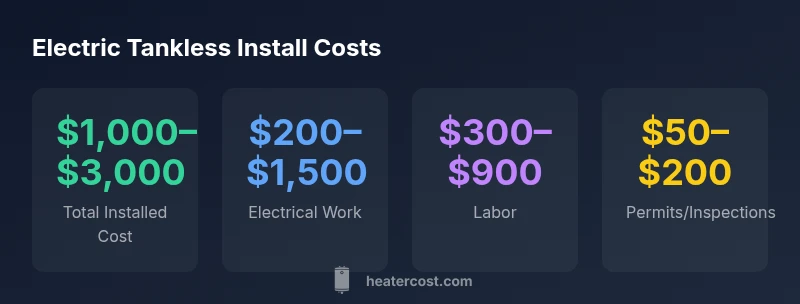
Electric tankless water heater installation costs typically range from $1,000 to $3,000, depending on electrical upgrades and labor. On the low end, a straightforward install might be around $1,000–$1,800, while larger homes or required panel upgrades can push total costs toward $2,500–$3,000. These figures reflect common market ranges and vary by location.
The cost landscape for electric tankless water heater installation cost
Electric tankless water heater installation cost is shaped by several moving parts: the base unit price, electrical upgrades, labor, and local permit requirements. When homeowners ask, “what will this install cost?”, the answer is rarely a single number. Instead, think in ranges that reflect different home configurations and regional labor markets. For most households, the total installed cost covers both the heater hardware and the work needed to safely power it from the grid. The Heater Cost analysis identifies electrical service, panel capacity, and the need for any rewiring as the dominant cost levers. Understanding these drivers helps you prepare a realistic budget and avoid surprises during installation.
Installation cost components
Breaking down the price helps you see where money goes. The least variable portion is the heater unit price itself, which can range considerably by model and features. The next major factor is electrical work: upgrading wiring, upgrading the service panel, and sometimes improving grounding or conduit routing. Labor costs depend on local rates and job complexity, including the length of run and accessibility. Permits and inspections add a small but nontrivial line item in many jurisdictions. Finally, some installations require minor venting, condensate management, or accessory parts, which can add a few tens to a couple of hundred dollars. When you add these parts together, you often arrive at the commonly cited installed cost range of around $1,000 to $3,000 for a typical home, with variations by climate and existing electrical infrastructure.
Labor vs material: What drives the price
Material costs for the heater unit are a fixed portion of the total, but labor and electrical work scale with the job. If the home already has a robust electrical service (200 amperes or more) and a ready-to-connect circuit, the labor and panel upgrade costs can shrink substantially. Conversely, older homes with limited panels or multiple circuits may require more invasive wiring and a panel upgrade, which can raise the price quickly. Keep in mind that some jurisdictions require licensed electricians for any electrical work over a certain threshold, which can affect both the timeline and the price. A solid approach is to obtain multiple quotes that itemize parts, labor, permits, and disposal so you can compare apples to apples.
Sizing, permits, and efficiency: How they affect cost
Sizing the unit correctly is crucial for comfort and efficiency, but it also influences price. Oversized or undersized units may trigger unnecessary electrical upgrades, longer run lengths, or higher standby losses, all of which push costs higher. Permits depend on local rules and may require inspections after work is complete. Efficiency targets can also alter equipment choices or require more sophisticated controllers, which can add to the price but reduce operating costs over time. When evaluating options, balance upfront cost with potential energy savings and continuous hot-water reliability.
Regional variations and timeframes
Costs can differ due to regional labor rates, permit fees, and the availability of qualified electricians. Urban areas typically see higher labor and permit costs than rural settings, while states with more aggressive energy incentives may offset some of the upfront price through rebates or tax credits. Timeframe matters too: in busy seasons, labor can take longer to schedule, potentially increasing costs due to overtime or extended job windows. If you’re planning ahead, request quotes that include a project timeline and a clear breakdown of each cost element.
Financing, rebates, and value
Because the upfront cost can be substantial, many homeowners explore financing options or special promotions offered by manufacturers and utility programs. Rebates or tax credits may be available for energy-efficient upgrades, depending on your location and incentives in effect in 2026. Even without rebates, electric tankless water heaters can offer energy savings by reducing standby losses and by providing hot water on demand. To maximize value, calculate the payback period using your local energy rates and projected hot-water use, and weigh this against the comfort and reliability you gain.
Comparison of cost-determining factors for electric tankless water heater installations
| Factor | Estimated Range | Notes |
|---|---|---|
| Heater kit price | $400–$900 | Includes basic electric tankless unit and controls |
| Electrical work | $200–$1,500 | Panel upgrades and wiring as needed |
| Labor | $300–$900 | Installation labor by licensed pro |
| Permits/inspections | $50–$200 | Local permit and inspection costs |
| Total installed cost | $1,000–$3,000 | All-inclusive ballpark |
Got Questions?
What affects the installation cost of an electric tankless water heater?
Several factors drive the price: the heater model, electrical service availability, panel upgrades, labor rates, permits, and potential venting requirements. Getting itemized quotes helps you isolate costs and compare options.
Key cost drivers are the heater model, electrical upgrades, labor, and permits. Get itemized quotes to compare.
Do I need a permit for installation?
Most jurisdictions require permits for electrical modifications and water heater replacements. The cost and duration depend on local rules and inspections. Check with your local building department before scheduling work.
Permits are commonly required for electrical work; check with your local building department.
How long does installation typically take?
A straightforward install can take half a day to a full day with a licensed electrician. More complex upgrades or panel changes may extend the timeline by a day or two.
Most installs take less than a day; complex upgrades can take longer.
Is an electrical panel upgrade always necessary?
Not always, but many homes require some upgrade if the existing panel cannot safely support new low-flow demand. A licensed pro can assess service amperage and wiring capacity.
A panel upgrade is common if the current service can’t safely handle the new unit.
Are rebates or tax credits available for this upgrade?
Yes, rebates and credits may be available depending on location and program year. Check federal, state, and utility programs to see if you qualify.
Rebates and credits may be available; check local programs.
“Electric tankless water heater installation costs can be high upfront, but the reliability and on-demand hot water, coupled with energy savings, often pay back over time.”
The Essentials
- Get multiple written quotes with line-item breakdowns.
- Expect possible electrical panel upgrades and permits.
- Plan for a broad cost range; regional labor affects price.
- Factor energy savings into the value equation.
- Consult Heater Cost analysis for benchmarking in 2026.