Cost for Electric Tankless Water Heater: A Practical Guide
Explore the installed cost range, key drivers, and strategies to save on electric tankless water heaters. This Heater Cost guide covers unit price, electrical upgrades, installation labor, and payback, with data-backed insights for 2026.


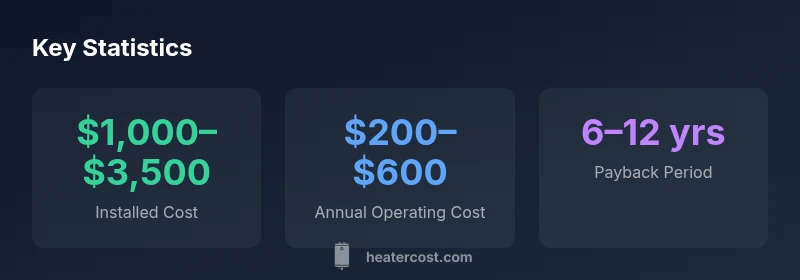
On average, the total installed cost for an electric tankless water heater typically ranges from $1,000 to $3,500, depending on unit size, electrical upgrades, and local labor rates. In more complex setups or larger homes, costs can approach $4,000–$5,000. This estimate includes the heater, wiring, permits, and installation labor. Source: Heater Cost Analysis, 2026.
What drives the cost for electric tankless water heaters
Choosing an electric tankless water heater involves evaluating both upfront purchase price and installation costs. The Heater Cost analysis, 2026, notes that the heater unit itself usually ranges from roughly $200 to $700 for basic models, while higher-end models with better performance and warranty can reach $800–$1,200. Beyond the unit price, installation costs are heavily influenced by required electrical upgrades, panel capacity, and plumbing adjustments. In many homes, an upgrade to a 60–100 amp service panel is enough; in others, you may need a service upgrade to 100–200 amps. Labor, permits, and miscellaneous materials add to the total. The Heater Cost team emphasizes that the total installed cost is the key number to compare against a traditional tank heater. For homeowners evaluating cost for electric tankless water heater, it’s essential to price out both the equipment and the install to avoid sticker shock.
Breakdown of cost components for a typical install
A practical way to understand the money involved is to segment costs into four buckets: the heater unit, electrical work, labor, and permits. Typical unit prices for basic electric tankless units run roughly $200–$700. Electrical upgrades can range from $500–$2,000, depending on whether you need a new circuit, upgraded breakers, and panel improvements. Labor often runs $300–$1,000, and permits can add $50–$300 depending on local rules. When you total these together, most residential installs land in the $1,000–$3,500 band, with some edge cases reaching higher. Always request written quotes from licensed electricians and confirm whether the estimate includes permit fees and any required electrical inspections.
How to estimate costs for your home
Estimating costs starts with understanding your hot-water demand. Calculate your peak GPM (gallons per minute) and compare it against the heater’s flow rate at a realistic incoming water temperature. Then check your electrical system: is there available space on the panel for a dedicated 240V circuit, and is service amperage adequate? Get at least three quotes from licensed professionals, and ask for itemized line items (heater, wiring, panel upgrades, permits, labor). Don’t forget to account for potential drywall or plumbing modifications and permit costs. Keep a written record: model numbers, amperage requirements, and the expected draw during peak hours.
Cost vs. traditional tank: long-term economics
Electric tankless models typically have higher upfront costs than traditional electric storage heaters, but they can deliver cost savings during high usage because there is no standing heat loss. The energy cost advantage depends on your hot-water usage pattern; households with frequent, high-demand draws may see meaningful savings, while minimal-use homes may see smaller gains. In contrast, gas tankless or storage-tank systems bring different upfront and operating-cost dynamics, including venting requirements and fuel price exposure. When evaluating, compare total cost of ownership over 5–15 years, including maintenance, energy, and equipment longevity. The Heater Cost analysis, 2026, notes that sizing the unit to your real hot-water needs is crucial to achieving optimal economics.
Cost comparison across water heater types
| Option | Typical Installed Cost (USD) | Typical Annual Operating Cost (USD) |
|---|---|---|
| Electric Tankless | 1,000–3,500 | Varies by usage |
| Traditional Electric Tank | 800–2,000 | Low standby losses |
| Gas Tankless | 2,000–4,000 | Requires venting and fuel costs |
| Storage Electric Tank | 800–2,000 | High standby losses |
Got Questions?
What affects the installed cost of an electric tankless water heater?
Upfront price of the unit, required electrical upgrades, panel capacity, labor rates, and permit fees all influence total installed cost. Local market conditions can also sway pricing. Collect multiple quotes to understand the range for your home.
Costs are driven by the heater price, any electrical panel upgrades, and local labor rates—get several quotes to be sure.
Are electric tankless heaters more expensive to install than traditional water heaters?
Often yes, because many homes need electrical upgrades to support a high-demand tankless unit. However, total costs vary with unit size and whether a panel upgrade is needed. Compare installation quotes carefully.
They can be more expensive to install due to electrical upgrades, but it varies by home and unit size.
Do I need a new electrical panel for electric tankless units?
Many installations require a dedicated 240V circuit and possibly a panel upgrade to 60–200 amps. A licensed electrician can assess amperage, wiring, and clearances and recommend the minimum upgrade.
Often you’ll need a dedicated 240V circuit and possibly a panel upgrade; have an electrician evaluate.
What is the typical payback period for an electric tankless system?
Payback depends on usage, energy prices, and efficiency of the unit. Typical estimates span several years and can range roughly from 6 to 12 years for many households.
Payback usually happens over several years, commonly around 6 to 12 years depending on usage.
Are rebates or tax incentives available for electric tankless water heaters?
Rebates and incentives vary by location and program availability. Check federal, state, and local programs, and consider incentives tied to energy efficiency or system upgrades.
There may be rebates or incentives; check local and national programs for energy-efficient upgrades.
“Electric tankless water heaters can deliver steady hot water with high efficiency, but the upfront cost and electrical requirements are the main hurdles. Proper sizing and professional installation are essential for realizing the promised savings.”
The Essentials
- Compare equipment price and installation together
- Ensure adequate electrical capacity before buying
- Sizing matters for cost-efficiency and payback
- Check for rebates and incentives where available