Why Would Heat Stop Working in House: Troubleshooting Guide
Urgent guide to diagnose why heat stops in your home. Learn quick fixes, step-by-step checks, and when to call a pro. This practical approach by Heater Cost helps homeowners regain warmth safely.


Heat outages in a home are usually caused by thermostat or power issues, or a clogged filter. Start with power, thermostat settings, and a quick filter check, then follow the step-by-step troubleshooting flow to diagnose common causes. If heat still won’t start, proceed with the full guide for deeper checks and safety tips.
Why would heat stop working in house
When your home suddenly feels like a refrigerator, the instinct is to panic. Instead, take a calm, methodical approach. The most common culprits are simple, user-facing components: the thermostat might be misconfigured or running on the wrong mode, the system could have lost power due to a tripped circuit, or an air filter could be clogged and choking airflow. According to Heater Cost, many heat outages stem from easily fixable issues that homeowners can address safely without a professional on day one. This section helps you distinguish quick wins from problems that truly require a licensed technician. By starting with the lowest-risk checks, you protect yourself and your equipment while restoring warmth faster.
Key idea: take control of obvious, low-risk fixes first, because those exist on almost every heating system and can save you time and money.
Common Causes at Home
There are several frequent reasons heat stops working, and understanding them helps you triage efficiently. Core causes include thermostat missettings or a dead battery in the wall unit, a tripped circuit or blown fuse disconnecting the heating system, a dirty air filter that restricts airflow, and fuel-related issues such as a gas valve being off or an empty oil tank. Other possibilities include an ignition or burner problem in gas furnaces, a closed damper, or a malfunctioning relay. Each issue has a practical, testable fix you can undertake safely—begin with the simplest checks and move deeper only if needed. Heater Cost analysis highlights that many outages are preventable with routine maintenance and proactive checks.
Checklist of common causes:
- Thermostat misconfiguration or dead batteries
- Tripped circuit breaker or blown fuse
- Dirty or clogged air filter
- Fuel supply issues (gas valve off, empty oil tank)
- Ignition/burner problems in gas furnaces
- Closed dampers or restricted ductwork
- Faulty relay or control board
- Outdoor unit blocked or frozen (for heat pump systems)
Quick Safety Checks Before You Dig In
Before you perform any tests or inspections, prioritize safety. If you smell gas, hear an unusual hissing, or notice a flame that won’t stay lit, exit the area and call your gas utility or a licensed technician immediately. For all non-emergency checks, start with these quick safety steps:
- Turn off the system if you detect unsafe conditions or suspect a gas leak, and never attempt to fix gas lines yourself.
- Use proper PPE and avoid touching live electrical components with wet hands.
- Keep children and pets away from the working area while you test or inspect.
- If your home has a solid-fuel or oil-burning system, ensure you have adequate ventilation during testing.
- Note any strange noises, smells, or error codes to share with a technician if you call one.
These precautions help minimize risk while you troubleshoot. According to Heater Cost, safety-first practices are the backbone of any home heating repair plan.
Steps
Estimated time: 30-60 minutes
- 1
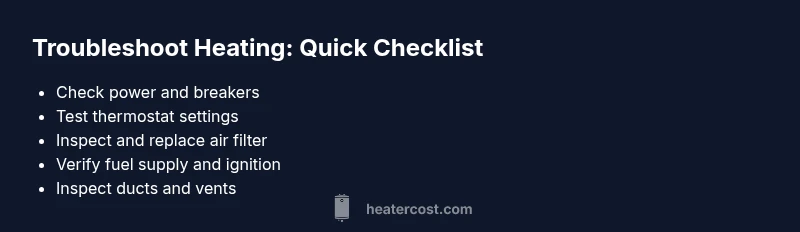
Check power and breakers
Locate the main electrical panel and look for a tripped breaker or blown fuse affecting the heating system. Reset any tripped breakers and replace fuses if needed. After resetting, wait a minute for the system to respond and try turning the heat back on.
Tip: Take a photo of the panel labeling before you flip breakers so you can revert if needed. - 2
Test the thermostat
Ensure the thermostat is powered, set to heat, and the setpoint is higher than the current room temperature. If the display is blank or unresponsive, replace the batteries or consider reprogramming or replacing the unit.
Tip: If you suspect wiring issues, avoid poking around thermostat terminals and consult the manual. - 3
Inspect and replace the air filter
A dirty filter can choke airflow and cause the system to shut down or deliver insufficient heat. Replace with the correct MERV rating per manufacturer guidelines and note when maintenance is due.
Tip: Mark a calendar reminder for routine filter changes every 1–3 months depending on use. - 4
Check the fuel supply and ignition (for gas/oil systems)
Confirm the gas valve is open and there is adequate fuel supply. For oil, ensure the tank is not empty and the burner is clean. If ignition components show signs of wear, a professional should inspect them.
Tip: Do not attempt to clean or adjust burners if you’re unsure of the procedure. - 5
Inspect ductwork and airflow
Look for closed dampers, collapsed ducts, or obvious blockages. Clear obstructions and ensure registers are open to restore proper airflow.
Tip: Poor airflow isn’t a single fix; address both supply and return paths to balance the system. - 6
Test system after fixes
Turn the heat back on and observe ignition, flame color, and cycle times. If the unit starts and then shuts off quickly, note any error codes and consider professional inspection.
Tip: Record any audible codes or blinking lights to share with a tech.
Diagnosis: Your heat won't start when the thermostat calls for heat
Possible Causes
- highPower or electrical issue (tripped breaker, blown fuse)
- mediumThermostat misconfiguration or faulty wiring
- mediumFuel supply issue or burner/ignition problem
- highAirflow restriction (dirty filter, closed damper)
Fixes
- easyReset the circuit breaker or replace a blown fuse
- easyVerify thermostat is set to heat, recalibrate or replace batteries, and rewire if needed
- mediumCheck gas valve, fuel supply, and ignition components; ensure connections are secure
- easyReplace the air filter and inspect for closed dampers or blocked ducts
- hardIf problems persist, contact a licensed HVAC technician for a comprehensive diagnostic
Got Questions?
Why won’t my heat turn on?
Common causes are thermostat issues, power problems, and clogged filters. Start with power and thermostat checks, then inspect the air filter before proceeding to deeper diagnostics.
Heat often fails due to thermostat or power issues. Start with power and thermostat checks, then inspect the air filter before deeper diagnostics.
Is it safe to reset a furnace or thermostat?
Resetting is sometimes safe if recommended by the manufacturer and done with power off. If you’re unsure, consult the manual or contact a licensed HVAC technician.
Resetting can be safe when guided by the manual. If unsure, avoid it and call a professional.
Why is my thermostat display blank?
A blank display usually means power to the thermostat is interrupted or batteries are dead. Check the battery and power wiring, then replace if needed.
A blank screen usually means no power; change batteries or check wiring.
When should I call a professional?
Call a professional if you detect gas smells, persistent ignition issues, electrical concerns, or if the system remains non-operational after basic checks.
If gas feels involved or basic checks fail, contact a licensed tech.
Can a dirty filter cause no heat?
Yes. A clogged filter reduces airflow and can cause the system to shut down to protect itself. Replace the filter and check for improved airflow.
A dirty filter blocks airflow and can stop heat; replace it to fix airflow first.
What if I smell gas around the furnace?
A gas smell is serious. Do not operate electrical switches or create sparks. Leave the area and call the gas utility or emergency services immediately.
Gas smells require leaving the area and calling your gas provider right away.
Watch Video
The Essentials
- Identify the simplest fixes first
- Prioritize safety and know when to call a pro
- Keep systems maintained to prevent outages
- Document symptoms for faster diagnosis