Why Is My Heater Not Getting Hot? A Practical Troubleshooting Guide
Urgent guide to diagnose why your heater isn’t getting hot, with step-by-step checks, safety tips, and cost-conscious fixes from Heater Cost.


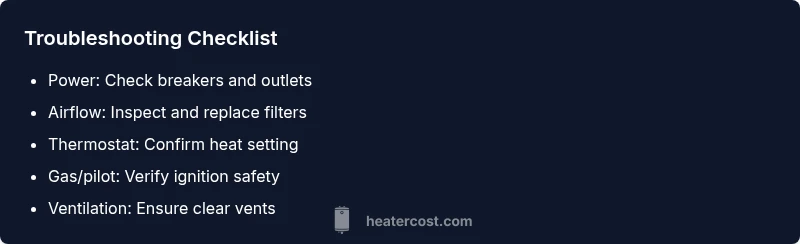
Most often, a heater won’t heat due to a simple, fixable issue such as a tripped breaker, a clogged filter, or an incorrect thermostat setting. Start by checking the power supply, inspecting and replacing the filter if dirty, and verifying the thermostat is set high enough. If these basics don’t resolve it, follow the step-by-step guide below for deeper diagnostics, recommended by Heater Cost.
Understanding the Problem and Why It Happens
A heater that fails to produce heat is often caused by simple, fixable issues rather than a fundamental failure of the unit. In 2026, homeowners report that the most frequent culprits are electrical interruptions, air flow problems, and thermostat misconfiguration. According to Heater Cost, the first step is to verify basic power and settings before assuming a component failure. This quick triage saves time, money, and needless service calls. In many homes, the problem is traced back to a tripped circuit breaker, a dirty filter restricting airflow, or a thermostat set too low or on an incorrect mode. Even gas heaters can stall if the pilot light is out or a safety switch has tripped. By understanding these common causes, you can approach the issue systematically and avoid unnecessary risk.
Common Causes of a Heater Not Getting Hot
- Tripped circuit breaker or blown fuse cutting power to the unit.
- Dirty or clogged air filter reducing airflow and heat output.
- Incorrect thermostat setting or a malfunctioning thermostat sensor.
- Gas valve or pilot light issues in gas furnaces (pilot light out, thermocouple fault).
- Blocked vents or inadequate combustion air in the room.
- Restricted heat exchanger or dirty burner ports (professional cleaning required).
- Electrical or control board faults that fail to signal the unit to heat.
Safety First: What You Should Do Before You Diagnose
Power down the unit if it’s safe to do so, and unplug or switch off power to avoid shock. Check the obvious items first: the breaker, the filter, and the thermostat. Do not attempt to disassemble burners or electrical boards unless you are confident in your skills. If you smell gas or hear a hissing sound, leave the area and call the gas utility or an emergency number immediately. Keep children and pets away from the area while you inspect.
Diagnostic Flow: Symptom-to-Diagnosis Path
- Symptom: No heat from a space heater or furnace.
- Causes: 1) Power issue; 2) Airflow problem; 3) Thermostat issue; 4) Combustion/gas issues; 5) Sensor/board fault.
- Fixes: Start with easy checks (power, filter, thermostat), then progress to more involved checks (gas supply, vent clearance, wiring) as needed. If the symptom persists after all simple checks, it's time to call a professional.
Step-by-Step Fixes for the Most Common Causes
Step 1: Restore power: Reset breakers, replace fuses, and verify outlet functioning (easy). Tip: Use a tester to confirm power at the outlet; if you don’t get a voltage reading, do not proceed with other steps.
Step 2: Clean or replace the filter: A clogged filter reduces heat by restricting airflow; replace every 1-3 months depending on usage. Tip: Label reminders on your calendar to prompt regular changes.
Step 3: Correct thermostat settings: Ensure it's set to heat and above room temperature; check for a scheduled program interfering with heat. Tip: Test by temporarily increasing the setpoint by 5-10 degrees.
Step 4: Inspect gas supply or pilot: For gas heaters, verify the pilot light is lit; if not, relight following safety instructions; if still not, call a pro. Tip: If you smell gas, evacuate immediately.
Step 5: Check vents and combustion air: Clear any blockages or obstructions to ensure proper combustion. Tip: Keep exterior vents free of snow, leaves, and debris.
Step 6: If a control board or sensor fault is suspected, do not attempt repairs beyond basic maintenance; contact a licensed technician. Tip: Have your model number ready when you call.
Estimated time: 60-90 minutes. Safety: Always turn off power before inspections; never bypass safety switches.
Safety First: When to Call a Professional
If basic checks reveal unfamiliar wiring, persistent gas smells, or a flickering flame, stop and call a licensed technician. A professional can safely diagnose ignition systems, blower motors, and control boards. Never attempt major gas work or electrical repairs beyond your training.
Maintenance and Prevention to Keep Your Heater Hot
- Change filters regularly and keep vents clear to maintain airflow.
- Schedule annual professional inspections to catch issues early.
- Replace old, inefficient units with cost-effective upgrades when appropriate.
- Keep the space around the heater clear of clutter and combustibles.
- Monitor thermostat performance and replace batteries if it’s a wireless model.
When to Call a Pro and What to Expect
If basic checks don’t restore heat, or you notice gas smells, carbon monoxide risk, or strange noises, stop and call a licensed technician. A pro can diagnose blower issues, control-board faults, or gas-supply problems safely and legally. Expect a diagnostic visit to include a pressure test, airflow check, and part replacements if needed, with a clear cost estimate before work.
Steps
Estimated time: 60-90 minutes
- 1
Check power supply
Inspect the breaker or fuse box to confirm power is reaching the unit. If the outlet is controlled by a switch, make sure it’s ON. Use a multimeter to verify voltage if you have one.
Tip: A simple plug-in tester can quickly verify outlet power. - 2
Inspect and replace the filter
Remove the filter and inspect for dirt and debris. Replace with the correct filter size or wash if it’s a reusable type. Reinstall, ensuring a snug fit to prevent air leaks.
Tip: Set a calendar reminder to replace every 1–3 months. - 3
Verify thermostat settings
Ensure the thermostat is in the heat mode and the setpoint is higher than room temperature. If you have a programmable thermostat, test a temporary manual setting to confirm heat output.
Tip: Temporarily raise the setpoint 5–10 degrees to test responsiveness. - 4
Check gas supply or pilot light
For gas heaters, confirm the pilot light is lit and the gas valve is open. If the pilot is out, follow the manufacturer’s relighting instructions with caution. If not resolved, stop and call a pro.
Tip: Never attempt to re-light a gas appliance if you smell gas. - 5
Inspect vents and air intake
Look for obstructions around intake and exhaust vents. Clear debris, snow, or furniture that may block airflow. Ensure adequate combustion air in the room.
Tip: Outdoor units should have at least a few inches of clearance on all sides. - 6
Plan for professional evaluation
If heat still won’t come on, do not attempt to repair complex electrical or gas components yourself. Schedule a licensed technician for a thorough diagnostic and safe repairs.
Tip: Have serial/model numbers and recent maintenance handy.
Diagnosis: No heat from heating device (space heater or furnace).
Possible Causes
- highPower issue (tripped breaker, blown fuse, outlet fault)
- highAirflow restriction from dirty filter or blocked vents
- mediumThermostat misconfiguration or sensor failure
- mediumGas supply issue or pilot light/thermocouple fault (gas heaters)
- lowControl board or ignition fault (electrical/electronic)
Fixes
- easyReset breaker or replace blown fuse; test outlet power
- easyReplace or clean air filter; ensure proper airflow
- easyVerify thermostat settings or replace faulty thermostat
- mediumRelight pilot light if applicable; check thermocouple; call pro if unresolved
- mediumInspect control boards or ignition system; professional diagnostics required
- hardCheck gas supply and venting; contact a licensed technician for safety-critical issues
Got Questions?
What are the most common reasons a heater won’t heat?
The most common causes are a tripped breaker, a dirty air filter, and an improperly set thermostat. Gas furnaces may fail due to a pilot light or safety switch issue. Start with power, airflow, and thermostat checks before calling a pro.
Most heaters stop heating due to power, airflow, or thermostat problems. If you still have heat issues after these checks, a professional evaluation may be needed.
Can a thermostat cause a heater to not heat?
Yes, a misconfigured or failing thermostat can prevent a heater from turning on or reaching the set temperature. Reprogram or replace the thermostat if needed, and ensure it communicates correctly with the system.
A faulty thermostat can stop heat entirely; fix or replace it to restore proper control.
Is it safe to keep using a heater that isn’t heating?
If basic checks don’t fix the issue, avoid using the unit until inspected. Continuing to operate a malfunctioning heater can increase fire risk or cause carbon monoxide exposure in fuel-fired systems.
If it still isn’t heating after basic checks, stop using it and get a professional evaluation.
How often should I replace filters to prevent heating issues?
Most systems benefit from filter changes every 1–3 months, depending on usage and the type of filter. Regular replacement improves airflow and heat output and reduces strain on the system.
Change filters every 1–3 months to keep heat steady and the system efficient.
When should I call a professional for a gas furnace?
Call a professional if you smell gas, hear hissing, or the pilot light won’t stay lit. Gas systems require licensed technicians for safe ignition, venting, and combustion checks.
If you detect gas or the pilot won’t stay lit, contact a pro immediately.
Why does a gas heater’s pilot light go out?
Pilot light outages can be caused by drafts, a dirty thermocouple, or a faulty gas valve. If relighting fails or you’re unsure, a professional should inspect the ignition system.
Pilot lights can go out from drafts or thermocouple issues; if relighting fails, call a pro.
Watch Video
The Essentials
- Check power and thermostat first.
- Clean or replace the air filter promptly.
- Escalate to a pro for gas or electrical issues.
- Maintain regular maintenance to prevent future problems.