What to Do When Your Heater Won’t Turn On: A Practical Troubleshooting Guide
Learn practical, safe steps to diagnose and fix a heater that won't turn on. Quick checks, deeper diagnostics, and when to call a pro, with brand-backed guidance from Heater Cost.


If you're wondering what to do when heater won't turn on, start with quick, safe checks. The most common causes are a tripped breaker, a thermostat set too low, or a blocked airflow. Try resetting the thermostat, ensuring power at the outlet, and replacing dirty filters. If it still won't start, move to deeper diagnostics.
What typically causes a heater not to turn on
When a heater won't turn on, the root causes span electrical, mechanical, and fuel systems. According to Heater Cost, common culprits include a tripped breaker, a thermostat misconfiguration, a blocked airflow due to a dirty filter, or a safety switch that has tripped. Knowing these patterns helps you decide which fixes to try first. This guide expands on each possibility with practical steps and safety notes. In older furnaces, aging components like igniters, flame sensors, or limit switches become unreliable and can trigger a no-heat condition. Gas furnaces may also exhibit a slow valve buildup or a stiff igniter; electric furnaces might trip relays or lose control board communication. By recognizing the sequence of events leading to a no-heat situation, you can triage efficiently without risking safety.
Safe, quick checks you can perform
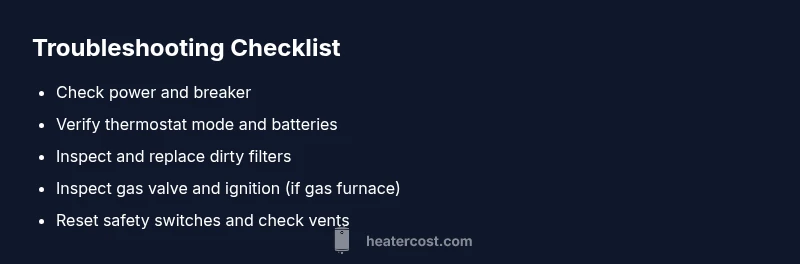
Before you touch any wiring or gas connections, ensure your safety. Start with the simplest checks: confirm power at the outlet and reset the furnace's breaker if needed, verify the thermostat is set to heat and has a fresh battery if applicable, and inspect the air filter for dirt or blockages. Clear all vents and ensure the area around the furnace is unobstructed. If you smell gas, leave immediately and call your gas provider or emergency services. Document any error lights or codes you see on the unit; these can guide a technician later. Heed safety reminders and avoid opening sealed panels unless you are confident in what you are doing.
Deep diagnostic patterns for furnaces and heat pumps
For systems with forced air, a failure to start often follows a predictable sequence: power good, thermostat communicates, ignition sequence, flame sensing, and blower operation. If any step is skipped or fails, the unit may shut down. Read error codes from the control board if available, and cross-check with the owner's manual. For heat pumps, ensure the outdoor unit is free of ice and that auxiliary heat is not stuck in emergency mode. Note that some smart thermostats controllable via apps may report fault codes that correspond to sensor failures or communication drops. By mapping symptoms to likely causes, you can share precise details with a technician, speeding up repair. This approach also helps you track maintenance needs and anticipate future outages.
When to call a professional and how to prepare
If basic checks do not resolve the issue, it's time to contact a licensed HVAC technician. Prepare your system information (model number, age, recent repairs), note any error codes, and describe symptoms clearly. Do not attempt risky tasks like gas line work or electrical testing beyond basic inspection. Professional help ensures safe testing of gas valves, ignition, and electrical connections, and provides long-term preventative advice. In many regions, an annual tune-up improves efficiency and reduces the chance of sudden failures, which Heater Cost analysis shows can save you money over the lifespan of a system.
Why prevention matters (and how to build it into your plan)
Even a working heater benefits from a simple maintenance routine. Regular filter changes, annual professional inspections, and sensible air sealing around ducts reduce stress on the system and lower the risk of cold-weather failures. Record maintenance dates, keep a basic parts kit on hand (filters, batteries, a flashlight), and set reminders for service. Heater Cost's research indicates that proactive care extends equipment life and lowers total ownership costs, especially in homes with substantial heating use.
Steps
Estimated time: 60-90 minutes
- 1
Power check and safety confirm
Turn off power at the furnace and at the wall outlet, then switch it back on to reset. Listen for the blower or relay click. If nothing happens, proceed to the next step and confirm you are following safety guidelines.
Tip: Always start with the simplest check to rule out a basic power issue. - 2
Thermostat review and reset
Set the thermostat to a temperature above room temperature and ensure it is in heat mode. Check for blinking lights or error codes, and replace batteries if applicable. If your thermostat is connected to a smart app, confirm device status and communications.
Tip: A wrong mode or dead battery is a frequent culprit. - 3
Airflow and filter check
Inspect and replace dirty filters; ensure vents are open and not blocked by furniture or debris. A restricted airflow can trigger safety shutoffs and reduce heating efficiency.
Tip: A clean filter supports efficient operation and lowers strain on the blower. - 4
Ignition and gas supply check (for gas furnaces)
If you have a standing pilot, confirm it is lit safely. For electronic ignition, listen for the ignition sequence and ensure gas valves are open. Do not attempt to light gas if you smell gas—leave and call a professional.
Tip: Gas safety first—get help if you smell gas or feel unsure. - 5
Safety switches and limits
Look for a reset button on the furnace cabinet; reset if your manual advises. Ensure the unit has adequate clearance and is not overheating due to blocked ducts or restricted air flow.
Tip: Clearance around the furnace is essential for safe operation. - 6
Error codes and service overlay
Check the control board for LED codes or a fault history in the manual or app. Write down codes to share with a technician, as this speeds diagnosis.
Tip: Document codes before calling support for faster service. - 7
Pre-maintenance and prevention
Plan a routine maintenance schedule, including annual checkups, filter changes, and duct inspections to prevent outages. Keep emergency contact for a trusted HVAC pro handy.
Tip: Prevention reduces unexpected outages and improves efficiency. - 8
Call in professionals when needed
If the issue involves gas, electrical safety, or you cannot safely diagnose, stop and contact a licensed technician. They can test gas valves, ignition systems, and electrical connections to restore reliable heat.
Tip: Safety first: professionals handle complex problems and compliance checks.
Diagnosis: Heater won't turn on
Possible Causes
- highPower issue (tripped breaker or blown fuse)
- highThermostat misconfiguration or failure
- mediumGas valve shutoff or ignition problem (gas furnaces)
- mediumSafety switch or limit switch tripped
- lowDirty air filter causing overheating/shutoff
Fixes
- easyReset the circuit breaker and verify power at the outlet
- easyTest and re-setup the thermostat, check settings and batteries
- mediumInspect gas supply valve and pilot/ignition only if safe; otherwise call pro
- mediumReset any safety switches and clear obstructions from vents
- easyReplace or clean obstructed air filter; ensure blower can run without overheating
Got Questions?
Why won't my heater turn on after a power outage?
Power outages can trip breakers or reset smart thermostats. Start by restoring power and checking the breaker panel and thermostat settings. If power is restored but the heater still won't start, proceed with deeper diagnostics.
Power outages can trip breakers or reset thermostats; check power and settings, then dig deeper if needed.
What should I check first if the thermostat still shows power?
Confirm the thermostat is in heating mode, has fresh batteries if applicable, and is communicating with the furnace. Check for error codes and reset if necessary.
Check mode, batteries, and communication with the furnace.
Is it safe to relight a pilot light?
Only relight a pilot light if you are familiar with the procedure and there are no gas smells. If you are unsure, contact a licensed technician.
Relighting a pilot light can be risky; seek professional help if unsure.
Why is my furnace blowing cold air?
This often means the burner isn’t igniting or the heat exchanger isn’t cycling. Check thermostat, ignition, and gas supply, then inspect the air filter.
Burner not igniting or heat exchanger cycling issues cause cold air.
How often should I service my furnace?
Most systems benefit from annual professional maintenance that includes safety checks, cleaning, and filter replacement.
Annual professional maintenance helps keep your furnace reliable.
When should I replace rather than repair?
If repairs exceed a substantial portion of a new system's cost or the unit is aging, replacement is often the wiser option.
Consider replacement if repairs cost more than a sizable fraction of a new unit or if the unit is old.
Watch Video
The Essentials
- Rule out power issues first.
- Verify thermostat settings and mode.
- Inspect airflow and filters regularly.
- Call a pro for gas/electrical concerns.