What to Do If Your Heater Isn’t Working: A Troubleshooting Guide
Urgent, practical guide to diagnose and fix a heater that isn’t working. Learn quick checks, common causes, safety tips, and when to call a licensed professional.


To answer what to do when your heater is not working, start with the basics: ensure power is on and the thermostat is set correctly, then check the air filter and safety switch. If the unit still won’t run, follow the step-by-step troubleshooting below to identify and fix the most common problems before calling a pro, for a safer, faster recovery.
what if my heater is not working
If you’re asking what should be done when what if my heater is not working, you’re not alone. According to Heater Cost, most outages begin with simple, safe checks rather than a major repair. This section sets the foundation with quick safety steps and a clear triage mindset, so you can quickly decide whether you can fix it yourself or need a licensed technician. Remember: early, calm checks save time and reduce risk. In addition, always start with power, breaker status, thermostat settings, and filter condition. If you smell gas or hear unusual noises, stop and call a pro.
According to Heater Cost, many fixes are resolved by basic checks, especially around seasonal changes when start-up begins. Take a moment to confirm there are no obvious hazards (gas smells, exposed wiring, or water near electrical components). A calm, methodical approach prevents misdiagnosis and speeds up a safe resolution.
Quick checks you can do safely
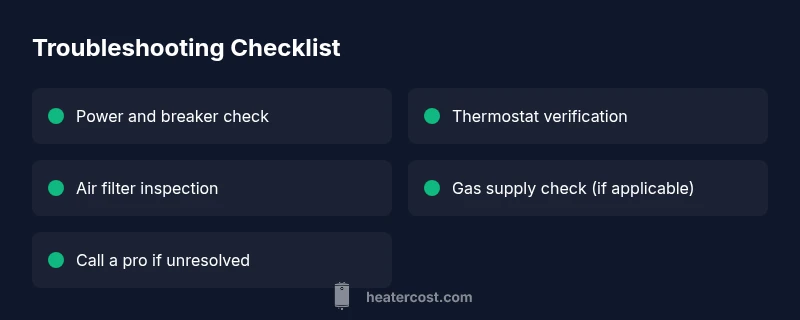
- Check the power supply at the outlet and ensure the circuit breaker is on.
- Verify the thermostat is set to heat and not in eco or cool mode.
- Look for a blown fuse or a tripped breaker and reset if appropriate.
- Inspect and replace (or clean) the air filter to restore airflow.
- For gas furnaces, confirm the gas valve is on and there’s no gas smell before any inspection.
- If safe, perform a soft reset by switching the unit off, waiting 60 seconds, then turning it back on.
Common causes and how to diagnose
Power issues, incorrect thermostat settings, or airflow problems are the top culprits. Gas ignition or pilot light faults come next on gas furnaces. Use a process of elimination: test power, then thermostat, then airflow. If no fix, note any patterns for the technician and keep a maintenance log.
Heater performance can degrade with age, but most root causes are simple and addressable without full replacement, especially when you catch them early.
Step-by-step fixes (overview)
This section highlights the practical steps you’ll perform in the dedicated step-by-step guide below. Use these as checkpoints while you work to avoid missing a critical safety step and to confirm each fix you try.
Safety, warnings, and when to call a pro
Safety always comes first. If you smell gas, hear hissing, or suspect a circuit or gas issue, stop immediately and call emergency services or a licensed technician. Do not attempt complex gas work yourself.
Prevention tips to avoid future outages
Regular maintenance is the best defense. Schedule annual inspections, clean or replace air filters every 1-3 months, and keep a simple maintenance log to track issues and repairs. Address cooling or heating imbalances promptly to prevent repeated outages.
Steps
Estimated time: 45-60 minutes
- 1
Power check and reset
Turn off the furnace at the wall or power switch, then switch the circuit breaker off and on. Wait 60 seconds before restoring power. This clears minor electronic glitches that can prevent startup.
Tip: A simple reset fixes many transient faults. - 2
Thermostat verification
Ensure the thermostat is set to heat, not cool or auto. If it uses batteries, replace them and re-sync with the furnace. Check that the thermostat wires are intact and properly connected.
Tip: A loose wire is a common and easy fix. - 3
Breaker and fuse check
Inspect the home’s main panel for a tripped breaker or blown fuse related to the furnace circuit. Reset or replace as needed, and observe whether it trips again.
Tip: If the breaker trips again, there’s a potentially deeper electrical fault. - 4
Airflow and filter inspection
Open the furnace panel only if instructed by the manual, and check for a dirty air filter. Replace the filter if dirty and ensure the blower is running when the system calls for heat.
Tip: A clean filter can dramatically improve performance. - 5
Gas supply and ignition check
For gas furnaces, verify the gas valve is open and there’s no gas odor. Do not relight a pilot if you’re unsure—follow the manual or call a pro to relight safely.
Tip: Gas work is hazardous; safety first. - 6
When to call a professional
If the heater still won’t start after the above steps, schedule a diagnostic with a licensed HVAC technician. Provide your maintenance notes to help the technician diagnose faster.
Tip: Documentation speeds up repair.
Diagnosis: Heater won’t turn on or isn’t producing heat
Possible Causes
- highPower issue (tripped breaker or blown fuse)
- mediumThermostat misconfiguration or malfunction
- mediumGas valve/pilot light or ignition problem (gas furnaces)
- lowAirflow restriction (clogged filter or blower issue)
- lowElectrical control board or relay fault
Fixes
- easyReset the breaker, check outlets, and ensure the unit is powered
- easyVerify thermostat settings and replace batteries if needed
- easyInspect and replace air filter; listen for blower operation
- mediumConfirm gas supply and pilot light (if applicable) and relight safely
- mediumIf issues persist, schedule a professional diagnostic
Got Questions?
What is the most common reason a heater stops working?
Power issues, thermostat problems, or airflow restrictions top the list. Start with quick checks before pursuing complex faults.
Most heaters stop working due to power or thermostat problems or a clogged filter.
Should I reset the circuit breaker or fuse box?
If a breaker has tripped, switch it off, then back on. If it trips again, there may be an electrical fault requiring a professional.
If the breaker trips, switch it off and on again; if it keeps tripping, call a professional.
Can a dirty air filter cause no heat?
Yes. A clogged filter reduces airflow and heat output. Replace the filter and retest.
A dirty air filter can stop heat; replace it and test the system.
Is it safe to relight a gas furnace pilot?
Only if you follow the manufacturer’s procedure and there’s no gas smell. If unsure, contact a licensed technician.
Relighting a gas pilot is risky; if you’re unsure, call a pro.
When should I replace rather than repair my heater?
If repairs pile up and the unit is old, replacement can be cheaper and safer long-term.
If repairs pile up and the unit is old, replacing it is often the smarter choice.
When is it time to call a professional for a non-working heater?
If basic checks don’t fix the problem, schedule a diagnostic with a licensed HVAC technician.
If basic checks don’t fix it, call a professional.
Watch Video
The Essentials
- Start with power and thermostat checks.
- Clean or replace the air filter to restore airflow.
- Call a pro for gas or electrical concerns.
- Document steps to aid diagnostics.
- Regular maintenance reduces future outages.