Reasons Your Heater Won’t Turn On: A Troubleshooting Guide
An urgent, cost-conscious guide to diagnosing why your heater won't turn on, with step-by-step checks, safety tips, and guidance on repair vs replacement. Learn practical tips from Heater Cost to fix common startup issues.


If your heater won’t turn on, the most common causes are a power issue, a tripped circuit breaker, a faulty thermostat or control board, a blown fuse, or a safety switch preventing startup. Start by checking the outlet, power switch, and thermostat settings, then move to wiring and ignition components if needed. This quick guide helps you identify the likely culprit and stay safe.
Why a heater won’t turn on: common causes
According to Heater Cost, the most frequent reasons a heater won’t start fall into five broad categories: power supply issues, control or thermostat faults, safety interlocks, ignition or heating element problems, and a failed circuit or breaker. In many homes, startup problems are not about a dead furnace but a simple oversight like a tripped breaker or a misread thermostat. The Heater Cost team emphasizes that understanding these categories helps homeowners prioritize fixes and avoid unnecessary replacements. By recognizing these common causes, you’ll be able to diagnose more quickly and plan cost-conscious repairs. This awareness also helps set expectations when you talk to a professional, and keeps you safer during any DIY checks.
From a cost perspective, many startup problems are inexpensive to fix, especially when caught early. Heater Cost analysis shows that addressing electrical supply issues, thermostat recalibration, or reseating loose wiring can save money compared to unnecessary parts replacement. If you’re unsure, treat any electrical work with caution and consider a pro for safety and accuracy.
Quick baseline checks you can perform safely
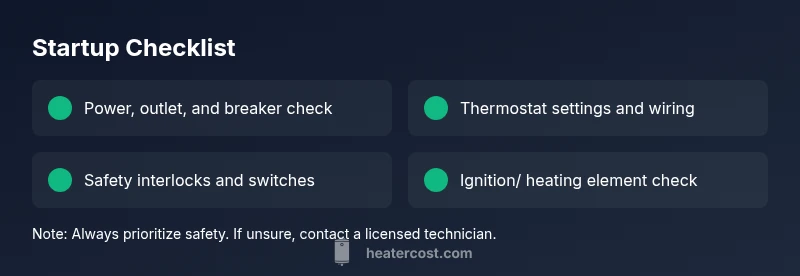
Before diving deep into components, run through baseline checks to confirm safe operation and exclude obvious issues. Start with the power source: confirm the unit is receiving power at the outlet, check the power switch on the furnace or heater, and verify the wall outlet isn’t dead. Reset the circuit breaker if a nuisance trip occurred, and inspect any visible fuses or reset buttons. Then review the thermostat: ensure the thermostat is set to heat, the setpoint is above room temperature, and the wiring terminating at the thermostat looks intact. If the unit is gas-fired, make sure the gas valve is open and there’s no pilot-light obstruction. If you don’t observe any life after these checks, move on to deeper diagnostics.
As you perform checks, keep notes of what you observe. Documentation helps when you escalate to a technician and supports a cost-effective repair plan.
Diagnosing electrical and control issues
Electrical issues are the most common and easiest to verify. Check for a blown fuse or a tripped breaker dedicated to the heating system. If the breaker is fine, inspect the furnace's control board for obvious signs of damage or burnt components. Loose or corroded wiring at the terminal blocks can prevent power from reaching the thermostat or ignition sequence. For models with a separate blower or inducer, ensure there are no obstructions and that safety switches (like high-limit switches) are engaged correctly. If the thermostat wires are loose, reseat them and test the system. If you have a digital or smart thermostat, re-pairing or reconfiguring the device can restore some functionality. Based on Heater Cost research, many startups fail due to simple wiring or misconfiguration rather than major component failures.
Gas vs electric vs oil heaters: common failure points
Different heater types have distinct failure modes. Electric heaters typically fail at the power supply, ceramic elements, or internal fuses; inspect the cord, plug, and internal fuses. Gas furnaces may fail to ignite due to a dirty igniter, clogged burners, or malfunctioning gas valve; you’ll often notice a delay or no ignition when attempting startup. Oil-fired units can have issues with fuel supply, pump operation, or air locking in lines. Safety interlocks and condensate switches are common across types and can prevent startup if triggered. For any gas-related issue, prioritize safety and consider professional service to diagnose ignition and venting correctly.
Safety, maintenance, and when to replace
Regular maintenance is the best defense against startup failures. Schedule annual inspections, replace air filters, and clean burners or igniters as recommended by your manufacturer's manual. If the system is older than 15–20 years, or if startup issues recur after servicing, assess the cost of repair versus replacement. Heater Cost suggests comparing the cost of a repair against the long-term energy costs and potential efficiency improvements of a newer unit. A professional can provide an accurate assessment and help you decide whether to repair or replace.
Documenting findings for a technician and next steps
When you’re ready to call a professional, prepare a concise report that documents the issue, observed symptoms, and any steps you’ve already tried. Include details such as breaker status, thermostat settings, ignition attempts, and any fault codes or LED indicators. Taking photos of wiring at the furnace, the thermostat wiring, and any exposed components can speed up diagnosis. This information helps the service technician determine whether you should pursue a repair or a full replacement. Remember to prioritize safety and never bypass safety interlocks or electrical barriers.
Steps
Estimated time: 30-60 minutes
- 1
Verify power to the unit
Ensure the heater is receiving power by testing the outlet with a known-working device. Check any disconnects or power switches on or near the unit. If the power source is fine, proceed to the next check without forcing the system.
Tip: Always start with the simplest power check to avoid unnecessary repairs. - 2
Check thermostat and setpoints
Confirm the thermostat is in the heat mode and set above room temperature. If you have a smart thermostat, verify connectivity and program settings. If the thermostat reads incorrectly, recalibrate or replace it.
Tip: A misconfigured thermostat is a common and inexpensive fix. - 3
Inspect circuit breakers and fuses
Look for a tripped breaker or blown fuse related to the heating system. Reset the breaker fully, and replace any blown fuses with the same type and rating. If the problem recurs, note which circuit trips and consult a pro.
Tip: Repeated trips may indicate a larger electrical issue requiring professional evaluation. - 4
Examine safety interlocks and switches
Check door panels (if applicable), condensate switches, and any access panels for proper seating and activation. Misplaced panels can trigger a safety shutoff. Correct any misalignment and test startup again.
Tip: Never bypass safety switches — they protect you and your home. - 5
Assess ignition and heating elements
For gas systems, inspect the igniter, spark module, and burners for cleanliness and alignment. For electric systems, test the heating elements and thermostatic switch with proper tools. Look for signs of wear, cracks, or scorching.
Tip: Gas ignition work should be performed by a licensed technician if you’re unsure. - 6
Decide on next steps
If none of the above fixes restore operation, contact a licensed HVAC technician for a professional evaluation. Prepare a summary of what you tried, along with any error codes, to speed up diagnosis.
Tip: Document costs and options to compare repair vs replacement value.
Diagnosis: Heater won't turn on
Possible Causes
- highPower supply issue or tripped circuit breaker
- mediumThermostat or control wiring fault
- highBlown fuse or failed safety switch
- mediumIgnition problem or control board failure (gas or electric)
Fixes
- easyCheck the wall outlet, power switch, and reset the circuit breaker; replace fuses if needed
- easyReseat thermostat wires and recalibrate or replace the thermostat if faulty
- mediumInspect safety interlocks and limit switches; correct misalignments or faulty parts
- hardFor gas units, check ignition components; for electric units, inspect heating elements and control boards
Got Questions?
Why won’t my heater turn on even though the thermostat is set?
Thermostat problems are common culprits. Recheck settings, recalibrate if possible, and test with a known-good thermostat. If there’s still no startup, wiring or control-board faults may be involved, requiring professional diagnosis.
Thermostat problems are a common cause. Check settings and recalibrate if possible; if it still won’t start, you may have wiring or control-board issues that need a professional look.
Can a tripped breaker stop a heater from turning on?
Yes. A tripped breaker cuts power to the furnace. Reset the breaker fully and test. If it trips again, there’s likely an electrical fault that requires inspection by a licensed electrician or HVAC technician.
Yes. A tripped breaker can stop startup. Reset it, and if it keeps tripping, call a pro.
Is a dirty igniter a safety risk?
A dirty igniter can fail to light, but it’s generally not a safety hazard if you avoid DIY gas work. Have a tech clean or replace the igniter and inspect the gas valve and burners for proper operation.
A dirty igniter can fail to light. Have a tech clean or replace it and check gas components for safe operation.
When should I replace vs repair my heater?
If startup problems persist after servicing, compare repair costs to the price and efficiency of a new unit. Older systems may be more cost-effective to replace, especially with newer, energy-efficient models.
If issues persist after service, compare repair costs with buying a newer, energy-efficient unit to decide.
What maintenance prevents startup problems?
Regular annual maintenance, filter changes, and cleaning of burners or igniters reduce startup failures. Scheduling professional checkups can catch problems early and protect your investment.
Regular maintenance and clean burners help prevent startup problems and protect your investment.
Do I need a professional for every startup issue?
Not every issue requires a pro. Start with basic power, thermostat, and breaker checks. If the problem involves gas ignition, electrical work beyond basics, or uncertain risk, hire a licensed HVAC technician.
Not every issue needs a pro. Start with basics, but hire a licensed tech for gas or risky electrical work.
Watch Video
The Essentials
- Check power and breakers first.
- Thermostat settings often cause startup issues.
- Document findings for a technician and cost decision.
- Call a pro for gas-related or electrical problems.