Heater Won't Kick On: Step-by-Step Troubleshooting
Learn practical steps to diagnose why your heater won’t kick on, including electrical, thermostat, safety interlocks, and airflow checks. Safe tips, when to call a pro, and maintenance to prevent future no-heat events.


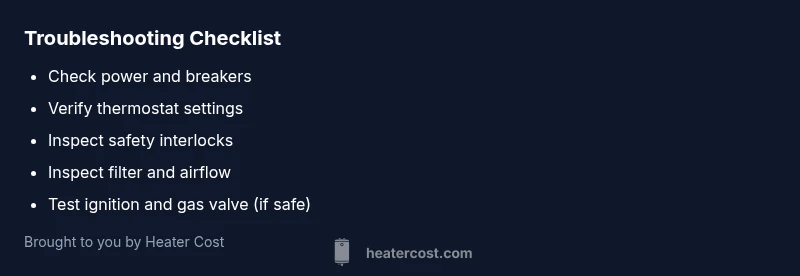
Most often, a heater won’t kick on due to a power issue, a faulty thermostat, or a safety interlock. Start by confirming power at the outlet and breaker, then verify thermostat settings and communication. If needed, inspect the safety switch and ignition or airflow components before calling a pro.
Why your heater won't kick on (and how to think about it)
If your heater won't kick on, you're not alone. According to Heater Cost, most failures start with simple, solvable causes rather than expensive parts. The root issues fall into power faults, thermostat problems, or safety interlocks that prevent ignition. Understanding the sequence helps you prioritize checks so you can restore heat quickly and safely. In this guide, we walk through common scenarios with practical steps you can take today, safely and methodically.
Safety-first electrical checks: power, breakers, and fuses
Before anything else, confirm the system is powered. A tripped breaker or blown fuse is the easiest fix and often the culprit when a heater won't kick on. Locate your main panel, reset any tripped breakers to the ON position, and test the outlet feeding the heater with a voltmeter or a simple lamp test. If the outlet works but the furnace still stays dark, move to the next check. Do not bypass breakers or use makeshift fuses; safety comes first.
Thermostat sanity check: settings, batteries, and communication
Thermostats control when heat fires, so even a small misconfiguration can prevent the unit from turning on. Verify the thermostat is set to heat, the target temperature is above room temp, and the mode is not in emergency or fan-only. If the thermostat runs on batteries, replace them with fresh AA or AAA cells. For smart thermostats, ensure Wi‑Fi connectivity and app control are functioning; a misunderstood schedule can mimic a dead heater.
Safety interlocks and access panels: interlocks do their job
Many furnaces and heat pumps have safety switches that disable operation if the panel is open or a blower door is mis-seated. Check that the access panel is firmly closed and the interlock engages when secured. If the system was serviced recently, verify the wiring to the interlock has not been disturbed. A loose or misaligned switch is a common reason your heater won’t kick on.
Airflow and filtration: why clogged filters stop heat
A dirty filter or restricted airflow can cause your furnace to shut down as a safety precaution. Inspect and replace disposable filters or clean reusable ones according to manufacturer instructions. Check supply vents and registers to ensure they are open and unobstructed. Good airflow reduces strain and helps your system reach target temperatures more reliably.
Fuel supply and ignition checks (gas or oil only)
Gas furnaces require an uninterrupted fuel supply and a reliable ignition source. If you hear a click but no flame, the issue may be gas valve control, ignition rod alignment, or a blocked burner. For oil-based systems, check for clean nozzles and proper pump operation. Do not attempt to troubleshoot gas ignition beyond basic inspection; if you smell gas or aren’t sure, stop and call a professional immediately.
Reset, retry, and re-test: safe operating procedure
After performing the above checks, reset the furnace control board or thermostat according to the manual. Wait a few minutes, then re-test by turning heat on and observing the sequence. Listen for the ignition sequence or blower run. If you still can’t get heat, note any error codes on the furnace display to guide the next steps.
When to call a professional and what to expect
If basic checks don’t restore heat, or you encounter signs of a gas leak, carbon monoxide, or dangerous wiring, contact a licensed HVAC technician. A pro can safely diagnose issues like faulty ignition, gas valve problems, or electrical faults. Homeowners can prepare by listing symptoms, recent service, and any error codes; this helps the technician diagnose faster. Regular maintenance minimizes future no-heat events.
Preventive maintenance to minimize future no-heat events
Establish a simple maintenance routine: replace filters on schedule, keep vents clear, and schedule annual furnace inspections. Clean outdoor units and check for unusual noises or vibrations seasonally. Proactive care reduces breakdown risk and extends system life, saving time and money when cold weather returns.
Steps
Estimated time: 30-60 minutes
- 1
Verify power and breakers
Locate the furnace panel and confirm the main power switch is ON. Check the home’s breaker panel for any tripped breakers feeding the furnace circuit, then reset them to restore power. If the outlet powering the unit feels dead, test another device to confirm the circuit status before proceeding.
Tip: Flip the breaker OFF, then ON to reset; avoid reusing a tripped breaker without diagnosing the cause. - 2
Test thermostat settings and batteries
Set the thermostat to HEAT and ensure the setpoint is above room temperature. If your thermostat uses batteries, replace them with fresh ones. For smart devices, confirm app control and Wi‑Fi status to rule out communication faults.
Tip: Consider temporarily bypassing schedules to check immediate response. - 3
Inspect safety interlocks and access panel
Make sure the furnace access panel is fully closed and the interlock switch engages. A loose panel or mis-seated door can keep the system from starting. If serviced recently, recheck wiring around the interlock.
Tip: Never bypass interlocks; they protect you from hazards. - 4
Check air filter and airflow
Examine the air filter; replace if dirty or clogged. Verify supply vents and registers are open and unobstructed. Poor airflow can trigger safety protections that prevent ignition.
Tip: Use the correct filter type and size as specified by the manufacturer. - 5
Review fuel/ignition for gas/oil systems
For gas furnaces, ensure the gas valve is open and listen for ignition attempts. For oil systems, inspect nozzle cleanliness and pump operation. If you detect gas odor, evacuate and contact emergency services immediately.
Tip: Do not attempt to light or test gas if you smell fuel. - 6
Reset and re-test the system
Power down the furnace for a few minutes, then power back up and set to heat. Observe the ignition sequence and listen for blower activity. If an error code appears, note it for reference when seeking help.
Tip: Document error codes and symptoms before calling support. - 7
Decide on professional help
If basic fixes fail or you notice gas smells, electrical hazards, or unusual noises, contact a licensed HVAC technician. Provide symptom details, recent service notes, and any codes observed.
Tip: Safety first: never attempt risky repairs on gas equipment. - 8
Prevent future no-heat events
Schedule annual tune-ups, replace filters on schedule, and keep vents clear. A proactive plan reduces the likelihood of a no-heat outage during cold months.
Tip: Set calendar reminders for maintenance on a regular cycle.
Diagnosis: Heater won't kick on
Possible Causes
- highPower issue (tripped breaker, blown fuse, faulty outlet)
- mediumThermostat fault or miscommunication
- highSafety interlock or access panel not engaged
- lowFuel/ignition problem (gas valve or ignition failure)
- lowAirflow restriction or dirty filter
Fixes
- easyCheck main power switch and reset tripped breakers; test outlet with a simple device
- easyTest thermostat for proper settings and battery health; reconnect wires if needed
- easyVerify panel interlock engages when panel is closed; reseat if loose
- mediumInspect gas valve, ignition components, and burner cleanliness for gas systems; call pro if unsure
- easyReplace or clean the air filter; ensure all supply vents are open
Got Questions?
Why won't my thermostat turn my heater on after a power outage?
Power outages can trip breakers or reset thermostat settings. After a outage, reset the breakers and reconfigure the thermostat to heat. If it still won’t start, proceed with electrical and safety checks described above.
Power outages can trip breakers and reset thermostats; reset both and recheck the settings. If it still won’t start, follow the step-by-step checks outlined here.
Can a dirty filter cause the heater not to kick on?
Yes. A clogged filter can trigger safety features that prevent the furnace from igniting. Replace or clean the filter and ensure airflow is unobstructed before retesting.
A dirty filter can trigger safety shutoffs. Replace it and check airflow, then try starting again.
Is it safe to reset a furnace thermostat by removing the battery?
For many thermostats, removing and reseating batteries is harmless, but avoid this if your model requires a specific reset procedure. Refer to the manual and perform a standard power cycle if uncertain.
You can reset some thermostats by removing batteries, but follow the manual. A general power cycle can also help.
When should I call a professional if the heater won't start?
Call a professional if you detect gas smells, hear abnormal noises, or cannot safely troubleshoot electrical components. A licensed HVAC technician will diagnose ignition, gas valve, and wiring issues.
If you smell gas, hear strange noises, or aren’t sure about the wiring, call a pro.
What should I do if I smell gas near the furnace?
Leave the area immediately and call emergency services. Do not operate switches or the furnace, and avoid creating sparks until professionals assess the situation.
If you smell gas, leave the area and call emergency services right away.
Watch Video
The Essentials
- Check power first; many no-heat issues are electrical.
- Thermostat problems are a common culprit; verify settings and connectivity.
- Safety interlocks protect you—don’t bypass them.
- Call a pro for gas, electrical hazards, or unclear ignition issues.