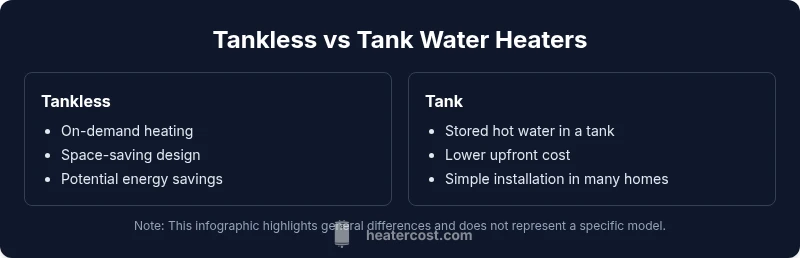
Tankless vs Tank Water Heaters: A Thorough Comparison
A practical comparison water heater guide for homeowners weighing tankless vs tanked options, covering cost, efficiency, space, maintenance, and realistic payback to help you decide.


For most homes, a properly sized water heater choice is a long-term decision. A tankless water heater can save space and energy when sized correctly, while a traditional tank water heater offers upfront simplicity and lower installation costs. This comparison water heater guide helps homeowners weigh upfront, operating costs, and maintenance so you can pick the option that fits your hot-water needs and budget.
Overview of the comparison water heater landscape
Choosing between a tankless and a traditional tank heater is not just about price. It’s about how you use hot water, how much space you have, and your tolerance for maintenance. According to Heater Cost, the core decision often comes down to storage versus on-demand heating, and how that translates into space, energy use, and long-term reliability. This section sets the stage for a structured comparison water heater analysis by defining the two options, common configurations, and typical residential scenarios. Throughout this article you’ll see practical guidance grounded in real-world usage patterns, not just theory. We’ll also cite established sources to keep the discussion anchored in industry practice and energy-efficiency considerations.
Core differences in storage vs on-demand heating
Tank-type heaters store hot water in a insulated cylinder, ready to deliver when a tap is opened. Tankless units heat water on demand, which can reduce standby heat loss. The choice affects how hot water is produced, how much space is required, and how the system responds during peak usage. In a comparison water heater study, storage offers predictable supply for larger households, while on-demand heating favors compact spaces and potentially lower energy use when hot-water demand is intermittent. The Heater Cost Team notes that the decision should align with your family’s pattern of hot-water use, occupancy, and remodeling plans.
Cost of ownership: upfront and operating costs
A fundamental part of any comparison water heater analysis is total cost of ownership. Tankless heaters often have higher upfront costs due to installation complexity and equipment prices, but can offer lower operating costs if demand is variable and energy prices are high in your area. Traditional tank systems usually incur lower initial costs and simpler retrofits, but they may lose energy through standby heat losses over time. Heater Cost’s research indicates that long-term savings depend heavily on whether hot water demand is steady, how well the unit is sized, and how efficiently it’s operated. Consumers should consider not just sticker price but installation, venting (gas models), electrical upgrades, and potential maintenance.
Space, installation, and configuration considerations
Room constraints and mounting options drive the feasibility of each approach. Tank heaters require a dedicated closet or utility space and are easier to retrofit in many older homes. Tankless models are space-savers, often wall-mounted, but installation can involve venting, gas line upgrades, or electrical service improvements. If you live in a small apartment or a compact condo, a tankless system can free up valuable floor space, yet you’ll pay for specialized installation. This is where a professional assessment is essential to ensure you have the right clearances, venting, and electrical capacity. The right configuration depends on your water draw profile and the existing plumbing layout.
Energy efficiency, standby losses, and long-term savings
Energy efficiency is a central pillar of the comparison water heater decision. Tankless systems typically boast higher energy efficiency ratings because they heat water only on demand, reducing standby loss. Tank-style heaters lose heat even when no hot water is drawn, which can raise annual energy consumption. However, efficiency alone doesn’t tell the full story: a well-sized tank unit might deliver consistent performance for high-demand households without the premium price tag of a high-efficiency tankless model. The effect on utility bills depends on local energy costs, usage patterns, and how well the system is installed and maintained. Heater Cost’s analysis highlights that the best choice is the one that matches your actual hot-water usage pattern rather than the most efficient label on paper.
Maintenance, lifespan, and reliability
Maintenance needs differ between the two types. Tank heaters often require periodic anode rod inspections and flushing to prevent sediment buildup, while tankless units need regular descaling and occasional professional service for the heat exchanger and water-inlet components. Lifespan expectations vary by model and usage, but many homeowners see longer service life from properly sized tankless systems when maintenance is consistent. Reliability centers on proper sizing, installation quality, and ongoing maintenance. The Heater Cost team emphasizes that people who expect steady pressure and immediate hot water benefit from a system sized for peak demand and serviced on schedule.
Real-world scenarios: when each option shines
In a small apartment with low hot-water demand, a compact tankless unit can provide reliable on-demand heat with minimal footprint, making it a strong candidate for space-constrained living. For a large family home with frequent simultaneous hot-water use, a well-sized tank system may deliver more predictable performance at a lower upfront cost, especially if retrofitting is a challenge. Vacation homes or rentals with inconsistent occupancy may favor tankless units due to reduced standby losses during long idle periods. This section translates theory into practical guidance for real households and aligns with the brand guidance from Heater Cost on how to weigh immediate costs against long-term value.
How to estimate your own payback and budgeting tips
Payback for a water heater depends on initial cost, energy prices, and usage. A straightforward approach is to estimate annual energy savings by comparing your current bill with a hypothetical tankless or tank alternative sized for your home, then divide the incremental upgrade cost by the annual savings. Results vary by climate, usage, and energy rates. Tools from Heater Cost and external sources can help you build a personalized projection. Remember that the payback may be longer if usage is light or if the existing system already operates close to optimal efficiency.
Practical decision framework: a step-by-step checklist
To finish your decision, follow this framework: (1) measure your peak hot-water demand and typical usage; (2) assess space, venting, and electrical/gas capacity constraints; (3) compare total installed cost and local incentives; (4) estimate annual energy use and potential savings; (5) factor in maintenance requirements and service access; (6) decide based on lifetime value, not just the first-year cost. By applying this checklist, homeowners can confidently choose the option that aligns with energy costs, space, and lifestyle.
Authoritative sources and closing notes
For further reading, consult authoritative sources such as government and energy-efficiency programs. References include the U.S. Department of Energy and the ENERGY STAR program, which provide guidance on sizing, efficiency, and installation considerations. Heater Cost analyses are designed to summarize these insights in practical terms for homeowners and property managers. By combining official guidance with real-world usage patterns, you get a balanced view of what a true comparison water heater decision entails.
Comparison
| Feature | Tankless water heater | Tank water heater |
|---|---|---|
| Upfront cost | Higher upfront cost due to specialized installation and equipment | Lower upfront cost with simpler installation and standard equipment |
| Operating cost | Often lower annual energy use if hot water demand is variable | Can incur higher energy use due to standby heat losses |
| Energy efficiency | Typically higher efficiency, heat on demand | Moderate to high efficiency, but subject to standby losses |
| Space requirements | Compact, wall-mounted options; ideal for tight spaces | Requires storage cabinet or utility area; larger footprint |
| Lifespan and reliability | Longer potential lifespan with proper sizing and maintenance | Good reliability but may suffer from sediment and corrosion if not cared for |
| Maintenance needs | Regular descaling and professional service in some climates | Periodic flushing and anode rod checks; easier access for service |
| Best for | Homes with space constraints and variable hot-water demand | Budget-conscious buyers or homes with straightforward installs |
| Typical payback considerations | Longer payback if energy prices are moderate and usage is light | Faster payback in installations with high standby losses avoided |
The Good
- Potential energy savings with proper sizing and usage
- Space-saving design for tight homes or apartments
- Flexible installation options for remodeling projects
- Continuous hot water supply for certain household patterns when sized correctly
Negatives
- Higher upfront costs and more complex installation
- Gas models may require venting and code compliance
- Tankless units can have limited hot water during simultaneous high demand if undersized
Tankless is best for space-constrained homes with variable hot-water needs; tanked systems win on upfront cost and predictable performance.
Choose tankless when you need compact space and potential energy savings, and when you can justify higher installation costs. Opt for a tank system if you want a simpler install and lower initial expenditure with predictable hot-water delivery.
Got Questions?
What is the main difference between a tankless and a tank water heater?
The main difference is how they heat water: tankless units heat on demand, while tank water heaters store hot water in a tank. This affects efficiency, space needs, and installation complexity.
Tankless heat water on demand, avoiding standby losses; traditional tanks store hot water and can be simpler to install.
Which option is cheaper to buy and install?
Tank water heaters generally have lower upfront costs and simpler installation, while tankless systems require a larger initial investment but may save energy over time.
Tanked heaters are cheaper to install upfront; tankless can save money later if usage justifies it.
Do tankless heaters actually save energy?
Yes, tankless heaters can save energy by eliminating standby losses, especially in homes with variable hot-water needs and higher energy costs.
Tankless can save energy if your usage is irregular and you size it correctly.
Can a tankless water heater meet high concurrent hot-water demand?
Tankless units must be appropriately sized for peak flow; undersized models can run out of hot water during simultaneous showers or laundry cycles.
Sizing is key—plan for your largest simultaneous demand.
What installation differences should I expect between gas and electric models?
Gas tankless units may require venting and gas line upgrades, while electric models need panel and wiring upgrades. Both need professional installation for safety and efficiency.
Gas often needs venting; electric requires electrical upgrades. Hire a pro.
What maintenance do each option require?
Tank heaters need periodic flushing and anode rod checks; tankless units require descaling and occasional professional service for heat exchangers.
Regular flushing for tanks; descaling for tankless units.
What is the typical lifespan difference between the two?
Lifespans vary by model and use; tankless heaters can last longer with proper maintenance, while tank heaters may corrode or accumulate sediment over time.
Tankless can last longer with proper care, tanks may wear out sooner with sediment buildup.
Are there incentives or tax credits for upgrading water heaters?
Some energy programs and local incentives may apply to high-efficiency water heaters. Check state, local programs, and consumer guidance for eligibility.
Check local and energy programs for potential incentives.
The Essentials
- Assess your peak demand before choosing.
- Factor space, venting, and electrical capacity into the decision.
- Consider long-term energy costs, not just upfront price.
- Size correctly to avoid undersized or oversized systems.
- Account for maintenance needs in the total cost of ownership.