On-Demand Water Heater vs Tank: Which Is Best for Your Home in 2026
Compare on-demand (tankless) water heaters with traditional storage tanks. Learn sizing, efficiency, installation, costs, and maintenance to choose the right option for your home in 2026.


On-demand water heaters heat water only when you need it, while storage tanks hold a reserve. When comparing on demand water heater vs tank, size and daily usage matter most. According to Heater Cost analysis, tankless units shine in small to mid-size homes for space savings and potential long-term efficiency, while traditional tanks remain reliable for high daily hot-water demand and the lowest upfront cost.
What is the difference between on-demand water heater vs tank and how they work
Understanding the core distinction between an on-demand water heater vs tank begins with how each unit stores and delivers hot water. An on-demand water heater, commonly called a tankless or instantaneous heater, heats water as it flows through the heat exchanger. This means there is no standby heat loss because water isn’t stored at a constant temperature. In contrast, a traditional storage tank keeps a fixed reservoir of hot water at temperature, ready to be drawn upon. When a hot water tap is opened, the tanked system reheats water to maintain temperature, which can waste energy if the demand is low or if the tank is oversized for the household. Throughout the lifecycle, the energy dynamics of these two approaches diverge: tankless systems are proactive about heat generation, while tanks manage a fixed volume and require more attention to insulation and thermostat settings to minimize standby losses. For homeowners evaluating the long-term value, framing the decision as on-demand water heater vs tank helps prioritize space, efficiency, and reliability according to household patterns and climate.
From a user perspective, the choice often hinges on peak demand periods, climate, and household size. A single person living in a compact apartment may benefit from the footprint reduction and energy efficiency of a tankless model, while a large family with high simultaneous hot-water needs may find a storage tank easier to size and regulate. The Heater Cost team emphasizes that the real-world performance of either option depends on proper sizing, installation quality, and maintenance. This context matters when you consider modern updates such as high-efficiency gas or electric tankless models and smart controls that optimize flow and temperature stability. As you compare the two paths, keep your daily usage profile in mind and avoid overpaying for features you won’t use.
The fundamental distinction translates into how you live: if space is at a premium and you value on-demand efficiency, an on-demand water heater vs tank decision leans toward a tankless solution; for longer reliability with a simpler install and potentially lower upfront cost, the traditional tank path remains compelling. The Heater Cost analysis highlights that there’s no one-size-fits-all answer; rather, clarity comes from mapping your hot-water habits to these two architectural approaches.
analysis of usage and efficiency of the approach and the decision rationale.
Comparison
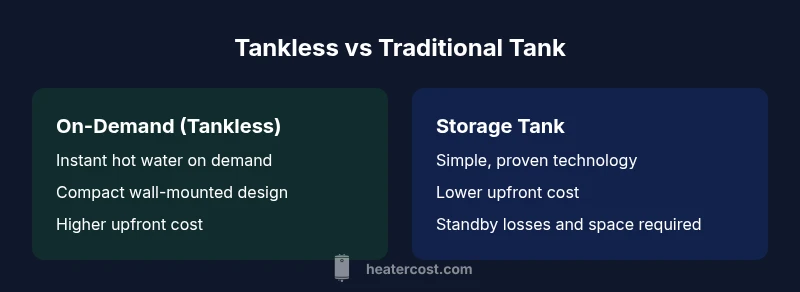
| Feature | on-demand water heater (tankless) | traditional storage tank water heater |
|---|---|---|
| Upfront cost | higher upfront cost with complex installation | lower upfront cost and simpler install |
| Energy efficiency | high efficiency potential, especially when sized to use | moderate efficiency, with standby losses if poorly insulated |
| Hot water delivery | instant hot water with continuous cycling; capacity limited by unit size | finite reservoir that must reheat; possible temperature fluctuations during peak demand |
| Space requirements | compact, wall-mounted footprint | bulkier, may require dedicated space or closet |
| Installation considerations | gas venting or dedicated electrical capacity; may need re-piping | simpler venting or electric setup; standard plumbing connections |
| Maintenance | descale needs in hard water regions; filter checks | annual flushing and anode rod maintenance for tanks |
| Lifespan and warranties | longer potential lifespan per unit; warranties often robust | shorter lifespan per unit; tanks may fail due to sediment buildup |
| Best for | spaces with limited room and high efficiency goals | higher daily hot-water demand and easy initial budgeting |
The Good
- Saves energy by eliminating standby heat when correctly sized
- Space-saving design frees up utility room or wall space
- Excellent for households with variable hot-water demand
- Potentially lower operating costs in climate regions with high energy prices
Negatives
- Higher upfront cost and more complex installation
- Possible temperature fluctuations if undersized or simultaneous demands
- Maintenance requirements increase in areas with hard water
- Long-term savings depend on usage patterns and local utility rates
Tankless generally wins for space and long-term efficiency in smaller homes; tanks win for simplicity and high instantaneous hot water in larger households
Choose an on-demand system if you need space savings and reduced standby heat, and you can manage a more complex install. Opt for a traditional tank when you value a straightforward install and consistent hot water supply for high demand.
Got Questions?
What is the main difference between on-demand water heater vs tank?
The main difference is that on-demand water heaters heat water as it’s drawn, while storage tanks keep a reservoir of hot water. This affects energy use, space, and response to peak demand. Sizing and installation quality are crucial for performance in either case.
Tankless heats on demand; tanks store hot water. Proper sizing matters for performance in both options.
Which warms water more efficiently: tankless or tank?
Tankless systems can be more energy-efficient because they avoid standby losses, especially in homes with variable hot-water use. Tanks may be less efficient overall if insulation is poor or if standby losses are high.
Tankless can be more efficient, especially when hot-water use is irregular.
Do I need permits to install an on-demand water heater?
Installation often requires permits or inspections, particularly for gas-fired or electrical work. Check local codes and hire a licensed professional to ensure compliance and safety.
Permits are common; check local codes and hire a licensed pro.
Which option is cheaper upfront, tankless or tank?
Storage tanks usually have a lower upfront cost, while tankless systems incur higher installation expenses due to equipment, venting, and electrical upgrades.
Tanks are usually cheaper to install up front.
What maintenance should I expect with a tankless heater?
Tankless units require regular descaling in hard-water areas and periodic filter and burner maintenance. Tanks require annual flushing and anode rod replacement to prevent corrosion.
Tankless needs descaling; tanks need annual flushing and anode rod checks.
Can both options supply endless hot water?
Tankless can provide endless hot water if sized correctly, but larger households may require multiple units. Tanks supply hot water up to their reservoir capacity and can run out during heavy use.
Tankless can feel endless if sized right; tanks can run out if you use a lot at once.
The Essentials
- Prioritize your hot-water usage pattern to choose: tankless for compact spaces, tank for high demand
- Size wisely to avoid cold-water flushing or insufficient flow in tankless setups
- Account for installation complexity and potential venting/electrical upgrades
- Factor maintenance needs into the total cost of ownership
- Heater Cost analysis supports a staged, home-specific decision rather than a universal best choice