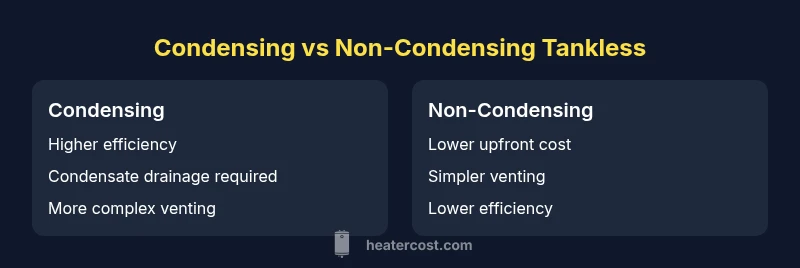
Condensing vs Non Condensing Tankless Water Heaters: Which Is Right for Your Home?
A detailed, data-driven comparison of condensing vs non condensing tankless water heaters, covering efficiency, venting, costs, maintenance, and installation to help homeowners decide which system fits their home and budget.


Condensing tankless water heaters generally deliver higher efficiency and lower operating costs than non-condensing models, thanks to a secondary heat exchanger. They also require more complex venting and condensate handling. See the full comparison to decide which fits your home.
What condensing vs non condensing means for tankless water heaters
Condensing vs non condensing tankless water heaters represent two families within gas-fired, on-demand units. Condensing models capture and reuse heat from exhaust gases via a second heat exchanger, which improves overall efficiency. Non-condensing models vent exhaust directly and do not reclaim latent heat. In practical terms, condensing units tend to use less fuel for the same hot water output, especially in households with consistent hot water demand. This section will unpack how the two approaches affect performance, energy use, and installation considerations. For homeowners evaluating costs and comfort, it’s essential to understand that both types can supply endless hot water, but their operating economics and venting requirements differ. Throughout this guide from Heater Cost, we will emphasize real-world factors like installation compatibility, maintenance, and long-term value. The goal is to help you decide which approach best fits your home’s heating strategy and budget.
How condensing technology works in gas tankless units
Condensing technology in gas tankless water heaters relies on a secondary heat exchanger to extract additional heat from the exhaust stream. This recovered heat lowers fuel consumption and increases overall efficiency. The process also produces condensate, a liquid byproduct tied to the cooling of exhaust gases, which must be safely drained. Modern condensing units often use corrosion-resistant materials to handle condensate and are designed to work with venting paths that capture exhaust gases efficiently. Understanding this mechanism helps homeowners appreciate why condensing models can offer meaningful energy savings, especially in homes with consistently high hot water demands. The Heater Cost team highlights that choosing the right venting approach and condensate management is crucial to realizing those savings.
Efficiency and AFUE differences (qualitative)
Efficiency remains the most debated topic when comparing condensing and non-condensing tankless heaters. Condensing units typically achieve higher efficiency ratings due to heat recovery and better heat exchanger design, translating to lower fuel usage over time. Non-condensing models, while capable and reliable, generally operate at a lower end of the efficiency spectrum. The practical impact depends on your water usage patterns, climate, and fuel costs. In real-world terms, higher efficiency often means better long-term value, particularly for households with frequent hot water needs and longer appliances duty cycles. In our assessments, the efficiency gap is most meaningful when you compare lifetime costs rather than upfront price.
Venting, condensate drainage, and installation considerations
Venting is a critical differentiator between condensing and non-condensing tankless heaters. Condensing units require a condensate drain to remove liquid byproducts, and they may benefit from more robust venting materials to withstand acidic condensate over time. Non-condensing models generally have simpler venting requirements but still need proper venting to vent gases safely. Installation implications include potential changes to vent routing, condensate piping, and possibly upgrading vent materials. For retrofits, consider existing venting constraints and whether the home can accommodate condensate drainage and corrosion-resistant materials without compromising safety or warranty. Planning with a qualified installer is essential to avoid common pitfalls.
Reliability, maintenance, and service life
Condensing tankless heaters often demand attention to condensate management components such as traps and neutralizers, which may require periodic inspection and cleaning. However, modern condensate systems are designed for durability and long service life when properly maintained. Non-condensing models tend to have fewer condensate-related components, potentially reducing routine maintenance tasks. Both types benefit from regular professional tune-ups, descaling if you have hard water, and prompt repair of gas or electrical connections. Overall reliability hinges on quality installation, routine maintenance, and the availability of service in your area.
Cost considerations: upfront vs long-term savings
Upfront costs for condensing tankless heaters are typically higher due to more complex venting and condensate systems. Yet, long-term operating costs can be lower because of energy savings from higher efficiency. Non-condensing models usually come with lower initial price but may incur higher fuel costs over time. When evaluating value, balance your local fuel prices, typical hot water usage, and how long you plan to stay in the home. In many cases, the payback period for condensing units is reasonable for households with steady hot water demand and a well-designed venting plan.
Sizing, installation compatibility with existing venting, and retrofit challenges
Sizing a condensing vs non-condensing tankless heater requires accounting for peak hot water demand and the venting layout. Condensing units may demand larger or differently configured vent paths and condensate drainage routes. If your current setup cannot accommodate a condensate drain or requires material upgrades for corrosion resistance, installation complexity and cost rise. An experienced technician can perform a through-the-wall vent assessment and recommend whether a retrofit is feasible or if a full replacement with compatible venting is warranted.
Performance under different usage patterns and climates
In colder climates or high-demand households, condensing tankless heaters can provide more consistent output thanks to heat recovery and higher efficiency. In milder climates with low hot water usage, non-condensing models may meet daily needs at a lower upfront cost. Consider your peak usage hours, family size, and whether you need simultaneous hot water for multiple outlets. The choice may hinge on whether you value uninterrupted performance now or long-term energy savings.
How to evaluate your home needs and pick between condensing vs non condensing
Start with your hot water demand profile: how many bathrooms, simultaneous uses, and peak usage times. Assess venting feasibility: is there existing condensate drainage and corrosion-resistant venting, or would upgrades be required? Compare total cost of ownership, including installation, maintenance, and fuel costs over a typical replacement cycle. Use a simple decision worksheet: if you prioritize efficiency and have venting ready, condensing is attractive; if upfront costs and retrofitting are concerns, non-condensing may be a practical choice.
Common myths and misunderstandings
Myth: Condensing units always cost less over time. Truth: Savings depend on usage and installation costs. Myth: Condensing requires expensive venting upgrades in every home. Truth: Some homes can utilize existing vent paths with minimal upgrades. Myth: Non-condensing means poor performance. Truth: Non-condensing models can meet many households’ needs with appropriate sizing and usage.
Maintenance checklist for condensing tankless heaters
Check condensate drain and traps for clogs, inspect venting for corrosion, schedule annual descaling if you have hard water, and verify gas pressure and electrical connections. Use manufacturer-recommended replacement parts and schedule professional service at least once a year. Keeping a log helps track maintenance and warranties.
Quick-start guide: what to ask a contractor
Ask about venting options, condensate drainage readiness, required clearances, unit sizing for peak load, and compatibility with your fuel type. Request a written estimate detailing installation steps, warranty terms, and maintenance expectations. Ensure the contractor provides a plan for condensate handling and venting materials chosen.
Comparison
| Feature | condensing tankless | non-condensing tankless |
|---|---|---|
| Efficiency (qualitative) | high efficiency (condensing) | moderate efficiency (non-condensing) |
| Venting requirements | requires condensate drain; more complex venting | simpler venting with less condensate handling |
| Condensate management | integrated condensate drain and possible neutralizer | no condensate management needed |
| Install cost | higher upfront cost | lower upfront cost |
| Operating costs | lower operating costs over time | higher operating costs over time |
| Maintenance needs | condensate-related maintenance may be needed | fewer condensate-specific tasks |
| Warranty considerations | often premium components for condensate durability | standard components with fewer condensate parts |
| Best for | energy-conscious homes with proper venting | cost-conscious installs or retrofits |
The Good
- Higher energy efficiency and lower operating costs
- Better performance with modern venting systems
- Strong long-term value for homes with adequate venting and drainage
Negatives
- Higher upfront cost and installation complexity
- Requires condensate drainage and possibly more complex venting
- Retrofit challenges in older homes with limited vent space
Condensing tankless wins for most homes when venting and drainage are feasible
Condensing models offer superior efficiency and potential long-term savings, making them the preferred choice for energy-conscious buyers. If venting and condensate drainage can be accommodated without excessive cost, condensing tankless is typically the better long-term value; otherwise, non-condensing remains a viable, lower-cost option.
Got Questions?
What is the main difference between condensing and non-condensing tankless water heaters?
The main difference lies in heat recovery: condensing units use a second heat exchanger to reclaim heat from exhaust, boosting efficiency, while non-condensing units vent directly without heat recovery. This affects operating costs and venting requirements.
Condensing units reclaim heat from exhaust to improve efficiency, unlike non-condensing models which vent directly without heat recovery.
Are condensing tankless water heaters worth the extra upfront cost?
In many homes, yes—especially with steady hot-water demand and favorable fuel prices, since energy savings can offset the higher installation price over time.
They can pay back over time if you have steady hot water use and reasonable fuel costs.
Do condensing tankless heaters require special venting?
Yes. Condensing models typically need a condensate drain and corrosion-resistant venting. An installer can evaluate current venting and advise on upgrades if needed.
Yes, they usually need condensate drainage and upgraded venting in some cases.
Can you retrofit an existing system to a condensing tankless model?
Retrofits are possible but depend on venting layout, condensate drainage feasibility, and space. A professional assessment is essential to avoid costly surprises.
You can retrofit, but it depends on your venting and drainage setup.
What maintenance is required for condensing tankless units?
Regular inspections of condensate traps, descaling if water is hard, and periodic vent checks to prevent corrosion. Follow manufacturer guidelines for service intervals.
Keep an eye on condensate parts and schedule routine service.
Which is better for high-demand homes?
Condensing models are typically better for high-demand homes due to higher efficiency and greater heat recovery, provided venting and drainage are feasible.
Condensing units usually perform better for busy households if venting can be arranged.
The Essentials
- Assess venting capacity before choosing a model
- Condensing models offer higher efficiency but require condensate drainage
- Factor installation costs into long-term savings
- Non-condensing can be a practical choice for retrofits with venting constraints
- Choose based on hot-water needs and home retrofit feasibility