Hybrid Water Heater vs Tankless: An Objective Comparison
A data-driven guide comparing hybrid water heaters and tankless systems, focusing on energy efficiency, installation, lifecycle costs, and scenarios to help homeowners choose the right fit.


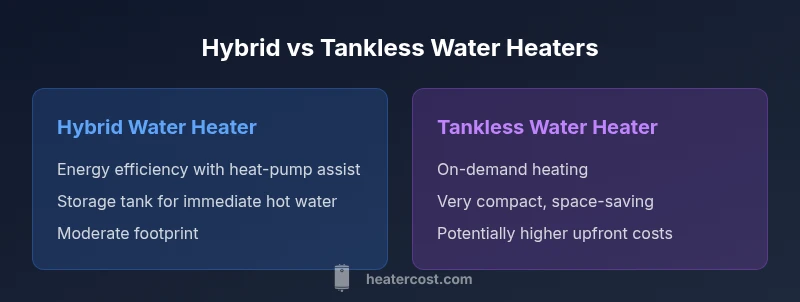
Hybrid water heaters blend a heat-pump assist with a storage tank for efficiency, while tankless units heat on demand for high flow. Upfront costs vary with model and installation, but hybrids often offer better energy savings for moderate use, while tankless shines in compact spaces and peak-demand scenarios. For most homes, hybrids provide a balanced profile; tankless suits space-constrained homes with high water needs.
What hybrid water heater is and how it works
A hybrid water heater, sometimes called a heat-pump hybrid, uses electricity to move heat from the surrounding air into a storage tank. The heat-pump component dramatically reduces electricity usage compared with traditional electric storage models. In practice, hybrids combine this heat-pump assist with a conventional tank to store hot water, making them well suited for households with steady, average hot-water demand. The technology is most effective in warmer climates or well-insulated homes where the heat pump operates efficiently. When evaluating a hybrid, consider climate, insulation, and your daily hot-water habits. Market guidance suggests that the hybrid’s performance hinges on proper sizing and installation, rather than simply selecting the most efficient unit. The Heater Cost team emphasizes that real-world results depend on the balance between tank size, heat-pump efficiency, and how you use hot water. This is why homeowners often see meaningful energy savings without sacrificing reliability when the system is correctly matched to demand.
bold note:
text2 for multiple?],
Comparison
| Feature | Hybrid Water Heater | Tankless Water Heater |
|---|---|---|
| Energy Efficiency / Operating Costs | Higher efficiency with heat-pump assist when sized for moderate demand | Typically high efficiency, but long-term operating costs depend on flow and fuel source |
| Upfront Cost | Moderate to high (tank plus heat-pump integration) | Moderate to high (unit cost plus potential installation adjustments) |
| Installation Complexity | Moderate (tank, venting, controls) | Potentially high (gas line, venting, permits; may require multiple units for very high demand) |
| Space Requirements | Requires storage footprint; footprint increases with tank size | Very compact footprint; wall-mounted options available |
| Hot Water Availability / Recovery | Steady supply with stored hot water; recovery depends on tank size | On-demand heating; flow rate limits if multiple fixtures draw simultaneously |
| Maintenance | Annual service; heat-pump maintenance as needed | Descale and venting checks; regular service |
| Lifespan / Warranty | Typically 12-15 years depending on model and use | Often 15+ years; warranties vary by manufacturer |
| Best For | Medium hot-water demand in climates favorable to heat pumps | High-demand or space-constrained homes; prioritizes instant hot water |
The Good
- Potential energy savings with proper sizing and climate
- Reliable hot water due to the storage tank in hybrids
- Compact tankless designs save space in small homes
- Flexible installation options for retrofits in many homes
Negatives
- Higher upfront costs depending on model and installation
- Tankless may require multiple units for very high demand
- Hybrid performance declines if not correctly sized for climate or usage
- Maintenance and venting considerations can add to long-term costs
Hybrid water heaters are generally the balanced choice for average homes; tankless excels for high demand and tight spaces.
If your household has moderate hot-water needs and you want energy savings with reliable storage, a hybrid is often the safer, cost-effective option. Choose tankless when floor space is at a premium or you anticipate very high peak flow, accepting potentially higher upfront costs and installation complexity.
Got Questions?
What is the main difference between a hybrid water heater and a tankless model?
The hybrid uses a heat-pump assisted storage tank for efficient, steady hot water, while tankless heats water on demand with no storage. The choice depends on your climate, space, and peak flow needs.
Hybrid uses a storage tank with a heat pump; tankless heats on demand. Consider your climate and space needs to decide.
Which is more energy-efficient for an average home?
In many cases, hybrids offer the best energy efficiency for households with moderate hot-water use, especially where the heat pump operates efficiently. Tankless units can be very efficient but may lose some efficiency at high flow or with more complex installations.
Hybrids usually save more energy for typical households; tankless efficiency depends on demand and system setup.
Can I retrofit my home to use hybrid or tankless water heaters?
Retrofits are common but require evaluating gas versus electric options, existing venting, and space for storage or wall-mounted units. A professional assessment helps ensure proper sizing and code compliance.
Yes, but a pro must assess venting, fuel type, and space to size correctly.
Does installation cost vary significantly between the two options?
Installation costs vary by home configuration. Tankless systems may require new venting or gas lines, while hybrids may need efficient heat-pump placement and electrical work. Both can incur costs for permits and professional sizing.
Costs depend on existing infrastructure; both can require professional sizing and permits.
Do hybrids require more maintenance than tankless?
Both systems require periodic maintenance. Hybrids need heat-pump and tank checks; tankless units require descaling and venting inspections. Following manufacturer guidelines extends lifespan.
Both need regular checks; hybrids focus on the pump and tank, tankless on descaling and venting.
How do I size for my home’s hot-water demand?
Start with peak-hour demand and a rough gallons-per-minute calculation. An installer can translate this into tank size for hybrids or flow rates for tankless units.
Size by peak demand and flow rates; an installer will tailor to your home.
The Essentials
- Assess hot-water demand before sizing.
- Consider climate impact on heat-pump efficiency.
- Hybrid for balanced energy savings and reliability.
- Tankless for space savings and high flow requirements.
- Consult a professional to size correctly and optimize installation.