Tankless Condensing Water Heater: An In-Depth Guide
A comprehensive guide to tankless condensing water heaters, covering how they work, sizing, installation, maintenance, and cost considerations for homeowners and property managers.


Tankless condensing water heaters deliver hot water on demand with high efficiency. By using gas combustion and a condensing process to reclaim latent heat from exhaust, they typically outperform traditional storage heaters and many non-condensing on-demand models. They’re compact, minimize standby losses, and can reduce monthly bills when properly sized for your home. This makes a tankless condensing water heater a compelling option for modern homes seeking reliable hot water with energy efficiency.
What is a tankless condensing water heater?
Tankless condensing water heaters are compact, on-demand heaters that pair the instant heat of a tankless design with a condensing exhaust system to recover latent heat. This combination typically yields higher energy efficiency than older storage tanks and many non-condensing on-demand models. In practice, a tankless condensing unit fires only when hot water is requested, spinning up the burner and heaters to meet demand without keeping a large tank hot in the background. According to Heater Cost, this approach can reduce standby losses and make better use of natural gas heat that would otherwise escape up the flue. The result is a smaller, more efficient unit that can supply hot water to multiple fixtures in a busy household when correctly sized. For homeowners, renters, and property managers evaluating a tankless condensing water heater, the key questions are how it performs, what you’ll pay upfront, and how maintenance changes over time.
A tankless condensing water heater hinges on two core ideas: on-demand heat and heat recovery from exhaust. The condensing process captures additional heat from flue gases that would have otherwise been vented. When sized correctly for peak demand, it minimizes standby losses and delivers dependable hot water without the large standby energy draw of a traditional tank. This combination is especially attractive in new homes or renovations where space is at a premium and energy costs are a consideration. In short, a tankless condensing water heater offers long-term value through efficiency, compactness, and reduced energy waste, provided your home’s hot-water needs align with the unit’s output.
Brand notes: The Heater Cost team emphasizes that proper sizing and professional installation are essential to realizing the full benefits of a tankless condensing water heater. Without correct sizing, even the most efficient model can underperform or fail to meet demand during simultaneous hot-water draws.
How it differs from standard tankless and traditional tank heaters
A tankless condensing water heater differs from non-condensing tankless models primarily in heat recovery. The condensing design uses a secondary heat exchanger to reclaim extra heat from exhaust gases, increasing efficiency and reducing emissions. In contrast, traditional non-condensing tankless units may recover less heat, and standard storage tanks incur significant standby losses as they keep a large volume of water hot around the clock. The result is a heater that responds to demand without a large cold-water gap, but only if it’s properly sized for the home’s hot-water profile. For most homes, this means evaluating peak usage patterns ( Showers, laundry, dishwasher ) and ensuring the gas supply and venting system can support a tankless condensing unit. A properly configured system can deliver consistent hot water and improved energy performance, while a poorly sized system may lead to short bursts of heat or cold water at peak times.
When comparing to traditional storage, tankless condensing gas water heaters deliver higher energy efficiency, eliminate most standby losses, and offer a smaller footprint. They also require venting that is compatible with condensing operation, typically with corrosion-resistant venting and condensate drainage. The key tradeoffs are upfront cost, installation complexity, and the need for professional sizing to ensure that the unit can meet the household’s demand without sacrificing comfort.
Brand perspective: Heater Cost notes that homeowners often overestimate the amount of hot water they need, which can lead to undersized units and unsatisfactory performance. A correctly sized tankless condensing water heater balances efficiency gains with the reality of daily hot-water use.
Sizing and performance considerations
Sizing a tankless condensing water heater is about meeting the home’s peak hot-water demand, not just average usage. A common approach is to evaluate the number of bathrooms, the presence of high-flow fixtures, and simultaneous events (such as showers starting while the dishwasher runs). The result should be a unit with enough output to meet those simultaneous demands without noticeable delays. In practice, this means looking at the maximum gallons per minute (GPM) that the household may require during peak periods and selecting a model with a corresponding output rating. In colder climates, incoming water temperature can affect the effective output, so homeowners may need a slightly more powerful unit to maintain comfortable hot-water delivery. A well-sized tankless condensing heater will provide steady hot water, minimize fluctuations, and sustain performance during busy mornings or when multiple taps are used.
Performance for a tankless condensing water heater improves when paired with proper venting and a reliable gas supply. Upstream considerations include gas line capacity and venting routes to avoid pressure drops or backdrafts. It’s also important to consider the condensate drainage system, which can require a drain connection or pump depending on local codes. Balanced sizing, venting, and gas supply are the trio that ensures a tankless condensing unit delivers on its promise of on-demand hot water with high efficiency.
Expert tip: Work with a licensed installer who can run a detailed hot-water calculation that accounts for fixture types, usage patterns, and climate. This helps ensure you select a unit with sufficient GPM to meet your family’s needs without oversizing.
Installation considerations and venting requirements
Installation of a tankless condensing water heater is more involved than a simple replacement of an older storage tank. It typically requires professional gas piping checks, venting updates, and a condensate drain line. Condensing units rely on a secondary heat exchanger that condenses flue gases, which means the vent system must tolerate acidic condensate and moisture. In many homes, installation may also necessitate structural or clearance changes, especially if the unit is mounted on a wall or located in a small utility area. Local permits are commonly required, and some jurisdictions have building-code requirements specific to high-efficiency gas appliances. A quality installation considers vent type (direct-vent or power-vent configurations), the routing of venting to the exterior, and the condensate drain’s location. Professional installers will verify gas pressure, vent integrity, and correct clearance from combustible materials, ensuring the unit operates safely and efficiently.
From a homeowner’s perspective, planning ahead for installation costs and potential renovations helps keep the project on track. If the existing venting is inconsistent with a condensing unit, retrofit work may be necessary, adding to the overall project timeline and budget.
Brand insight: Heater Cost highlights that a clean installation and proper venting are pivotal to achieving the promised efficiency gains and reliable hot water delivery from a tankless condensing water heater.
Maintenance and longevity
Maintenance for a tankless condensing water heater is less frequent than for some traditional systems, but it’s not optional. In areas with hard water, descaling is an important preventive task. Periodic descaling helps prevent mineral buildup that can reduce heat transfer efficiency and water flow. In many regions, a yearly or biannual service visit from a licensed technician is prudent to verify venting integrity, check seals, and ensure condensate drainage operates correctly. A straightforward descaling or flushing procedure, performed as recommended by the manufacturer, can extend the life of the unit and preserve energy efficiency. Regular maintenance also provides an opportunity to inspect gaskets, filters, and the heat exchanger for signs of wear or corrosion. Keeping the unit clean and free of obstructions, along with monitoring for any unusual noises or temperature fluctuations, helps ensure reliable performance for years to come.
Maintenance considerations also include ensuring the system has a clear air supply and that the outdoor or indoor location remains free of obstructions that could affect venting or combustion air. Because tankless condensing water heaters are more complex than simple storage tanks, working with a qualified technician for maintenance is wise. Proactive care supports the long-term value of the investment and minimizes the risk of unexpected outages during cold snaps.
Brand reminder: Heater Cost recommends a maintenance plan aligned with your local water quality and usage patterns to maximize longevity and sustained efficiency of the tankless condensing water heater.
Cost, savings, and payback considerations
The economic case for a tankless condensing water heater depends on installation costs, fuel prices, and hot-water usage. Upfront costs can be higher than traditional storage tanks, driven by unit price, venting requirements, and installation labor. However, operating costs tend to be lower due to reduced standby losses and higher efficiency. The payback period varies widely by household and locale, influenced by climate, gas prices, and how extensively the system is used. For homes with heavy and simultaneous hot-water demands, the savings potential is greater, and the unit may recoup its initial investment more quickly. It is important to consider total cost of ownership, including potential maintenance contracts, warranty terms, and long-term reliability. When evaluating options, compare models that have good warranties and solid service networks, and verify that the chosen unit aligns with your home’s hot-water profile and gas supply.
In many markets, incentives, rebates, or tax credits may be available for energy-efficient gas appliances. If incentives exist, they can shorten the payback period and improve the overall value proposition of a tankless condensing water heater. Always check local programs and consult your installer about current opportunities.
Brand perspective: Heater Cost notes that performing a careful cost-benefit analysis—factoring in upfront costs, operating savings, and incentives—helps homeowners decide whether a tankless condensing water heater makes sense for their property.
Choosing the right model for your home
Choosing the right model involves matching the unit’s capacity to your family's hot-water needs, climate, and the home’s gas and venting setup. Start with a clear assessment of peak usage, the number of simultaneous fixtures, and whether you have hard water that may require additional treatment. Consider the space available for installation, as some units are wall-mounted and require a certain clearance. Evaluate venting options and the long-term compatibility with your current chimney or exhaust system. Finally, review warranties, service networks, and the installer’s track record. A properly selected tankless condensing water heater will deliver consistent hot water, quality build, and reliable performance, minimizing the likelihood of cold showers during morning rushes.
As a practical next step, obtain quotes from multiple qualified installers, ask for a hot-water draw‑down study, and compare product literature for efficiency, warranty, and maintenance requirements. With careful planning, your home can realize the energy savings and comfort benefits of a tankless condensing water heater for years to come.
Comparison of Tankless Condensing vs Traditional Tank Water Heaters
| Category | Efficiency (EF) | Pros | Cons |
|---|---|---|---|
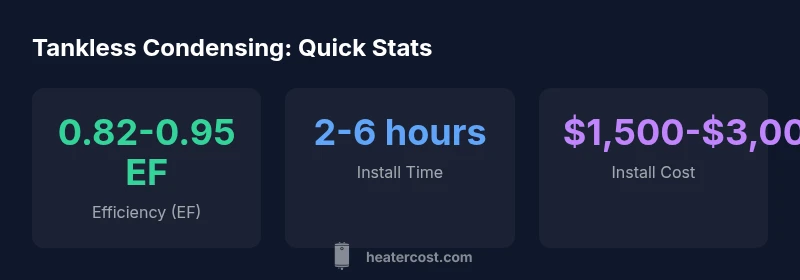
| Tankless Condensing | 0.82-0.95 | On-demand hot water, compact footprint | Higher upfront cost, installation complexity |
| Traditional Tank | 0.60-0.70 | Low upfront cost, simple install | Standby losses, larger space required |
Got Questions?
What is a tankless condensing water heater?
A tankless condensing water heater heats water on demand and uses a secondary heat exchanger to reclaim heat from exhaust. This improves efficiency and reduces wasted energy compared with older storage tanks.
A tankless condensing water heater heats water when you need it and saves energy by capturing heat from exhaust.
Do they save energy compared to traditional heaters?
Yes. They generally use less energy because there is little or no standby heat loss. Savings depend on usage patterns, climate, and proper sizing.
Yes, they save energy, but savings depend on how you use hot water and how well the unit is sized.
Is installation more complex and expensive?
Installation can be more involved due to venting, gas supply checks, and condensate drainage. A licensed installer is usually required, which adds to upfront costs.
Installation can be more involved and may cost more upfront because of venting and gas work.
What maintenance does it require?
Regular descaling in hard-water areas and periodic professional servicing help maintain efficiency and longevity.
Descale regularly if you have hard water, and have the unit serviced occasionally.
Are there tax credits or incentives available?
In many regions, energy-efficient water heaters qualify for incentives. Check local programs and utility rebates for current offers.
Check local energy programs or rebates for incentives on efficient water heaters.
How do I choose the right size for my home?
Assess peak hot-water demand across fixtures and consider climate and gas supply. A professional can run a draw-down analysis to specify the correct size.
Have a pro calculate your peak demand to choose the right size.
“Tankless condensing water heaters can dramatically reduce standby losses and energy use when properly sized and installed, but the upfront cost and installation complexity require careful planning.”
The Essentials
- Size the unit for peak demand to avoid cold-water bursts
- Plan venting and gas supply early to prevent installation delays
- Expect higher upfront costs, but lower operating costs over time
- Regular descaling helps maintain efficiency in hard-water areas
- Choose models with strong warranties and service access