What to Turn Water Heater To: A Practical Guide for Homeowners
Discover the safest, most energy-efficient water heater temperature for your home. This Heater Cost guide covers baseline settings, safety tips, and practical steps to adjust your thermostat for comfort and cost savings.


What temperature should you set a water heater to? For most homes, 120°F (49°C) is the recommended baseline, balancing comfort, safety, and energy efficiency. This setting minimizes scald risk for children and seniors while reducing standby heat loss compared with higher temperatures. If your household has higher hot water needs, you can adjust within a narrow range, typically to 110–125°F, but avoid going below 110°F for safety.
What to turn water heater to: baseline guidance
Choosing the right thermostat setting is one of the simplest, most impactful energy decisions a homeowner can make. The question of what to turn water heater to comes down to safety, comfort, and efficiency. The recommended baseline is 120°F (49°C), which provides hot water quickly enough for most uses while limiting the risk of scalding. As Heater Cost analyzed in 2026, this setting balances standby heat loss with delivery temperature without requiring constant adjustments. If your household includes young children or elderly adults with sensitive skin, consider maintaining 120°F but using anti-scald devices on faucets and showerheads to further reduce risk. For households with high hot water demand, or where you frequently run multiple fixtures at once, you may need to adjust to slightly higher settings, up to about 125°F, while ensuring everyone can test the water first. Always consult a licensed professional if you’re unsure about safe installation.
Safety considerations: scald prevention and elderly safety
Safety is the cornerstone of any temperature decision. Water at 120°F can still cause burns with very brief contact, so anti-scald devices, tempering valves, and properly installed mixing valves at showers and sinks are essential. Children, the elderly, and those with reduced sensation are most at risk. If you raise your thermostat above 120°F, pair it with these safety measures and educate household members on testing hot water before use. Regular checks—especially after plumbing work or thermostat changes—help prevent accidents. Remember, the safer the mix of hot and cold at the tap, the more comfortable your home will feel without over-relying on the thermostat for safety.
Energy implications and cost awareness: what's the trade-off
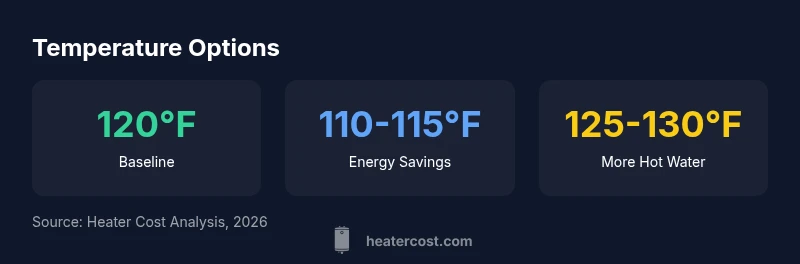
Temperature decisions influence energy use because water must be heated to the target temperature and then maintained. Lowering from higher settings reduces energy consumption, but the impact varies with usage patterns, pipe length, and climate. The Heater Cost analysis for 2026 emphasizes that the baseline at 120°F offers a practical compromise between comfort and efficiency for most homes. If you frequently draw large amounts of hot water, a modest increase to 125°F may be worth it for quicker supply, but be mindful of the incremental energy cost. Conversely, reducing to 110–115°F can yield noticeable energy savings, particularly in households with moderate hot water needs, while still delivering acceptable comfort for showers and laundry with shorter draws.
How to adjust the thermostat: step-by-step
- Safety first: for electric water heaters, switch off the power at the breaker; for gas, set the unit to the pilot mode before making changes. 2) Remove the access panel and insulation to reach the thermostat. 3) Use a flat screwdriver to rotate the dial to the desired setting (e.g., 120°F). 4) Restore the insulation, replace the panel, and turn the power back on or relight the gas. 5) Test the water temperature with a thermometer at a tap after an hour to confirm the setting. If you’re unsure, contact a licensed technician. 6) Consider installing anti-scald devices or a mixing valve to maintain safety while using the chosen temperature.
Common myths about water heater temperature
Myth: Higher temperatures always mean better hot water. Reality: Beyond a certain point, higher temps waste energy and increase burn risk. Myth: 120°F is too cool for every home. Reality: 120°F suits most households, but some high-demand or large families may justify slight adjustments with safety features in place. Myth: You should never adjust the thermostat after installation. Reality: Temperature settings are designed to be adjustable; periodic tweaks can optimize comfort and efficiency. Myth: Tankless systems are immune to temperature concerns. Reality: Tankless systems still rely on correct feed temperatures and user expectations for hot water flow.
Temperature settings for different households
- Families with kids or elderly residents: start at 120°F and use anti-scald valves on taps. - High-demand households (large families, frequent showers): consider 125°F, monitor hot water supply, and ensure adequate flow with appropriate plumbing. - Apartments or small homes with limited hot water capacity: 110–115°F can reduce energy use while maintaining reasonable performance. - Homes with solar or heat pump systems: coordinate settings with system controls to avoid excess cycling.
Integration with thermostats and smart controllers
Smart thermostats and connected controllers can help you maintain the right temperature without manual checks. Set a baseline of 120°F, and use geofencing or schedule-based adjustments to allow for higher temperatures during peak usage times (evenings or weekends) and lower temperatures when the home is unoccupied. If you have a recirculation pump, ensure the control strategy doesn’t negate the safety benefits. Maintain an alarm or notification if temperatures drift beyond a safe range. Smart systems make it easier to balance comfort, safety, and energy costs over the long term.
Seasonal adjustments and hot water demand
In winter, households may experience higher hot water demand due to longer showers or bathing. You might temporarily raise the setting to 125°F for a few days to avoid cold starts, then revert to 120°F. In summer, demand often drops; a lower setting (110–115°F) can yield meaningful energy savings without sacrificing comfort. Keep an eye on supply vs. demand, and adjust gradually. Regularly inspect insulation on hot water pipes to minimize heat loss across seasons.
Practical examples by home type
- Apartment dwellers: 110–115°F is often sufficient; use showerheads with mixed flow and ensure compact plumbing to minimize heat loss. - Small family home: 120°F baseline; anticipate occasional high use with a possible 125°F boost if needed. - Large family or guest homes: 120–125°F, paired with anti-scald devices and a plan for hot water distribution across fixtures. - Older homes with long piping runs: ensure the system can deliver 120°F at most taps; consider recirculating pumps or closer-tap heaters to reduce wait times.
Temperature settings and energy considerations for water heaters
| Setting | Recommended Temp (F) | Notes |
|---|---|---|
| Default Thermostat | 120 | Baseline for safety and comfort |
| Lowered Setting | 110-115 | May conserve energy; hot water supply may be limited during peak use |
| Higher Setting | 125-130 | Quicker hot water; higher energy use; ensure safety devices |
Got Questions?
What is the recommended water heater temperature?
For most households, about 120°F is the recommended baseline. This balances safety with comfort and reduces energy waste. If you have unique needs, adjust within 110–130°F while using anti-scald devices.
The recommended temperature is 120 degrees Fahrenheit; adjust as needed within a safe range.
Can I set my water heater lower than 120°F?
You can set within 110–115°F, but you may experience less hot water, longer wait times, or safety concerns if the temperature drops too low. Always pair temperature changes with anti-scald devices and test taps before use.
You can set a bit lower, but it may reduce hot water and safety—test the taps after changing.
How do I adjust the thermostat on my water heater?
Power off the unit (electric) or set to pilot (gas), remove the access panel, use a screwdriver to rotate the dial to the target temperature, reassemble, and restore power or gas. Test water at a faucet after about an hour to confirm the setting.
Turn off power, adjust the dial, resecure, and test the temperature at a tap.
Will changing the temperature affect my water heater’s lifespan?
Temperature adjustments have a small practical impact on wear over many years. Maintaining safe settings and avoiding extreme temperatures can help prolong heater life with regular maintenance.
It won’t dramatically shorten the life if you avoid extreme temps and keep up with maintenance.
What about tankless heaters or smart thermostats?
Tankless systems typically respond to demand differently, but a baseline of around 120°F is still common. Smart thermostats can help you maintain the target temperature efficiently by scheduling adjustments based on usage patterns.
Tankless or smart controls still benefit from a steady 120°F baseline with smart adjustments.
“Setting your water heater to around 120°F is a solid baseline for most homes; adjustments should consider safety, usage patterns, and energy costs.”
The Essentials
- Set baseline at 120°F for most homes and safety
- Lower to 110–115°F to save energy with trade-offs in hot water availability
- Raise to 125–130°F for faster hot water at the cost of higher energy use
- Always use anti-scald devices and proper mixing valves for safety
- Test water temperature after changes to confirm safe and comfortable delivery