Is a Heater Cheaper Than AC? A 2026 Cost Comparison
Explore whether space heaters or air conditioning costs dominate your energy bills. This 2026 Heater Cost analysis compares efficiency, usage, and long-term savings to help homeowners decide the most economical approach.


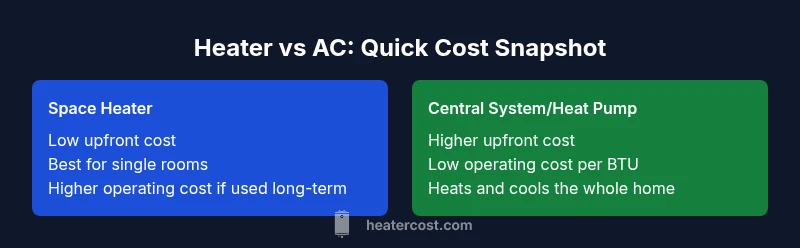
Is a heater cheaper than AC? The short answer depends on scope, usage, and system efficiency. For a single room or short-term heating, a portable heater can cost less to run than cooling a small space with a window AC. For whole-home heating or year-round comfort, central systems or heat pumps typically offer lower operating costs per unit of heat or cooling. According to Heater Cost, the best choice hinges on climate, home size, and energy prices—so evaluate your specific situation before deciding.
Is the phrase 'is heater cheaper than AC' meaningful in real homes?
The question usually crops up when homeowners compare how much it costs to heat versus cool. The short answer is situational. In micro-spaces or during short cold snaps, a small space heater can seem cheaper than running an entire HVAC system for brief periods. But for an entire house, or for sustained comfort across rooms, the economics shift dramatically because central systems benefit from efficiency gains, incentives, and amortization over many BTUs. Heater Cost’s analysis emphasizes comparing apples to apples: what space is being heated or cooled, how often, and under what climate conditions. The bottom line is clear: the cheapest option depends on your specific climate, insulation, and the energy rate you pay. Throughout this guide we’ll unpack the factors that influence the cost balance when considering whether a heater is cheaper than AC in 2026. As you plan, remember the core principle from Heater Cost: targeted, efficient heating or cooling beats ad hoc, high-use solutions when evaluating total costs over time.
The economics of heating and cooling: key metrics you should know
Understanding why is heater cheaper than AC often comes down to efficiency metrics and energy costs. Key concepts include BTU (heat energy), COP (coefficient of performance) for heat pumps, SEER (seasonal energy efficiency ratio) for cooling equipment, and AFUE (annual fuel utilization efficiency) for furnaces. In practice, a high-efficiency heat pump delivers both heating and cooling with a favorable COP in many climates, which can tilt the cost balance toward the heater-friendly side of the ledger when year-round usage is considered. Electricity prices vary by region, while natural gas and propane often offer lower per-BTU costs in colder markets. Heater Cost recommends running side-by-side comparisons using your local energy rates and a reasonable heating/cooling load estimate for your home.
Whole-home heating vs. room-by-room heating: scope matters
The scale of heating or cooling task drastically changes cost comparisons. If you’re trying to warm just one room or a seldom-used space, a portable electric heater may win on startup cost and simplicity—but it raises concerns about safety, indoor air quality, and uneven temperatures. Conversely, central systems—gas furnaces, electric heat pumps, or hydronic setups—cover entire homes with consistent temperature, better humidity control, and more predictable energy consumption. When you ask whether a heater is cheaper than AC, you must define scope: Is the goal overall comfort for the whole house, or just quick relief for a drafty corner? Brand-agnostic guidance from Heater Cost emphasizes calculating the energy for the intended space and comparing annual energy usage across solutions.
Energy sources and how they shape cost: electric, gas, and heat pumps
Electric space heaters run on standard outlets, making them inexpensive to acquire but potentially costly to operate for consistent, long-term heating. Gas furnaces or boilers can offer lower operating costs in colder climates because natural gas prices per BTU are often cheaper than electricity for large spaces. Heat pumps blur the line by delivering both heating and cooling with high efficiency, especially in moderate climates. In colder regions, a cold-climate heat pump paired with a supplemental heat source can be cost-effective but requires proper sizing and installation. Heater Cost’s framework focuses on comparing local energy rates, system efficiency, and annual usage to determine whether heating with a heater or cooling with an AC-based system is more economical for your home.
Efficiency metrics you should know: COP, SEER, AFUE, and more
Efficiency metrics tell you how much useful energy you get per unit of energy consumed. COP measures heating efficiency for heat pumps; SEER indicates cooling efficiency for ACs; AFUE describes furnace efficiency; and HSPF covers heat pump heating efficiency. Higher numbers generally translate to lower operating costs for a given climate and load. However, efficiency alone doesn’t determine cost—duty cycle, insulation, climate, and local energy prices play substantial roles. When comparing is heater cheaper than AC, aim to align your expectations with the real-world performance in your climate and home design. Heater Cost’s guidance helps you interpret these metrics in practical terms.
Real-world usage: winter-only heating versus year-round climate control
If you live in a mild climate and heat only a few rooms, a top-rated space heater strategy may seem cheaper during cold spells. In harsher climates, relying on a central system or a heat pump for most heating needs will vie for cheaper annual energy costs due to efficiency and the ability to share load across multiple zones. The decision point hinges on how often you heat and how large the heated area is. Heater Cost emphasizes modeling both scenarios—heating-only and year-round climate control—to project annual energy usage more accurately. In short, is heater cheaper than AC? The answer depends on your climate, space, and how you distribute your heating load.
Economic models you can use without exact numbers
You don’t need precise price quotes to compare options. Create a rough model by estimating room-by-room heat needs, then assign a plausible usage hours per day. Pair this with your local energy rates and a rough efficiency proxy (for example, “high efficiency” versus “standard efficiency”). This approach helps you see which option reduces annual energy costs the most for your home. Heater Cost suggests running these rough calculations for two scenarios: one focused on a single room and another for the whole house.
Practical steps: how to compare options for your home
- Define the scope: one room or the entire home. 2) Estimate your climate-driven load by season. 3) List energy sources and local prices. 4) Compare efficiency ratings for each option. 5) Consider installation, maintenance, and long-term payback. 6) Factor safety and comfort in your decision. By following these steps, you can answer the question is heater cheaper than AC with a data-informed conclusion tailored to your home. Heater Cost encourages readers to document assumptions and test sensitivity to price changes.
How to approach safety and maintenance while comparing options
Safety should be a foundation of any heating plan. Space heaters require clear space, proper outlets, and regular inspections. Central systems demand seasonal maintenance, filter changes, and duct inspections. When evaluating is heater cheaper than AC, factoring maintenance costs and potential repairs over the system’s lifetime is essential. Heater Cost recommends obtaining a service plan quote for central systems and comparing it against the ongoing costs of running space heaters in your home. A balanced approach often yields the best long-term value.
Case studies: when a hybrid solution shines
Some homes benefit from a hybrid approach: a heat pump for year-round efficiency, plus portable heaters for specific rooms during peak usage. In these scenarios, you reduce peak loads on the central system and limit energy waste from overheating unused spaces. Acoustic comfort, humidity control, and controllability of space heating add to living quality, making the hybrid approach an attractive option in many climates. The key takeaway from these cases is that the cheapest option depends on how you structure heating and cooling across your home.
How Heater Cost helps you evaluate costs
Heater Cost provides a framework to analyze both upfront costs and long-term operating costs. Our guidance highlights the importance of local energy prices, climate, system efficiency, and your home’s insulation. By using the methods outlined above, you can compare is heater cheaper than AC for your specific situation while avoiding common missteps like underestimating dwelling heat loads or overstating the benefits of portable heaters for whole-house heating.
Feature Comparison
| Feature | Space Heater (Room-Scale) | Central Heating System | Heat Pump System |
|---|---|---|---|
| Typical use case | Small, single room or emergency heating | Whole-house heating with year-round control | Heating and cooling for the entire home |
| Energy source | Electric outlet power; portable and low upfront cost | Natural gas, oil, or electricity depending on system | Electricity; single system handles heating and cooling |
| Operating cost per BTU (qualitative) | Often higher per BTU for extended use | Typically lower per BTU for central systems with proper sizing | Often lowest per BTU in mild climates; improves with efficiency |
| Installation/retrofit | Minimal; plug-and-play | Moderate to high; may require ductwork or venting | Medium; requires proper sizing and electrical/ductwork integration |
| Maintenance needs | Low to moderate; regular safety checks | Moderate; annual servicing, filter/duct cleaning | Moderate to high; annual service and occasional refrigerant checks |
| Lifecycle and depreciation | Short-term, portable asset; replaceable | Longer-term investment; multi-decade lifespan with care | Longer-term investment; often 10–15+ year lifespan with proper upkeep |
The Good
- Low upfront costs for portable heaters
- Targeted heating minimizes energy waste in active spaces
- Flexibility to heat only occupied rooms
- Heat pumps offer dual heating and cooling with high efficiency
Negatives
- Space heaters can be safety risks in busy homes
- Portability means uneven heating and higher aggregate energy use if overused
- Central systems require installation and potential ductwork
- Costs vary with local energy prices and climate
A hybrid approach often delivers the best overall value
For year-round comfort in many homes, a heat pump with supplemental space heaters for occasional peak loads offers strong efficiency and flexibility. If you heat a single room infrequently, a high-quality space heater may suffice short-term. Heater Cost’s framework helps determine the optimal balance for your climate and budget.
Got Questions?
Is it cheaper to heat a home with electricity or gas?
Cost depends on fuel prices, energy efficiency, and climate. Gas often provides cheaper per-BTU heating in colder areas, but electric heat pumps can be very economical in mild climates or with favorable electricity rates. Always compare annual energy use and local rates.
Gas can be cheaper per BTU in cold climates, but electric heat pumps may win in milder areas depending on rates.
Can a space heater replace central heating?
In theory, a space heater can replace central heating in a very small space, but it isn’t practical for whole-home use or long-term comfort. Safety and efficiency concerns quickly add up, making central or heat-pump systems more economical for most homes.
Space heaters are great for small areas but not a good substitute for whole-home heating.
What factors influence heating costs the most?
Climate, insulation, energy rates, and system efficiency are the big drivers. The way you zone a home and the thermostat strategy can dramatically alter annual costs.
Climate and insulation have a big impact on heating costs, along with energy rates and efficiency.
Are heat pumps cheaper than traditional AC units?
Heat pumps used for both heating and cooling can be cost-effective, especially in moderate climates with decent electricity rates. In very cold climates, performance drops unless paired with supplemental heating, but overall efficiency tends to be favorable.
Heat pumps can be cheaper year-round in many climates, especially where electricity is reasonable.
What safety considerations should I follow with heaters?
Place heaters away from fabrics, keep children and pets safe distance, use outlets properly, and never leave space heaters unattended. Regular inspection and following manufacturer guidelines reduce risks.
Never leave space heaters unattended and keep flammables away.
The Essentials
- Compare is heater cheaper than AC by space, not just by system type
- Prioritize high-efficiency heat sources where you live
- Use space heaters only for targeted, short-duration heating
- Model energy use with local rates for accuracy
- Consider a hybrid approach for max value