Heater and AC Combo: Integrated vs Separate Systems — A Comprehensive Comparison
A thorough side-by-side comparison of integrated heater and AC combos versus separate furnace + central air, with buying guidance, energy performance insights, and maintenance considerations for homeowners in 2026.


According to Heater Cost, a heater and AC combo can save space and simplify setup, but may cost more upfront. Separate furnace + central AC often offers lower upfront costs and easier component upgrades. The right choice hinges on climate, energy goals, and maintenance willingness. Consider current ductwork, climate, and future expansion before deciding.
Why Homeowners Consider a Heater and AC Combo
A heater and AC combo is a unified approach to heating and cooling, designed to reduce ductwork, simplify controls, and save space in tighter homes. For homeowners, especially in compact houses or condos, this can offer a cleaner mechanical room and a streamlined installation. According to Heater Cost, the decision often hinges on space constraints, climate needs, and long-term energy goals. When evaluating a heater and ac combo, consider your current ductwork, insulation quality, occupancy patterns, and willingness to manage service contracts. A well-sized, properly matched system can deliver comfortable year-round climate control with fewer equipment footprints and a simpler ownership experience.
Integrated vs Separate Systems: The Core Differences
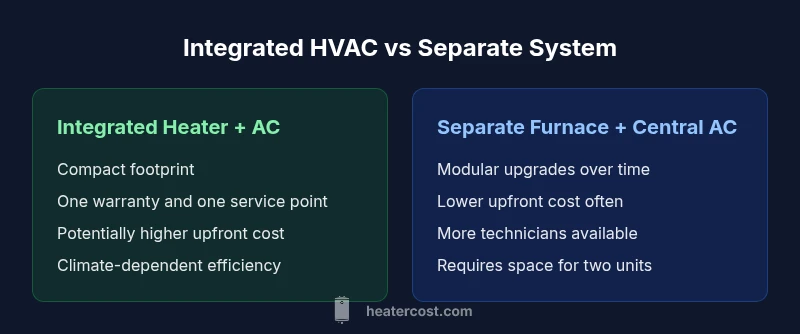
Integrated heater and AC units aim to provide heating and cooling from a single platform, often sharing controls and a compact footprint. Separate systems rely on a dedicated furnace or heat source paired with a central air conditioner and separate distribution network. The core differences include installation complexity, zoning potential, and upgrade paths. An integrated unit can simplify warranty terms and service, but may limit independent upgrades. Separate systems typically offer more flexibility to upgrade heating or cooling components over time and to tailor the duct design for each function.
Cost and Value: Upfront vs Long-Term
Upfront costs for an integrated heater and AC combo tend to be higher, driven by the single multi-function package. Separate furnace plus central AC configurations usually have lower initial prices but may require more extensive ducting and two warranties. Long-term value depends on climate, usage patterns, and maintenance costs. If the climate supports efficient operation of a heat pump, a modern combo can reduce operating costs; if heating needs are extreme, supplemental heat may raise ongoing costs. Based on Heater Cost analysis, homeowners should weigh upfront investment against predicted operating costs, expected lifespan, and warranty protection.
Energy Efficiency and Climate Fit
Energy efficiency in heater and ac combo scenarios largely depends on the core technology. A pack or integrated unit using a modern heat pump can deliver strong efficiency in milder winters and year-round cooling, potentially lowering energy bills. In very cold climates, performance may dip without supplemental heat, affecting efficiency gains. Separate systems allow you to tailor the furnace’s efficiency with a suitable AFUE and pair it with an efficient air conditioner or heat pump, optimizing performance for winter heating and summer cooling. The climate and insulation quality of the home should guide which path yields the best annual energy cost.
Installation, Space, and Aesthetics
The promise of a heater and ac combo is a smaller mechanical footprint and cleaner interior aesthetics. Fewer bulky air handlers and separate closets can simplify room layout and reduce sightlines. However, the installation must ensure correct sizing and airflow to avoid bottlenecks. In older homes with limited ductwork, an integrated solution may be preferred for tighter space, while in larger homes with existing duct networks, two separate units may offer smoother integration and zoning control.
Maintenance, Repairs, and Serviceability
Maintenance for a single integrated unit can be straightforward, with a single service point and a unified warranty. The trade-off is that a fault in one part can impact both heating and cooling, potentially increasing downtime. Separate systems generally provide easier diagnostics because the heating and cooling sides are distinct, with more technicians available to service each function. While two service contracts can increase administrative overhead, they also allow targeted repairs and replacements without affecting the other system.
Decision Framework: A Practical Checklist
- Climate assessment: Do you need reliable year-round heating and cooling, or primarily heating with occasional cooling?
- Space and ductwork: Is there room for single integrated equipment or two separate units?
- Upfront vs operating costs: Are you prioritizing initial investment or long-term energy spend?
- Warranty and service networks: Is there a unified warranty, or are there multiple providers?
- Rebates and incentives: What energy-efficiency programs apply to your home and selected system?
- Professional load and design: Have you had a licensed HVAC contractor perform a load calculation and equipment recommendation?
- Future plans: Will you upgrade insulation or home envelope in the coming years?
Comparison
| Feature | Integrated heater + AC unit | Separate furnace + central AC |
|---|---|---|
| Upfront Cost | Typically higher upfront for an integrated unit | Often lower upfront (two separate units) |
| Energy Efficiency & Performance | Strong efficiency with modern heat pump; climate-dependent | Can optimize efficiency with dedicated components and proper duct design |
| Maintenance & Serviceability | One service point; simultaneous heating/cooling | Two service points; easier to isolate issues |
| Space & Ductwork | Compact footprint; simpler installation | Requires space for two units and associated ductwork |
| Reliability & Upgrades | Integrated unit can simplify warranties; potential single-point failure | Modular upgrades possible; easier to replace components |
| Climate Fit | Integrated units excel in mild to moderate climates; may need backup heat in cold snaps | Very adaptable across climates; furnace backup enhances cold-weather performance |
| Maintenance Costs Over Time | Potentially lower service calls if single provider, but risk of bundled failures | Maintenance costs distributed across two systems; may be higher but targeted |
The Good
- Space-saving design and simplified controls
- One warranty and single service point for the system
- Potentially faster installation for compact homes
- Good energy performance with modern heat pumps
Negatives
- Higher upfront cost for integrated units
- Limited flexibility to upgrade components independently
- Repairing an integrated unit can be costlier
- Performance can vary in extreme climates without supplemental heat
Integrated heater and AC combo is often the better choice for space-constrained homes with moderate heating needs.
The Heater Cost team notes that space savings and simplified control can tip the balance toward a combo unit in smaller homes, while separate systems may win on upfront cost and modular upgrades in larger or colder homes.
Got Questions?
What exactly is a heater and AC combo, and who should consider it?
A heater and AC combo provides heating and cooling in one package or tightly coordinated system. It is often chosen by homeowners with limited space, a preference for simplified controls, or a desire to reduce ductwork. Consider climate, insulation, and long-term maintenance before choosing.
A heater and AC combo gives you heating and cooling in one unit. It’s good for small spaces, but consider climate and maintenance.
How does the upfront cost compare between integrated and separate systems?
Integrated units typically require a higher upfront investment because you’re buying a single multi-function package. Separate furnace and central AC setups can be cheaper initially, with costs influenced by unit quality, efficiency, and ducting needs.
Integrated units cost more up front, while separate systems can be cheaper to buy.
Which option is more energy efficient in typical conditions?
Efficiency depends on the equipment and climate. Modern heat-pump-based combos can be very efficient in mild to moderate climates, while separate systems let you tailor efficiency with a high-efficiency furnace and an appropriate air conditioner or heat pump.
Efficiency depends on climate and equipment; heat pumps are efficient in milder weather.
Can a heater and AC combo meet heating needs in very cold climates?
In very cold climates, combos may require supplemental heat to maintain comfort, affecting cost and efficiency. A separate furnace can provide robust heating reliability in extreme temperatures.
In cold climates, you may need backup heat with a combo; a separate furnace can be more reliable.
What maintenance should homeowners expect?
Maintenance for a combo is typically centralized, with one point of service. Separate systems require maintenance on two appliances, which can offer more targeted repairs but may incur higher total upkeep.
Maintenance is simpler with one unit, but two systems might mean more visits overall.
Are there tax credits or rebates available for heater and AC combos?
Incentives for energy-efficient heating and cooling upgrades vary by locale and program. Check federal, state, and local programs; Energy Star and DOE resources can guide eligibility for heat pumps and high-efficiency equipment.
Tax credits depend on local programs; check Energy Star and DOE resources.
The Essentials
- Prioritize climate and space when choosing a heater/AC setup
- Integrates save space but may cost more upfront
- Separate systems offer flexibility and easier upgrades
- Check rebates and warranties for energy-efficient options
- Get a professional load calculation before deciding