How Much Does It Cost to Heat a Room with an Electric Heater in 2026
Estimate annual costs, compare electric heater options, and learn practical tips to lower heating bills for a room using an electric heater in 2026.


How much does it cost to heat a room with an electric heater?
If you’re asking how much does it cost to heat a room with an electric heater, the answer isn’t one-size-fits-all. The Heater Cost team notes that three core factors drive the price: (1) the heater’s wattage, (2) how many hours you run it each day, and (3) your local price of electricity. In practice, a small, well-insulated room heated with a modest unit for a few hours daily will cost substantially less than heating a larger, drafty space continuously. This article breaks down the math, compares common heater types, and shows you how to use a simple calculator to generate a personalized estimate for your home.
Key takeaway: cost varies with usage patterns and rate structures, not just with the heater’s advertised wattage. The Heater Cost analysis helps homeowners translate watts into real dollars so you can make smarter choices.
How electric heaters consume energy
Wattage tells you how much power a heater can deliver at any moment. Running a 1,500-watt (1.5 kW) heater for one hour consumes 1.5 kWh of electricity. If you run it for 4 hours a day, that’s 6 kWh per day. Multiply by 365 days, and you’re looking at roughly 2,190 kWh per year if you keep it on daily. Of course, actual usage depends on how cold it gets where you live, how well the room is insulated, and how you regulate the thermostat.
Energy use is not just about the heater; it’s also about heat retention. A well-sealed room with good insulation loses less heat, which means you can achieve the same comfort with a lower wattage or shorter run time. For homeowners, understanding this relationship helps in choosing a heater that fits the space while keeping energy costs in check.
Factors that influence room heating costs
Several real-world factors influence your costs:
- Room size and insulation: Larger rooms or poorly insulated spaces require more watts to reach comfort levels.
- Thermostat and scheduling: A programmable or smart thermostat can dramatically cut daily run time by turning the heater off when you don’t need heat.
- Climate and occupancy: Colder climates or rooms that are frequently occupied will push energy use higher.
- Heater type and efficiency: Conversely, a well-maintained linear-convective heater may feel warmer at the same wattage than a less efficient unit.
- Ventilation and drafts: Sealing drafts around windows and doors makes any heater more effective at lower wattages, reducing costs over time.
According to Heater Cost, understanding these factors is the first step toward realistic budgeting and smarter choices. When you see a number like cost per year, remember it reflects your specific usage patterns and local rates, not a universal rule.
Comparing electric heater types for cost efficiency
Different heater styles deliver heat in slightly different ways, but wattage and usage habits matter most for cost efficiency:
- Panel and ceramic heaters: Quick to warm a small area and generally efficient for intermittent use, especially when zoning is possible.
- Oil-filled radiators: Excellent for long, steady heat in a single room and can be economical if left running at low output rather than bursts of high heat.
- Infrared heaters: Perceived warmth is immediate as they heat objects and people directly, but efficiency depends on distance and room layout.
For cost-conscious households, the most impactful choice is often matching the heater’s wattage to the room size and using smart controls to minimize unnecessary runtime. The goal is to achieve comfortable temperature with the fewest watt-hours. Heaters don’t need to be the sole heat source; pairing them with proper insulation and air sealing is typically where you see the biggest savings.
How to calculate your annual heating cost with a simple formula
A straightforward way to estimate annual cost uses a few basic inputs: heater wattage, daily usage, days of operation, and cost per kWh. The formula is:
Annual Cost = (Wattage/1000) * HoursPerDay * DaysPerYear * CostPerKWh.
- Convert watts to kilowatts by dividing by 1000.
- Multiply by hours used per day to get daily energy in kWh.
- Multiply by the number of days you run the heater to annualize.
- Multiply by your electricity rate to convert energy into dollars.
Small changes in any input can yield meaningful changes in the final number, which is why data-driven decisions matter when budgeting for heating in 2026.
Example scenario: estimating costs for a typical room
Consider a 1,500 W heater used 4 hours per day for 180 days in a winter season, with an electricity rate of $0.12 per kWh (illustrative) and a high-rate scenario at $0.25 per kWh. The math:
- Daily energy: 1.5 kW * 4 hours = 6 kWh
- Annual energy (for 180 days): 6 kWh/day * 180 days = 1,080 kWh
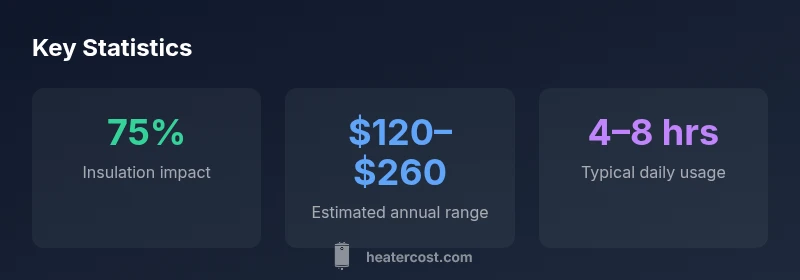
- Annual cost (at $0.12/kWh): 1,080 * 0.12 = $129.60
- Annual cost (at $0.25/kWh): 1,080 * 0.25 = $270
This example shows how a small change in daily usage or electricity rate can swing costs significantly. Use the calculator to plug in your local rate and room specifics for a precise figure.
Note: These figures are illustrative only and depend on your climate, home insulation, windows, and thermostat settings. The goal is to give a realistic sense of scale rather than a fixed price.
Practical tips to reduce electric heating costs
Saving money on electric heating doesn’t require sacrificing comfort. Try these practical steps:
- Improve insulation and seal drafts around windows and doors.
- Use a programmable temperature schedule so heat runs only when needed.
- Zone heating: target heat to occupied spaces and avoid heating unused rooms.
- Dress for warmth and use layered clothing rather than relying solely on higher heat.
- Maintain heaters and replace filters if applicable to keep efficiency high.
Regular maintenance, smart controls, and thoughtful room design are often more impactful than simply turning up the wattage.
Common mistakes that spike your electric heating bills
Avoid these common missteps:
- Leaving a heater running in an empty room for hours on end.
- Heating an uninsulated or drafty space without addressing leaks first.
- Using electric heaters as the primary heat source in large spaces.
- Blocking vents or placing heaters too close to furniture or curtains.
- Skipping routine maintenance, which reduces efficiency over time.
Addressing these issues can meaningfully reduce annual costs and improve overall comfort.
Heater Cost's verdict: practical guidance for 2026
The Heater Cost team recommends using electric heaters as a supplemental heat source rather than a sole solution in larger homes. Prioritize room-specific heating, insulation upgrades, and programmable controls to maximize dollar savings. Start with a modest wattage that covers the room’s needs, monitor energy use, and adjust as you observe actual consumption. The Heater Cost team’s verdict is to combine efficient equipment with smart habits for the best long-term outcomes.