How Much Do Heaters Cost in 2026? A Practical Guide for Homeowners
Learn how heater costs vary by type, installation, and energy use in 2026. This guide covers purchase prices, installation ranges, and budget tips for homeowners and property managers.


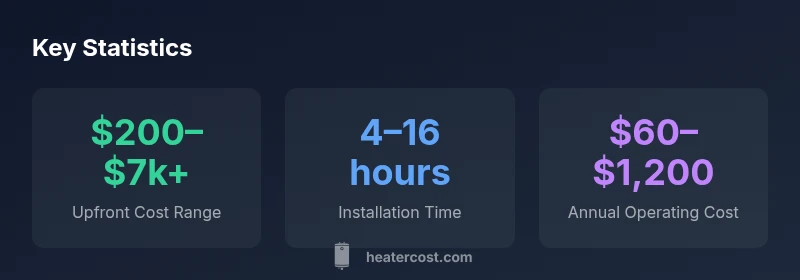
Typically, total upfront and installation costs for heaters range from about $200 to $7,000, depending on type and scope. Electric space heaters are on the low end, while central heating systems can push higher. Ongoing energy costs vary with efficiency, usage, and local prices. This guide breaks down costs by category and strategy to save money.
Why Costs Vary Across Heater Types
For homeowners asking how much does heaters cost, the simple truth is that price depends on type, size, and installation requirements. According to Heater Cost, the most significant price differences come from equipment choice and whether you install the unit yourself or hire professionals. Portable electric space heaters are inexpensive to purchase but offer limited heat output and do not replace a full heating system. Central solutions, like heat pumps or furnaces, carry higher upfront costs but typically deliver greater comfort, reliability, and efficiency over time. In practice, you’ll see a broad spectrum—from small, plug-in models under $200 to full central systems that can exceed $7,000 once labor, ducts, and venting are included. Other cost levers include the efficiency rating (SEER/AFUE), climate zone, and the size of your living space. Heating equipment with higher efficiency tends to reduce operating costs, even if its upfront price is steeper. The goal is to balance initial investment with expected energy savings and maintenance needs.
Upfront vs Installation: What Determines Price
The sticker price on a heater is only part of the total. Upfront costs include the unit price, delivery, and, for central systems, the installation labor. Installation complexity matters a lot: homes with existing ductwork, electrical upgrades, or venting require more labor and materials, raising the total. Permits, inspections, and potential modifications to electrical panels or gas lines can add to the bill. Regional differences in labor costs and contractor availability also influence final quotes. If you’re budgeting, assume a wider range and factor in local permitting fees. In 2026, a well-planned project with professional installation tends to be more reliable and energy-efficient over the system’s lifetime.
Central Heating vs. Point-Source Options
Central heating systems (furnaces, boilers, or heat pumps) generally involve higher upfront costs than stand-alone space heaters or small-room systems. However, they deliver climate-controlled comfort across larger areas and can provide year-round benefits, such as cooling with certain heat pumps. Point-source options (like electric baseboard heaters or portable heaters) are cheaper to buy and install but require careful zoning to avoid overspending on energy. When evaluating costs, consider the long-term savings from improved efficiency and the need for consistent temperature control in living spaces, basements, and rooms with poor insulation. A properly sized system minimizes wasted energy and reduces dramatic temperature swings.
Operating Costs: Energy Efficiency Matters
Operating costs are driven by how efficiently a heater converts energy into heat, your local energy prices, and how many hours you use the system. Higher-efficiency units can significantly decrease annual energy consumption, especially in colder climates where heating days are longer. In hot months, certain heat pumps can also offer cooling, improving overall home comfort without drastically increasing energy bills. To estimate annual costs, take the device’s wattage, multiply by expected hours of use, and apply your local electricity or gas rate. Small, efficient upgrades—like programmable thermostats or zoning controls—often pay for themselves over a few seasons.
Budgeting, Quotes, and Saving Money
Start with a practical budget by listing must-haves versus nice-to-haves. Get quotes from multiple contractors and ask about included services (commissioning, duct sealing, or zoning). A written comparison should cover equipment efficiency (AFUE/SEER), expected energy savings, and maintenance needs. If you’re replacing an old system, assess whether upgrading to a higher-efficiency model will reduce operating costs enough to justify the extra upfront. Consider incentives and rebates when available and factor in maintenance plans that extend the system’s life. Finally, plan for future energy price fluctuations by choosing scalable solutions that can be upgraded over time.
Example Scenarios: Budgeting for Different Homes
- Small apartment or dorm-style dwelling: A portable electric heater or a compact space heater might cost $50–$300 upfront, with minimal installation. Annual energy costs stay relatively low if the unit is used sparingly.
- Medium house with moderate climate: A ducted central heat pump or high-efficiency gas furnace could run $3,000–$8,000 before tax credits; installation may take a day or two. Expect annual operating costs in the low hundreds to a thousand dollars, depending on usage.
- Large home in a cold climate: Central systems with high AFUE or a high-efficiency heat pump combined with zone controls may total $6,000–$15,000 or more. Install time is longer due to ductwork and system balancing. Annual energy costs will be highly climate-dependent but can be significantly reduced with proper insulation and smart thermostats.
Typical cost and time considerations by heater type
| Heater Type | Typical Upfront Cost | Installation Time | Estimated Annual Operating Cost | Notes |
|---|---|---|---|---|
| Electric Space Heater | $20–$200 | 0–2 hours | $40–$150 | Portable, no venting; good for small spaces |
| Air-Source Heat Pump (Central) | $3,000–$9,000 | 6–16 hours | $150–$700 | Efficient year-round; cooling in summer |
| Gas Furnace | $2,000–$6,000 | 6–24 hours | $500–$1,200 | Requires gas line; venting and permits may apply |
| Oil Furnace | $3,000–$8,000 | 8–24 hours | $600–$1,500 | Less common; fuel deliveries needed |
Got Questions?
What is the typical total cost to outfit a home with a new heating system?
Costs vary by system and home size. Central systems generally cost more upfront, while portable heaters are cheaper. Always factor installation and potential modifications into your budget.
Costs vary by system and home size. Central systems cost more upfront, portable heaters cost less, and installation can add to the total.
How can I estimate operating costs for a heater?
Estimate annual energy use by multiplying the device’s wattage by expected hours of use, then multiply by your local energy rate. Don’t forget may be cheaper if you choose a high-efficiency model.
Multiply wattage by hours used, then multiply by your energy rate.
Do heat pumps really save money over furnaces?
Heat pumps are often more efficient in milder climates and can reduce operating costs over time, though upfront costs may be higher and climate matters.
They’re usually more efficient in milder climates and can save money over time.
Are there government rebates for heating equipment?
Many programs exist at federal or state levels; incentives change. Check local energy offices or rebate databases for current offers.
There are often rebates or tax credits; check federal and state programs.
What affects installation costs besides the unit price?
Labor, duct work, venting, permits, and existing wiring or gas lines can significantly affect price.
Labor, duct work, venting, and permits affect price.
How often should heaters be serviced?
Annual professional maintenance is recommended for most systems to preserve efficiency and safety.
Have a pro service it once a year.
“Prices reflect both unit cost and install complexity. Smart homeowners plan for maintenance and efficiency to lower lifetime costs.”
The Essentials
- Compare total installed costs across types before buying
- Prioritize energy efficiency to lower annual costs
- Get multiple quotes to control installation costs
- Consider heat pumps for moderate climates
- Budget for maintenance and potential upgrades