How Much Does a Heater Cost to Run in 2026? Practical Guide
Estimate running costs for central heating, space heaters, and heat pumps in 2026. Learn how climate, insulation, and efficiency affect monthly bills and how to cut costs with practical strategies.


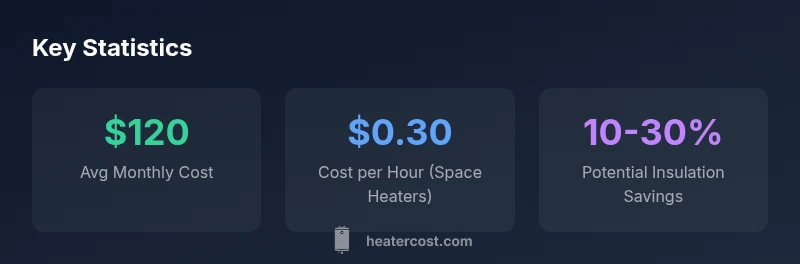
How much does a heater cost to run? In 2026, running costs depend on heater type, climate, and usage. On average, a central heating system may run roughly $100-$250 per month for moderate winters, while space heaters can push higher costs if used extensively. Efficiency, insulation, and thermostat settings dramatically influence these numbers.
Understanding what drives running costs
If you’re asking how much does heater cost to run, you should know that several variables determine the final monthly bill. In 2026, homeowners should consider heater type (central vs space), climate, home insulation, energy prices, and thermostat behavior. The Heater Cost analysis shows that even modest changes in setup can yield meaningful savings. By breaking costs into fuel type, efficiency, and usage patterns, you can build a realistic budget and identify low-cost upgrades that have a big impact over a heating season.
Common drivers include: (1) heating load governed by climate and home size, (2) system efficiency measured by AFUE/SEER/HSPF ratings, and (3) how aggressively you thermostat your space. Understanding these factors helps you forecast monthly bills more accurately and avoid surprises when winter peaks.
For renters and homeowners alike, a practical first step is to track your energy bills for 2-3 winter months to establish a baseline. From there, you can compare upgrading equipment or adjusting settings against ongoing monthly costs.
Comparing heater types and their running costs
Different heating approaches carry different price pressures. Here’s how common options typically stack up in running costs, with a focus on efficiency, control, and climate suitability:
- Central gas furnace: Often economical per degree in moderate-to-cold climates, with monthly costs that reflect gas prices and furnace efficiency. A well-maintained unit with a high AFUE rating tends to deliver lower running costs over time.
- Electric baseline heating (electric furnace or resistance heaters): Very controllable room by room but usually higher energy costs overall, especially in large homes or harsh winters. Zone strategies and good insulation can help offset expenses.
- Heat pumps (air-source or ground-source): Among the most energy-efficient options for many climates, especially with moderate winters. In very cold locales, performance can drop, raising running costs during peak cold snaps if supplemental heat is needed.
- Space heaters (portable units): Provide flexibility for heating specific areas but can be costly if used for long periods in larger spaces. They’re most cost-effective when used to supplement central heating in well-insulated rooms rather than to heat an entire home.
These comparisons assume typical energy prices and standard efficiency ratings. Real-world costs hinge on local rates, insulation, and how well the home retains heat.
How to estimate your own running costs
Estimating your own running costs starts with a simple energy-use calculation. Monthly energy use (in kilowatt-hours, kWh) multiplied by the energy price per kWh gives a baseline bill. Efficiency acts as a multiplier: higher-efficiency equipment uses less energy for the same heating effect. A practical example helps illustrate:
- If your home uses 800 kWh per month for heating and electricity costs are $0.15 per kWh, the raw energy cost is $120 per month. If your heat source has an AFUE/seasonal performance effectively reducing consumption by 15%, your effective cost might drop to around $102 per month.
- In colder months or with older equipment, the same home could see higher usage—up to $180-$220 per month—without any efficiency upgrades. These numbers are illustrative and should be refined with your local utility prices and equipment ratings.
To get precise estimates, use a monthly energy tracker and model several scenarios (higher/low usage, different thermostat settings, and potential upgrades).
Practical strategies to lower running costs
Lowering running costs is often a matter of efficiency and behavior as much as equipment. Practical steps:
- Improve insulation and seal air leaks to reduce heat loss by significant margins.
- Install a programmable or smart thermostat to optimize heating cycles and avoid wasting energy when no one is home.
- Zone heating: heat only the occupied areas and use portable heaters sparingly for rooms not often used.
- Schedule regular maintenance: clean/replace filters, inspect ducts, and service the furnace or heat pump to maintain efficiency.
- Lower thermostat setpoints gradually: even a 1-2 degree drop can yield meaningful savings.
- Consider better windows, weatherstripping, and door sweeps as low-cost upgrades with quick payback.
Small, consistent changes often add up across a heating season, reducing your overall costs without sacrificing comfort.
When to upgrade or replace for cost efficiency
Upgrading to a higher-efficiency system often makes sense when running costs start to climb due to aging equipment, frequent repairs, or large winter bills. Look at the AFUE for furnaces, SEER for heat pumps, and HSPF for heat pumps with heating mode. A cost-benefit analysis should include installation costs, potential energy savings, and your local climate. In many cases, a mid-life upgrade with a high-efficiency model yields a favorable payback period, especially when paired with insulation improvements and smart controls.
Putting it together: a practical budgeting approach
To translate these insights into a budget, start with a baseline of your current monthly energy costs, then model the impact of efficiency upgrades, thermostat optimization, and insulation improvements. Use 2026 price ranges as a reference, and adjust for your local climate and energy rates. Maintain a small reserve in your heating budget for unexpected cold snaps, and plan upgrades during shoulder seasons to minimize disruption and cost.
Typical running costs by heating type
| Heating Type | Avg Monthly Running Cost (Range) | Typical Energy Source | Notes |
|---|---|---|---|
| Central Gas Furnace | $100-$250 per month | Natural gas | Depends on gas prices and furnace efficiency |
| Electric Furnace/Baseboard | $120-$260 per month | Electricity | Higher energy costs but precise zone control |
| Heat Pump (Air-Source) | $90-$220 per month | Electricity | Most efficient in moderate climates |
| Space Heaters (single-room) | $25-$80 per month | Electricity | Best for limited spaces; not for whole-home heating |
Got Questions?
What is the typical monthly cost to run a central heating system?
Costs vary by climate, home size, and fuel prices. In moderate climates, monthly costs often range in the low hundreds, while very cold winters can push costs higher. The key is matching efficiency and insulation to your climate.
Costs vary by climate and home size. In moderate climates, expect costs in the low hundreds monthly; very cold winters can raise that amount.
Do space heaters cost more to run than central heating?
Space heaters can be more expensive per hour than a central system, especially in larger spaces. They’re most cost-efficient when used to heat specific rooms rather than the entire home.
Space heaters cost more per hour and are best for small, dedicated spaces, not whole-home heating.
How can I reduce running costs quickly?
Useful steps include insulating properly, sealing leaks, using a programmable thermostat, upgrading to high-efficiency equipment when needed, and reducing thermostat setbacks at night.
Insulate, seal leaks, use a smart thermostat, and upgrade equipment when cost-effective.
Do heat pumps cost less to run than furnaces?
Heat pumps are usually more energy-efficient and cheaper to run in moderate climates. In extremely cold areas, supplemental heat may raise costs, but overall efficiency remains favorable.
Heat pumps are often cheaper to run in milder climates; in very cold areas, supplemental heat can raise costs somewhat.
How does insulation affect running costs?
Better insulation reduces heat loss, which lowers heating demand. Even modest upgrades can noticeably cut monthly energy use and run-time.
Improving insulation cuts heat loss and lowers monthly energy use.
Are there financing options for high-efficiency upgrades?
Many programs offer rebates or low-interest financing for high-efficiency equipment and insulation upgrades. Check local utility programs and state incentives.
Look for rebates or financing programs from utilities or government programs for efficiency upgrades.
“Running costs are not just about the heater price; they hinge on climate, insulation, and efficiency. Homeowners should model monthly energy use with real usage patterns to avoid sticker shock.”
The Essentials
- Estimate costs using climate, insulation, and efficiency as core drivers
- Compare central heating vs space heaters with attention to efficiency
- Use programmable thermostats to cut costs
- Upgrade insulation to unlock substantial savings
- Model costs before buying to predict ROI