120V Space Heaters: Costs, Safety, and Buying Tips
Explore costs, safety features, and buying tips for 120V space heaters. Learn typical wattage ranges, estimated running costs, safe placement, and maintenance to heat small rooms efficiently.


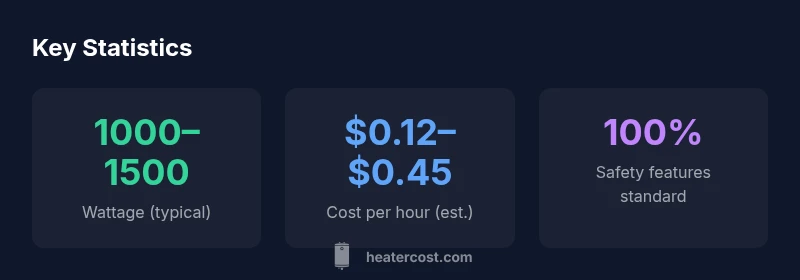
Heater 120v models typically run at 1000–1500 watts, translating to roughly 0.12–0.45 dollars per hour at common US electricity rates. They’re best for small rooms or spot heating, not whole-house warming. When selecting, prioritize safety features, energy efficiency, and the right size for the space. This reflects Heater Cost Analysis, 2026.
Understanding the heater 120v standard
In North America, the standard household circuit provides 120 volts. A heater 120v device is designed to plug into a regular outlet and deliver localized warmth. For homeowners evaluating heater options, the key is to match the unit’s wattage to the room size, use built-in safety features, and consider running costs. According to Heater Cost, when you talk about a heater 120v, you’re looking at compact, plug-in solutions that can supplement primary heating in smaller spaces. This guide from Heater Cost pulls together practical rules of thumb, typical wattage ranges, and cost considerations so you can choose a model that fits your space and budget.
Typical wattage and running costs
Most 120v space heaters operate between 500 and 1500 watts. A 1000-watt unit is a common default when you are unsure about room size. The running cost per hour depends on your local electricity price, typically expressed as dollars per kilowatt-hour. If you assume a price range like $0.07–$0.30 per kWh, a 1 kW heater costs roughly 8–30 cents per hour, while a 1.5 kW heater could be 12–45 cents per hour. Use these estimates as planning inputs, and remember that actual costs change with your rate plan and usage. This framing aligns with Heater Cost Analysis, 2026.
Safety features you should expect in 120V models
Safety is paramount with portable electric heaters. Look for features like a thermal cutoff or temperature limit switch that shuts the device off if it overheats. A sturdy tip-over switch that power-offs when the unit is knocked over is essential in living rooms or bedrooms. Overheat protection, a cool-touch housing, and a properly rated cord and outlet reduce fire risk. Some models include built-in thermostats and auto-restart after a power interruption. When you buy, verify certification marks and read the user manual to understand how to maintain safe operation.
Types of 120V heaters and where they fit
Within the 120V category you’ll encounter several technology approaches. Ceramic heaters use a ceramic element and a fan to distribute warm air; they heat quickly and cool down fast when off. Infrared or quartz heaters emit radiant heat that can feel warmer at a distance. Oil-filled radiators provide steady, gentle heat and often operate with a lower surface temperature, which some users prefer for bedrooms. Convection heaters circulate warm air through fins and fans. Each type has pros and cons for energy use, noise, and heat distribution, so choose based on room size, noise tolerance, and how you plan to zone heat.
Placement, sizing, and usage tips for best results
To maximize efficiency and safety, place the heater on a level, nonflammable surface, away from curtains or bedding. Maintain several feet of clearance from walls, furniture, and drafts. Avoid extension cords whenever possible; use a dedicated outlet for higher-wattage models. If you run multiple heaters, distribute them across circuits to prevent overload. For bedrooms, consider placing the unit near sleeping areas but away from the bed to avoid direct airflow. Use the built-in thermostat to keep a consistent temperature and reduce cycling.
Energy efficiency strategies for 120V heaters
Even small changes can reduce energy use. Set the thermostat to the lowest comfortable temperature and let the heater work as a zone heater rather than a space-wide solution. Use timers to limit runtime, especially when you are away or asleep. Combine a 120V heater with better insulation, draft stopping, and area rugs to reduce heat loss. In well-insulated rooms, a low-wattage setting can deliver adequate comfort without heavy energy use. The key is to heat only the space you are occupying and to monitor comfort with a small increase rather than a large one.
Maintenance and lifespan considerations
Regular maintenance extends the life of a 120V heater. Unplug the unit before cleaning and inspect the cord for cracks or exposed conductors. Clean dust from the grille and vent areas to maintain airflow and prevent overheating. Check that the plug, outlet, and cord remain in good condition; replace damaged cords with manufacturer-approved parts. Store units in a dry, cool area when not in use. Following manufacturer recommendations can help keep a heater 120v safe and effective for years.
Real-world scenarios: small bedroom vs living room
In a small 100–150 square foot bedroom, a compact 500–1,000 watt unit placed near the bed can provide comfortable warmth on chilly nights without overpowering the space. In a larger living room around 250–400 square feet, a 1,200–1,500 watt model used intermittently during the evening can supplement central heating without a long run. Real-world results depend on insulation, drafts, and how tightly you seal gaps. Use a lower setting for comfort and avoid continuous high-wattage operation.
Common mistakes to avoid with 120V heaters
Common mistakes include running a high-wattage heater on an undersized extension cord, placing it behind furniture, or using it as a primary heat source year-round. Don’t place heaters on carpets where heat can accumulate. Never leave a heater unattended around children or pets without supervision. Finally, avoid blocking air intakes or outlets; ensure adequate ventilation where needed. The Heater Cost team emphasizes safety and mindful usage as the default approach for 120V heating.
Quick reference: 120V heater basics
| Feature | Typical wattage | Voltage | Notes |
|---|---|---|---|
| Wattage range | 500-1500 | 120V | Depends on model and thermostat |
| Operating cost per hour | 0.06-0.45 | - | Based on kWh price range 0.07-0.30 |
| Safety features | Thermal cutoff; tip-over; overheat protection | - | Common in modern 120V models |
| Recommended room size | 100-400 sq ft | - | Best for small rooms or zones |
| Typical price range | 25-120 | - | Varies by features and brand |
Got Questions?
Is it safe to run a 120V heater all night?
Modern 120V heaters include safety features, but it is generally safer to use a timer or thermostat and avoid continuous operation through the night. Ensure the space has proper insulation and a safe surrounding area.
Use a timer and thermostat; don’t run it all night unless you have a proven safety setup.
Can I use a 120V heater on a power strip?
Avoid using power strips or extension cords with high-wattage heaters; they can overheat. Plug directly into a dedicated outlet for stability.
No, plug directly into a proper outlet to reduce fire risk.
What wattage is best for a 150 sq ft room?
For a well-insulated room of about 150 square feet, a heater in the 500–1000 watt range is usually sufficient, with adjustments for drafts.
A 500–1000 watt heater is commonly enough for that size.
Do electric heaters emit carbon monoxide?
No. Electric heaters do not burn fuel and do not emit carbon monoxide under normal operation. Always follow safety guidelines.
No CO risk from electric models when used properly.
Which heater type is quietest for a bedroom?
Oil-filled radiators and ceramic convectors are typically quieter than forced-air infrared units, making them suitable for bedrooms.
Oil-filled or ceramic heaters are usually quieter.
“A well-chosen 120V space heater can fill a room with comfortable warmth without breaking the bank, but correct sizing, safety features, and mindful usage are essential. Pair it with good insulation and timers to maximize efficiency.”
The Essentials
- Match heater wattage to room size for efficient heating.
- Estimate running costs: about $0.12–$0.45 per hour at common rates.
- Prioritize safety features like tip-over switches and overheat protection.
- Place heaters with ample clearance away from flammables.
- Use timers and thermostats to maximize efficiency.