Room Heater Low Watt: A Practical Guide for Small Spaces
Discover how low-watt room heaters heat small spaces efficiently. Learn sizing, energy costs, safety features, and practical buying tips from Heater Cost.


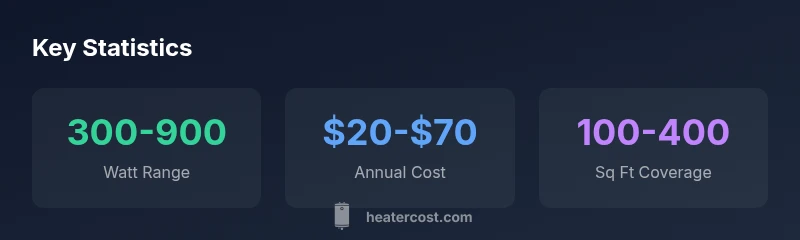
Low-watt room heaters typically operate in the 300–900 watt range, with 400–800W common for small rooms. This level provides targeted warmth while keeping energy use modest. For sustained heat, pair with proper insulation and thermostat controls to avoid overheating or high bills. This quick fact helps homeowners estimate running costs and plan heat strategy for tiny apartments, bedrooms, or offices. Starting with a conservative wattage ensures safety and comfort.
Why a low-watt room heater is a practical choice
In many homes, especially apartments or rooms with limited insulation, a room heater low watt option is the most practical way to add warmth without overhauling the heating system. A device that runs at 300–900 watts provides a targeted heat source that complements central heating rather than competing with it. The key benefits are lower up-front cost, reduced energy draw, and safer operation when used correctly. According to Heater Cost, selecting a unit at the lower end of this wattage range is often sufficient for personal comfort in small spaces like bedrooms, dens, or home offices. When used with a thermostat and eco mode, you can maintain a stable temperature without continuous high-power operation. The result is predictable energy consumption, fewer hot spots, and less impact on your monthly bill. Also, modern low-watt heaters include safety features such as tip-over switches and overheat protection, which significantly reduce risk for households with children or pets. This combination of affordability and safety makes low-watt models a sensible first step for many heating upgrades.
Sizing and placement for consistent comfort
Effective use starts with proper sizing and placement. For most small rooms under 200 square feet, a heater in the 400–800W range is commonly sufficient, while rooms around 100 square feet may be well-served by 300–600W options. If insulation is poor or windows are drafty, you may lean toward the higher end of these ranges. Place the heater on a stable, dry surface away from liquids, furniture, and drapes, with at least 3 feet of clearance on all sides. Avoid congested corners where airflow is blocked. If you’re unsure about fit, consider using two smaller units rather than a single high-wattage heater for even heat distribution and better control.
Operating costs and energy efficiency
Running costs hinge on the unit’s wattage, how long you run it, and your local electricity rate. A quick rule of thumb: cost per hour equals watts divided by 1000, times the price per kilowatt-hour. At typical residential rates, a 600W heater costs roughly 7–15 cents per hour to operate. This can add up over a chilly week, so using a programmable thermostat or eco mode helps keep expenses predictable. Energy-efficient features such as smart thermostats, oscillation for wider heat distribution, and automatic shutoff on overheating can further reduce consumption. Heater Cost Analysis, 2026 shows that small, well-controlled low-watt heaters can deliver comfort with a smaller energy footprint when compared to constant high-watt operations.
Safety features and maintenance
Safety should be your first priority with any space heater. Look for tip-over switches, overheat protection, and automatic shutoff when the unit tips or overheats. Keep the heater unplugged when not in use and avoid running it on an extension cord, which can overheat. Regular maintenance includes cleaning dust from grills, checking cords for damage, and inspecting the power switch. Always place heaters on hard surfaces rather than carpets to prevent heat buildup. If you notice strange smells, flickering lights, or oozing sounds, turn off the unit and consult a professional. With proper care, a low-watt heater remains a safe, reliable source of warmth for years.
Heat distribution: convection vs radiant vs fan-assisted
Low-watt heaters employ different heating methods. Convection models warm air that rises to circulate, which is effective for room-wide warmth when properly sized. Radiant/infrared units emit heat directly to objects and people, offering quick comfort at close range. Fan-assisted designs mix both approaches, using a small fan to accelerate heat spread. For best results in a small space, choose a model whose method aligns with your needs: instant warmth for a desk setup (radiant), or gradual, even warmth for a bedroom (convection).
How to compare models and specs
When evaluating options, focus on these key specs: wattage range, built-in thermostat, eco mode, noise level, and safety certifications. Look for modelos with a clear auto shutoff when ambient temperature rises too high and a stable base to prevent tipping. Compare energy efficiency claims by reviewing the efficiency mode and any programmable schedules. Check the cord length and the surface area the unit can heat, ensuring it matches your room size. Reading user reviews about real-world performance can help validate claims.
Practical use cases: bedrooms, home offices, porches
A 300–900W heater is particularly useful in a home office or bedroom where you want targeted warmth without heating the entire house. In a small living room or enclosed porch, a slightly higher wattage within the low-watt band provides comfortable warmth during colder days. For shared spaces, a compact, dual-unit setup may offer better heat distribution and user control. Always stagger placement to minimize drafts—one heater near the cooler wall and another near the seating area can distribute warmth more evenly.
Common myths and misconceptions
Misconception: Higher wattage always means faster heating. Reality: In a small space, proper insulation and placement often determine perceived warmth more than wattage alone. Myth: Low-watt heaters are unsafe. Reality: When used with safety features and proper clearance, these units are safe for typical indoor spaces. Myth: You should run a heater non-stop to stay warm. Reality: Programmed thermostats and eco modes improve comfort while saving energy. By debunking these myths, homeowners can approach room heating more rationally and efficiently.
Comparison of low-watt room heater types
| Model Type | Typical Wattage Range | Best For | Notes |
|---|---|---|---|
| Compact desk heater | 300-600 W | Personal warmth | Quiet operation, ideal for desks |
| Small room heater | 400-800 W | Bedrooms/living rooms under 200 sq ft | Energy-efficient supplemental heat |
| Large room heater | 800-1500 W | Larger spaces | More power, careful placement needed |
| Dual-unit setup | 600-900 W per unit | Shared spaces | Better distribution of heat |
Got Questions?
What wattage is best for a small bedroom?
For a small bedroom, a 400–800W unit is usually sufficient. If the room is poorly insulated or has drafty windows, consider the higher end of that range. Pairing with a thermostat enhances comfort without wasting energy.
For a small bedroom, a 400 to 800 watt heater is usually enough, especially if the room isn’t drafty. Use a thermostat to keep it comfortable.
Can a low-watt heater heat a large room?
A low-watt heater will heat a portion of a large room effectively but not the entire space. For larger rooms, use higher wattage within the low-watt band or supplement with another heater for even coverage.
It can help in a large room, but you may need more power or another heater for full coverage.
Is it cheaper to run a low-watt heater all day?
Running any space heater all day usually raises costs. Use an programmable thermostat or eco mode to balance warmth with energy savings, and insulate the room to reduce heat loss.
Running it all day can be costly; use eco modes and insulation to save energy.
What safety features should I look for?
Look for tip-over switches, overheat protection, and automatic shutoff. Ensure it has a stable base and is certified for indoor use. Keep it away from water and flammable materials.
Seek tip-over protection, auto shutoff, and a stable base for safe use.
Do low-watt heaters make a lot of noise?
Most low-watt heaters are quiet, especially radiant or convection models. Some fan-assisted units may produce light fan noise. If noise is a concern, choose a model marketed as quiet operation.
Most are quiet, but some fan models can be a bit noisy.
How should I install a low-watt heater safely?
Place on a stable, flat surface away from water, curtains, and furniture. Do not run on carpets and avoid extension cords. Follow the manufacturer’s instructions and keep children and pets away when heating.
Put it on a stable surface, away from water and clutter, and use guidelines from the manual.
“A measured approach to wattage and safety yields comfortable warmth without waste. Pairing the right low-watt heater with smart controls is the key to efficient small-space heating.”
The Essentials
- Choose wattage based on room size and insulation
- Prioritize safety features like tip-over switches
- Use thermostats and eco modes to control costs
- Place heaters with adequate clearance for safe operation
- Compare models by wattage, thermoset, and noise