Do Space Heaters Use a Lot of Electricity? A Practical Guide
Discover how space heaters consume electricity, what affects cost, and how to use them safely and efficiently. Compare wattage, runtimes, and alternatives for warm home comfort.


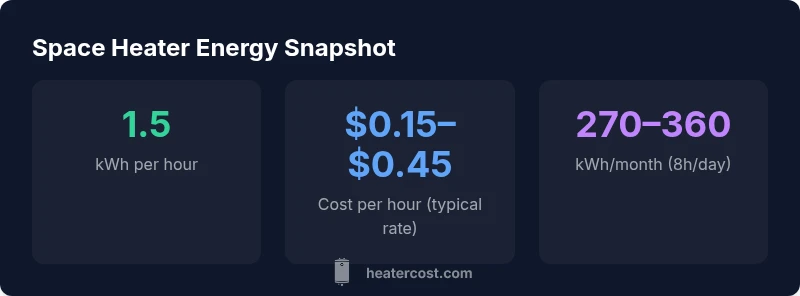
A typical 1500-watt space heater draws about 1.5 kilowatts, so running it for one hour uses roughly 1.5 kWh of electricity. Over a day, 6–8 hours can consume about 9–12 kWh, and a 30-day window could reach roughly 270–360 kWh, depending on usage. Costs vary by rate, roughly $0.10–$0.30 per kWh.
Do space heater use a lot of electricity
The simple answer to whether do space heater use a lot of electricity is: it depends on how you use it. A standard 1500-watt space heater can consume about 1.5 kWh per hour, which sounds large compared with a single room’s heat loss. If you only need to warm a small zone for a few hours, the electricity used may be reasonable. If you run it all day in a large space, the cumulative consumption can become substantial. For homeowners evaluating costs, it helps to frame electricity use in terms of watts, hours, and local rates. The takeaway is not that space heaters are inherently 'bad' for energy use; it’s that their efficiency hinges on scope, duration, and how well the space is insulated.
Contextual note: In many households, a space heater is most efficient when used as a targeted supplement rather than the primary heat source. When you evaluate do space heater use a lot of electricity, consider both the heater’s wattage and the length of time it runs. In regions with higher electricity rates, even short run times can add up quickly. This is why an informed approach—using thermostats, timers, and zone heating—can dramatically reduce costs while keeping rooms comfortable.
How wattage translates to consumption and cost
Wattage is the single most important input for estimating electricity use. A heater rated at 1000 W will consume approximately 1.0 kWh per hour if run continuously, while a 1500 W unit consumes about 1.5 kWh per hour. To estimate daily or monthly usage, multiply the hourly energy by hours of operation. For example, running a 1500 W heater for 6 hours results in ~9 kWh consumed in that day. Multiply by a typical billing cycle, and you can see why even modest run times can impact a home’s energy bill. If you live in an area with higher or lower electricity rates, you’ll see this cost adjust proportionally. Use this framework to compare models and determine whether a heater provides incremental comfort without breaking the budget.
Practical tip: If you’re unsure whether a heater meets your comfort needs, start with a 1000 W unit and test for a few days. If you still feel cool, consider stepping up to 1500 W only during peak demand times, rather than leaving a higher-wattage unit on for extended periods.
Real-world factors that affect space heater electricity use
Energy use is not determined by wattage alone. Room size, insulation quality, window drafts, and existing heating contribute significantly to how much energy you need from a space heater. A well-insulated 150–250 square foot room may maintain warmth with shorter run times, while drafty spaces require longer operation or a higher wattage. Infrared heaters can feel warmer at the same wattage because they heat objects directly rather than the air, which can influence perceived comfort and the actual energy cost. Conversely, convection models warm the air, which can dissipate faster in cooler rooms, potentially requiring longer operation to achieve the same comfort level. When considering do space heater use a lot of electricity, assess the room’s heat loss rate and balance it against the heater’s output.
Key takeaway: Pair heaters with drapes, weatherstripping, and door seals to reduce heat loss, then use the heater mainly for short-term zone heating rather than continuous full-room heating.
Safety and efficiency: tips to lower electricity use
To reduce electricity use without sacrificing comfort, deploy these best practices:
- Use thermostats and timers to automate daily heat needs and avoid idle warmth.
- Zone heating: target heat where you spend the most time (living room, home office).
- Insulate and seal drafts: a well-insulated space needs less heater runtime.
- Choose an energy-efficient model with a programmable thermostat and ECO mode.
- Maintain clearance around the heater and avoid running on carpet or cluttered spaces that impede airflow.
- Consider more efficient options for long-term heating: heat pumps or improved insulation in place of long-term space heating.
Decision guidance: If you must heat a large area for several hours, consider whether the cumulative electricity cost makes sense compared to upgrading insulation or using a more efficient, central solution.
Alternatives and complementary heating strategies
Space heaters shine for quick, localized warmth but are not ideal for entire-home heating. Alternatives include improving insulation, using a heat pump as a primary heating source, and employing smart zoning with modern thermostats. A practical approach is to use space heaters sparingly, such as for short-term comfort after arriving home or when a room is temporarily unoccupied. In colder months, sealing leaks and adding weatherstripping can dramatically cut energy losses, reducing the need for heavy heater use. When evaluating whether do space heater use a lot of electricity, remember: the price tag on electricity is still a major factor, so pairing space heaters with energy-efficient building practices yields the best long-term savings.
How to choose the right space heater for efficiency and comfort
Selecting the right heater involves matching the space to the heater’s capacity. For small rooms, a 1000 W model may be sufficient; for larger rooms, a 1500 W or higher unit with an efficient thermostat saves energy by delivering heat where and when you need it. Look for safety features such as tip-over protection and overheat shut-off, and verify the heater has a built-in thermostat that maintains a steady room temperature without cycling on and off constantly. Finally, compare energy-use features like ECO modes and smart timers. The overarching guidance is to use space heaters as a targeted tool rather than a blanket heating solution—this reduces overall electricity use while improving comfort in the specific zone.
Common mistakes that drive up electricity use
Common missteps include running heaters in uninsulated spaces, leaving doors open, and failing to use timers or thermostats. Another frequent error is keeping the heater on high wattage for extended periods instead of enabling moderate heat with shorter cycles. Additionally, placing heaters on soft surfaces such as beds or couches can block airflow and concentrate heat in unsafe ways, increasing energy waste. By avoiding these mistakes and focusing on controlled, intentional use, you can significantly reduce electricity costs while maintaining warmth in the areas that need it most.
Energy use scenarios for space heaters
| Scenario | Power (W) | Hourly Energy (kWh) | Estimated Hourly Cost | Notes |
|---|---|---|---|---|
| Standard Space Heater | 1500 | 1.5 | 0.15–0.45 USD | Typical 120V supply; main heat in a small zone |
| Smaller Heater | 1000 | 1.0 | 0.10–0.30 USD | Supplementary heat for compact spaces |
| Larger Heater | 2000 | 2.0 | 0.20–0.60 USD | High heat in larger rooms or drafts |
Got Questions?
Do space heaters use more electricity than central heating?
In general, space heaters are more energy-intensive per square foot than centralized systems when used to heat large spaces. They are most efficient as a targeted supplement for small zones. For whole-home comfort, a central system with proper insulation often proves more energy-efficient overall.
Space heaters can be expensive per square foot if used to heat large areas. They work best for targeted warmth in small zones, not as a total-home solution.
Is it safe to run a space heater all night?
Most manufacturers advise against overnight continuous operation. If you need warmth while you sleep, use timers or smart thermostats to reduce runtime, keep the unit away from fabrics, and never leave it unattended.
Don’t leave space heaters running all night. Use a timer or thermostat and keep flammables away.
How can I reduce electricity usage with a space heater?
Use thermostats or timers to limit runtime, target a small zone, seal drafts, and choose energy-efficient models with ECO or low-watt modes. Combine with better insulation to reduce overall heat loss.
Set a timer, heat only the needed area, and improve insulation to cut energy use.
What wattage should I choose for energy efficiency?
Start with the lowest wattage that meets your comfort needs—often a 1000 W unit suffices for small spaces. If you need more heat during peak times, switch to a higher wattage only when necessary.
Choose the smallest wattage that keeps you comfortable, upgrading only for brief periods.
Are infrared space heaters more energy-efficient than convection models?
Infrared heaters can feel warmer at the same wattage because they heat objects and people directly rather than warming air. Actual energy efficiency depends on room size, insulation, and usage pattern, not just heater type.
Infrared heaters feel warmer at the same wattage, but actual savings depend on room and use.
Can space heaters be a good option for whole-home heating?
Space heaters are not designed to replace a central heating system for entire homes. They’re best used for targeted heating and shorter bursts of warmth in specific zones, combined with better insulation and efficient central heating where possible.
They’re not ideal for entire-home heating; use them for zones and improve insulation instead.
“Space heaters can be a cost-effective way to heat a small area when used sparingly and with safety features.”
The Essentials
- Know the wattage and run time to estimate consumption
- Insulation and room size dramatically affect cost
- Use thermostats and timers to optimize efficiency
- Infrared vs convection affects perceived warmth and energy
- Pair space heaters with building improvements for best savings