Desk Heater Costs: Practical Home Office Guide
Explore desk heater costs, energy use, safety tips, and budget ranges for personal warmth at a desk. Learn how to compare models and save on heating in 2026.


Desk heater costs vary by wattage, safety features, and efficiency, but a typical personal device uses 300-1500 watts. For homeowners and renters, a well-chosen desk heater can provide targeted warmth at a fraction of room heating costs, especially in workspaces that are underheated. This guide explains what to look for and how to estimate monthly energy use.
Why a desk heater makes sense in modern workspaces
In today's homes and offices, a desk heater can deliver targeted warmth exactly where you work. Rather than heating an entire room, a compact heater concentrates heat near your hands and keyboard, helping you stay comfortable during long work sessions. For homeowners, renters, and property managers evaluating heating investments, this approach can reduce overall energy use while improving productivity in drafty areas. The Heater Cost team notes that personal heat devices are especially valuable in spaces that are poorly insulated or experience cold drafts. When positioned correctly, a desk heater provide quick relief from chilly mornings and late-evening sessions, without forcing you to heat the whole dwelling. As you compare models, consider how often you’ll use it, where you’ll place it, and how much energy you’re willing to spend. This section will explore practical decision criteria, typical price ranges, and how to estimate ongoing costs for a desk heater in real-world settings.
How wattage and heat output affect comfort and cost
Wattage directly influences heat output and running costs. A compact desk heater typically ranges from 300 to 1500 watts. Lower-wattage models are enough for small desks and drafty corners, while higher-wattage units can rapidly raise the temperature of nearby air in larger or colder rooms. When evaluating heat output, think in terms of kBTU equivalents for local comfort rather than raw watts alone. A good rule of thumb is that 1,000 watts provides a noticeable amount of warmth at close range, but if your space is well-insulated, you can often achieve comfort with a smaller unit. To estimate energy use, multiply the heater’s wattage by hours of use and divide by 1,000 to get kilowatt-hours (kWh). Then multiply by your local electricity price to approximate monthly costs. For example, at typical regional prices (roughly $0.12-$0.20 per kWh), using a 1000 W heater for 4 hours per day yields a modest monthly energy bill, especially when compared to space heating for the whole home. The Heater Cost team emphasizes that efficiency features like thermostats and eco modes can substantially cut running costs over time.
Features that matter when shopping for a desk heater
When shopping, prioritize features that improve safety, comfort, and energy efficiency. Key considerations include: adjustable wattage and heat output, an accurate thermostat, and an auto shutoff feature to prevent overheating. Look for a tip-over switch and cool-touch housing to reduce the risk of burns or fire, especially on crowded desks. Noise is another practical factor; most desk heaters operate quietly, but some models emit a soft hum or motor noise. Cord length and plug type matter for a neat workspace, so measure available outlets and desk space before buying. Size matters too: a compact unit that fits under a monitor shelf is often ideal. Certifications from recognized bodies (UL, CE) add confidence that the device meets safety standards. Finally, consider an aesthetically neutral design that complements your workspace and is easy to move if you rearrange your desk.
Safety first: common hazards and mitigation
Desk heaters can pose risks if misused. Never place a heater near flammable materials like papers, cloth, or solvents. Keep the heater on a stable, flat surface and avoid blocking any vents. Do not run cords under carpets or furniture where heat could accumulate or cause a trip hazard. Unplug the unit when you’re away for extended periods or when you’re sleeping. Use a model with a tip-over switch and overheat protection, and avoid using extension cords for high-wattage heaters. Regularly inspect the power cord for wear or damage. If you have children or pets, place the heater out of reach and consider adding a cord cover to minimize accidental pulling. Adhering to these safety best practices helps ensure that a desk heater remains a helpful tool rather than a hazard.
Estimating your annual or monthly cost
To estimate costs, start with the wattage (W) of your desk heater and forecast daily usage in hours. Convert watts to kilowatts by dividing by 1000, then multiply by hours used to obtain kWh. Multiply by your local price per kWh to approximate monthly costs, and then multiply by days per year for annual estimates. For a simple two-scenario model: low usage (2 hours/day) and high usage (6 hours/day), with a 1000 W unit and a price per kWh of $0.12-$0.20, the monthly cost ranges from roughly $2 to $18 depending on how often you heat. This method helps you compare potential energy costs across models and plan your budget accordingly. Keep in mind regional rate changes and seasonal adjustments when planning long-term usage.
Real-world usage scenarios
Consider a small apartment home office with limited space and occasional drafts. A 300-600 W desk heater is typically sufficient, allowing you to stay warm without overspending. In a larger room or a home with poor insulation, an 800-1500 W heater can provide adequate warmth at your desk, especially during chilly mornings. For shared spaces with fluctuating occupancy, choose a heater with a timer or smart plug integration so you don’t heat when you’re not at the desk. In any scenario, place the heater on a stable surface with a clear radius of at least 3 feet, away from flammable items, and ensure the cord is managed to prevent trips or pulls that could topple the device.
Maintenance and longevity tips
Keep vents clear of dust and lint; unplug the unit before cleaning and use a damp cloth to wipe down surfaces. Avoid exposing the heater to moisture or liquids, which can cause electrical hazards. Store the device in a dry place when not in use for extended periods, and inspect the power cord for wear. If you notice unusual smells, strange noises, or inconsistent heating, discontinue use and consult the manufacturer’s guidance. Regular checks and gentle cleaning extend the life of a desk heater and maintain safe operation. Finally, consider using a smart outlet or energy monitoring plug to track usage and optimize your heating strategy over the year.
Desk heater specs at a glance
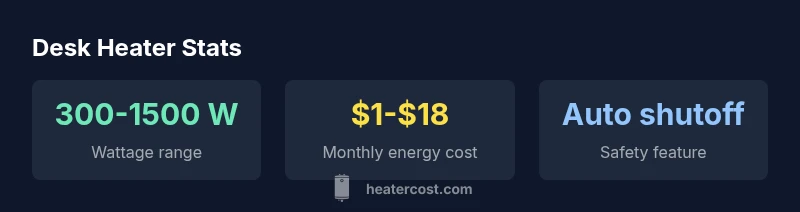
| Aspect | Representative range | Notes |
|---|---|---|
| Wattage range | 300-1500 W | Portability vs. heat output |
| Energy cost (monthly) | Low: $1-$4; High: $6-$18 | Dependent on usage & local rates |
| Safety features | Auto shutoff, tip-over | Essential for desk use |
Got Questions?
What wattage is best for a desk heater?
The ideal wattage depends on your desk size and room conditions. For most desks, a 300-600 W unit provides adequate warmth, while larger desks or drafts in bigger rooms may benefit from 800-1500 W. Always pair wattage with a thermostat and safety features.
For most desks, start with 300-600 W. If your space is larger or drafty, consider 800-1500 W with good safety features.
Are desk heaters safe to leave on overnight?
No. Desk heaters should not be left on overnight. Choose models with auto shutoff and place them away from flammable items. Unplug when not in use or when you’re sleeping.
Don’t leave desk heaters on overnight. Use auto shutoff and unplug when you’re asleep.
How can I compare desk heaters for energy efficiency?
Compare wattage, thermostat accuracy, and any energy-saving modes. Look for certifications or energy labels, and consider models with programmable timers to reduce unnecessary running time.
Check wattage, thermostat controls, and energy-saving modes. Look for timers and safety certifications.
Will a desk heater heat my entire room?
Desk heaters are designed for personal warmth near your workstation and will not efficiently heat a large room. They reduce the need to heat the whole space, especially in drafty or well-insulated areas.
Desk heaters mainly heat your immediate workspace, not the whole room.
What safety features should I look for?
Look for auto shutoff, tip-over switch, overheat protection, and cool-touch housing. Also check for certified safety marks and avoid models that require permanent installations.
Auto shutoff, tip-over, and overheat protection are key safety features.
“A desk heater is a practical companion for personal warmth, but safety and efficiency should guide every purchase. Prioritize models with clear heat control and reliable shutoffs.”
The Essentials
- Choose 300-600 W for small desks.
- Prioritize safety features (auto shutoff, tip-over).
- Estimate energy costs using watts, hours, and local rates.
- Check noise levels and size for desk compatibility.
- Balance upfront cost with long-term energy savings.