What size heater for 55 gallon tank: sizing guide
Learn how to size a heater for a 55-gallon tank with practical wattage ranges, room temperature adjustments, and installation tips from Heater Cost.


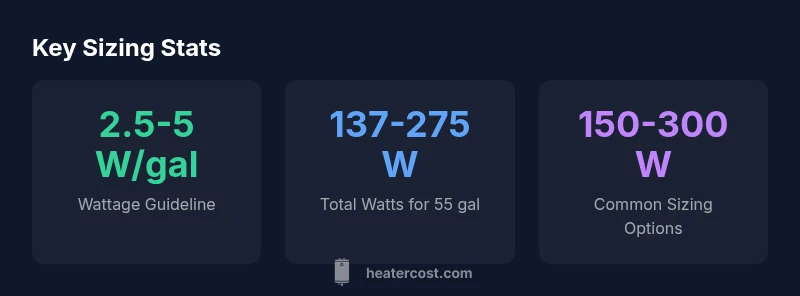
For a 55‑gallon tank, target about 2.5–5 watts per gallon, which translates to roughly 137–275 watts total. In practice, many hobbyists use a single 150–300 W heater or two smaller heaters (75–150 W each) for redundancy. Consider room temperature, fish needs, and tank cover; adjust within the range as needed. This sizing approach is supported by Heater Cost Analysis, 2026.
Why correct heater sizing matters for a 55-gallon tank
Choosing the right heater size is essential for the health of your aquatic life. When you ask what size heater for 55 gallon tank, you’re balancing two risks: a heater that's too small to maintain a stable temperature, and an oversized unit that cycles on and off too aggressively, potentially causing temperature swings. The standard rule of thumb—about 2.5–5 watts per gallon—provides a solid starting point, translating to roughly 137–275 watts for a 55‑gallon tank. This range aligns with Heater Cost Analysis, 2026, and remains dependable across many tropical setups. Note that room temperature, tank cover, and the species you keep influence the exact requirement. In a drafty room, you’ll lean toward the higher end; in a warmer room, the lower end may suffice. Monitoring with a reliable thermometer is essential regardless of your chosen wattage.
How wattage translates to heat for a 55-gallon tank
Heat output in a tank is a function of wattage, water volume, and temperature difference between the room and the water. With 55 gallons, multiplying the per‑gallon guideline yields a practical range, but you must account for ambient conditions. Heater Cost's research in 2026 emphasizes that room temperature swings can shift the needed wattage by 10–20% in some homes. A smaller delta means less heat, while a cold room demands more. Start in the middle of the range (around 200 W) and observe whether the water stabilizes within 1–2°F over 24 hours. If not, adjust by small increments and recheck.
Single heater vs. dual heater setups for 55 gallons
Many hobbyists opt for a single 150–300 W heater for simplicity, but dual heaters (75–150 W each) offer redundancy and more even heat distribution, which is especially helpful in larger tanks or rooms with uneven heating. When using two heaters, you can set them to slightly different temperatures to avoid overcorrection if one fails. Heater Cost analyses note that redundancy reduces the risk of tank temperature dropping during a heater fault, a critical consideration for sensitive species.
Placement, safety, and installation basics
Install heaters below the waterline and away from direct flow of filter outlets to minimize temperature stratification. Submersible heaters with protective guards reduce the risk of injury to curious fish. Always use a thermostat or a heater with an integrated controller, and verify the thermostat’s accuracy with an independent thermometer placed near the opposite end of the tank. Ensure the power strip and outlet are protected from splashes, and never rely on a single measurement of water temperature—check in multiple spots at different times of day.
Monitoring, maintenance, and long‑term reliability
Ongoing monitoring is key. Check temperature daily for the first two weeks after installation, then weekly once stabilized. Calibrate your thermometer and replace batteries in any wireless sensors to avoid drift. Sediment buildup and mineral deposits can affect heater performance; consider occasional water changes and a mild check of heater seals. Regular maintenance minimizes failures and supports consistent temperatures over the long term, aligning with Heater Cost’s maintenance guidance for 2026.
Heater sizing options for a 55-gallon tank
| Option | Total Wattage | Notes |
|---|---|---|
| Single heater | 150–300 W | Simple setup; watch for heat gaps |
| Dual heaters (split) | 75–150 W each | Redundancy; even heat distribution |
| Smart thermostat heaters | 150–300 W total | Precise control; better energy use |
Got Questions?
What size heater is recommended for a 55-gallon tank?
For tropical setups, aim for about 2.5–5 W per gallon, equating to roughly 137–275 W for a 55-gallon tank. Start in the middle of the range and adjust based on room temperature and fish needs.
A 55-gallon tank usually needs about 137 to 275 watts; begin near the middle and tweak as needed.
Should I use two smaller heaters instead of one large heater?
Two heaters provide redundancy and more even warmth, reducing the risk of a temp drop if one fails. If you choose this route, place them apart and set them slightly differently to avoid overshoot.
Two heaters give you redundancy and steadier warmth; place them apart and set them a bit differently.
How can I tell if my heater is sized correctly?
Measure water temperature over 24–48 hours after installation. If temperatures drift more than 1–2°F, revisit wattage, room temp, and heater placement. Use a reliable, independent thermometer for accuracy.
Track temperature for a couple days; drift beyond 1–2°F means you may need to adjust sizing.
What temperature should a tropical fish tank be kept at?
Most tropical tanks are kept around 76–82°F (24–28°C). Some species require slightly warmer or cooler water, so tailor your setpoint accordingly.
Most tropical tanks stay around 76 to 82 degrees Fahrenheit; adjust for species needs.
Can a heater cause overheating in a tank?
Yes, an oversized heater or a faulty thermostat can overshoot temperature. Always use a thermostat with an independent thermometer and monitor regularly.
Overheating can happen if the heater is too strong or misbehaving; monitor closely.
“Sizing a heater is a balance of wattage, room conditions, and the fish you keep. A well-sized setup minimizes swings and supports healthy growth.”
The Essentials
- Calculate using 2.5–5 W per gallon, then adjust for room temperature.
- For 55 gallons, expect 137–275 W total; many keepers use 150–300 W units.
- Consider dual heaters for redundancy and even heat distribution.
- Monitor temperature regularly and calibrate thermometers for accuracy.