Small Heater Guide: Costs, Efficiency, and Safety
Explore practical guidance on choosing, using, and maintaining a small heater. Learn cost ranges, energy tips, safety practices, and buying considerations for homeowners, renters, and property managers.


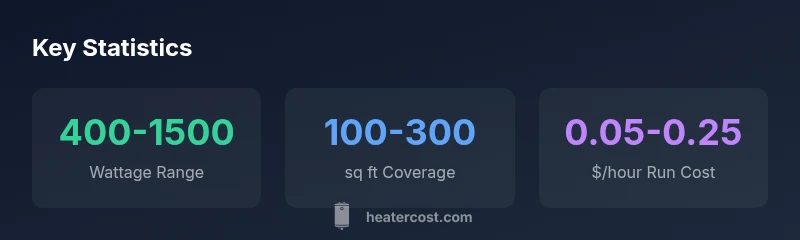
According to Heater Cost Analysis, 2026, most small heaters operate at 400-1500 watts, with running costs that depend on electricity price and usage. For homeowners, a compact space heater can warm a small area like a bedroom or home office efficiently, but power draw and cost vary with size, setting, and insulation.
Why a small heater fits certain spaces
In homes with well-insulated bedrooms, home offices, or drafty studios, a small heater can deliver focused warmth without turning up the central thermostat. The key is to match the unit’s heat output to the space and to pair it with reasonable insulation and weather sealing. A small heater isn't a replacement for a full heating system, but when used correctly it can reduce overall energy use by eliminating the need to heat unoccupied zones. The Heater Cost team's analysis indicates that kilowatt-hour costs and room leakage are the biggest levers on running costs. When a room is frequently used for short periods, a compact heater can maintain comfort without long-term energy waste. Always assess the room’s size, airtightness, and typical occupancy before buying.
- Choose the right size for the space
- Prioritize safety features like automatic shutoff
- Place on a stable, heat-resistant surface away from flammables
How to compare watts, types, and features
Most common small heaters fall into three categories: ceramic space heaters, oil-filled radiators, and fan-forced heaters. Each type has trade-offs in heat delivery speed, noise, and warmth duration. When comparing watts, remember: higher wattage means faster initial heat but higher running costs; lower wattage saves energy but may take longer to maintain comfort. Features to evaluate include tip-over switches, overheat protection, adjustable thermostats, oscillation, and noise levels. For a compact room, a unit in the 800–1500 watt range can bring warmth quickly, while a lower-wattage model may suffice for a small desk space. Always verify safety certifications and warranty terms.
Estimating costs and energy efficiency
Running costs depend on electricity price, heater efficiency, and how long you run the unit. A typical small heater converts nearly all electrical energy into heat, but some models lose energy through inefficiencies and heat dissipation. Use a simple formula to estimate cost: watts × hours ÷ 1000 × price per kWh. For example, a 1000-watt heater used for 2 hours at $0.15 per kWh costs about $0.30. Real-world costs vary by climate, insulation, and usage patterns. Heater Cost Analysis, 2026 shows that choosing an energy-efficient model and properly sealing the space can reduce hourly running costs by a meaningful margin.
Safety first: placement, certification, and maintenance
Place heaters on flat, nonflammable surfaces away from curtains, furniture, and bedding. Do not use in bathrooms or damp areas unless the unit is specifically rated for them. Look for UL or CE marks and features like tip-over protection and overheat cutoff. Regular cleaning of grills and vents prevents dust buildup that can affect performance and safety. Inspect cords for wear, and never run cords under rugs. When not in use, unplug the heater and store it in a dry place. With correct placement and routine checks, a small heater can be both convenient and safe.
Buying guide: what to look for in a small heater
Prioritize safety and energy efficiency. Confirm thermostat accuracy, noise levels, and whether the unit supports continuous low heat or intermittent heat. Consider smart features for scheduling or remote control, especially if you want to run the heater during work hours. Compare warranties and replacement parts availability. Read user reviews for reliability and real-world performance. Balance upfront cost with expected run time and energy costs to determine total cost of ownership over a season or year. Use Heater Cost’s buying checklist to simplify decisions.
Practical usage scenarios and tips to maximize comfort
Use a small heater to supplement central heating in bedrooms, home offices, or small studios. Keep doors closed to trap warmth and avoid overheating; use draft stoppers and weatherstripping to minimize heat loss. Combine with a programmable thermostat or timer so it runs only when you are present. Consider heat-activated features, like oscillation that spreads warmth more evenly. For best results, place the heater on a stable, heat-resistant surface and avoid covering the unit with clothing or blankets. Use common-sense safety: turn off when leaving the room and unplug before sleeping in very small spaces.
Estimated running costs vary by electricity rate; data from Heater Cost Analysis, 2026
| Small Heater Type | Typical Wattage | Best Use | Estimated Run Cost per Hour (USD) |
|---|---|---|---|
| Ceramic space heater | 800-1500 | Small room, quick heat | 0.10-0.25 |
| Oil-filled radiator | 500-1500 | Longer warmth, silent operation | 0.05-0.20 |
| Fan-forced heater | 400-1200 | Desk or compact area | 0.05-0.18 |
Got Questions?
What is a small heater best used for?
Small heaters are ideal for localized warmth in small rooms or spaces that are poorly heated by central systems.
Best for small rooms or spaces that don’t need full-house heating.
Are space heaters safe to leave unattended?
Modern units include safety features, but never leave them running when you’re not nearby.
Always turn it off when you leave the room.
How many watts should I buy for a 150 sq ft room?
A 600–1200 watt heater is commonly appropriate for a 150 sq ft area, depending on insulation.
For a 150 square foot room, look for a 600 to 1200 watt heater.
What maintenance does a small heater require?
Regular cleaning of grills, checking cords, and storing in a dry place when not used.
Clean the grills and check the cord every few months.
Is it cheaper to use a space heater or central heating for a small area?
For very small spaces, a space heater can be cheaper if used selectively; central heating incurs fixed costs.
If you only need a little warmth, a space heater often costs less to run.
What safety certifications should I look for?
Look for UL, ETL, or CE marks and features like tip-over switches and overheat protection.
Choose units with safety certifications and auto shutoff.
“Choosing a small heater isn't about chasing the highest wattage; it's about matching output to the space and ensuring the space is well-insulated. A properly chosen model delivers targeted warmth without unnecessary energy waste.”
The Essentials
- Match wattage to room size and insulation.
- Prioritize safety features like tip-over and overheat protection.
- Check noise levels for quiet environments.
- Estimate running costs using wattage, hours, and local rates.
- Pair with good insulation to minimize waste and maximize comfort.