Small Heater for a Room: A Comprehensive Guide for 2026
Learn how to choose a small heater for a room, size it correctly, compare types, estimate costs, and improve safety with practical tips from Heater Cost. Ideal for homeowners, renters, and property managers.


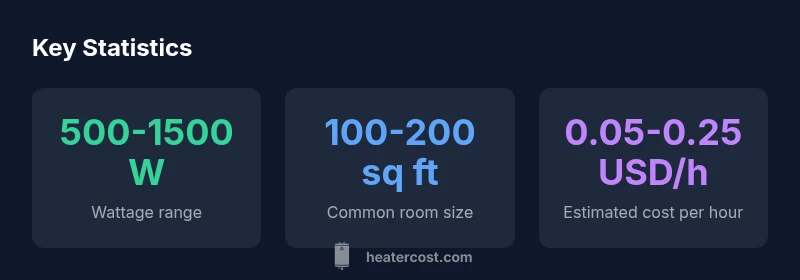
A small heater for a room typically uses 500-1500 watts, with the exact wattage depending on room size and insulation. For most 100–200 square foot spaces, a unit in the 750-1200 watt range is adequate; larger rooms or poor insulation may require up to 1500 watts. When shopping, prioritize thermostat control, overheat protection, and tip-over safety. Proper placement and ventilation maximize efficiency.
What counts as a small heater for a room?
Choosing a small heater for a room means balancing compact size with sufficient heat output and safety. The Heater Cost team found that most households benefit from devices designed for space heating rather than large, room-dominating models. According to Heater Cost, a true small heater should be easy to move, fit on a table or floor without blocking airflow, and include essential safety features such as a tip-over switch and overheat protection. In practice, the best choice depends on room dimensions, insulation quality, and climate expectations. We’ll discuss wattage targets, heater types, and practical buying criteria so you can pick a model that keeps your space comfortable without wasting energy.
Room sizing and wattage guidelines
A practical starting point for a small heater for a room is a wattage target of roughly 10 watts per square foot, assuming average insulation and moderate climate. For example, a 100–150 square foot room typically calls for a 1000–1500 watt unit, while a smaller 60–80 square foot space might get by with 500–1000 watts. If the space has large windows, high ceilings, or poor insulation, you may need to push toward the upper end of that range. Conversely, well-insulated spaces may require less heat. This sizing approach aligns with common industry guidance and is reinforced by Heater Cost Analysis, 2026. Always test the comfort level and adjust with a thermostat-controlled model to avoid overheating.
Types of small heaters and their pros and cons
There are several compact heater types suitable for small rooms, each with trade-offs. Ceramic convection heaters warm the air and spread heat quickly but can produce stronger fan noise. Oil-filled radiators offer steady warmth with quiet operation and low surface temps, but heat up more slowly. Infrared (radiant) heaters deliver targeted warmth to people and objects, which is useful near desks or seating areas but may feel uneven across a room. Micathermic combinations blend effects. When selecting, compare heat transfer, energy use, and safety features such as tip-over sensors and thermostats. The Heater Cost team notes that many modern models combine smart thermostat compatibility with energy-saving modes to reduce running costs over time.
Key features that influence cost and safety
Cost and safety hinge on features that matter in real-world use. The most important include an adjustable thermostat, an automatic shutoff when the unit overheats, and a stable base to prevent tipping. Look for a cool-to-the-touch exterior, a properly rated cord, and a space around the heater that meets clearance recommendations. Energy efficiency matters too; some units include eco-modes, energy-saver timers, and smart connectivity. Safety certifications (such as UL or ETL) provide assurance of reliability. The Heater Cost analysis emphasizes prioritizing units with multiple heat settings, a programmable timer, and a clear warranty to protect your investment.
Placement, ventilation, and practical usage tips
Placement can dramatically influence comfort and safety. Position the heater on the floor or a stable surface, not on furniture, and maintain several feet of clearance from curtains, bedding, and other combustibles. Avoid running cords under rugs or across doorways. Ensure a dedicated outlet to avoid overloading circuits, and never leave a space heater unattended, especially in bedrooms or near children's rooms. If you’ll use the heater in a damp area, pick models rated for bathroom or humidity-prone environments. Regularly inspect the power cord for wear and replace damaged units promptly.
Real-world scenarios: sizing for common room sizes
Consider these practical scenarios to translate wattage targets into real purchases. For an 80 square-foot reading nook, a compact 500–800 watt heater can usually maintain comfort; for a 150 square-foot living area, a 1000–1500 watt unit is typical. A larger 300 square-foot family room often requires a 2000–3000 watt system or multiple smaller heaters to distribute heat evenly and avoid hotspots. In all cases, prioritize models with thermostats and safety shutoffs to minimize running costs and reduce fire risk. The Heater Cost analysis suggests starting with the smallest unit that meets comfort and upgrading only if needed.
Operating costs, efficiency considerations
Operating costs depend on wattage, hours of use, and electricity rates. The same heater running longer at a lower level can be cheaper than brief bouts at high settings, so using a thermostat and energy-saving mode pays off. For budgeting, calculate hourly running costs by multiplying wattage (in kilowatts) by your local rate per kilowatt-hour and then by hours used. In regions with higher electricity prices, favor energy-efficient models with smart features that optimize runtime. This aligns with Heater Cost Analysis, 2026, which highlights the cost-benefit of programmable timers and zone heating where appropriate.
Maintenance, safety checks, and budget-friendly buying tips
Keep your small heater reliable by performing simple maintenance: wipe the grills to prevent dust buildup, check the power cord for cracks, and replace worn-out parts under warranty. Store the device in a dry, indoor location away from moisture when not in use. When budgeting, compare upfront cost with long-term running costs, and consider multi-unit setups for larger spaces rather than one oversized heater. Look for reputable brands, verified safety certifications, and clear return policies. A thoughtful combination of sizing, features, and maintenance helps you get the most warmth for your dollar.
Sizing guidance for small room heaters
| Factor | Guidance | Notes |
|---|---|---|
| Room size (sq ft) | 10 W per sq ft as starting point | Adjust for insulation and climate |
| Unit wattage | 500-1500 W typical | Higher for poor insulation |
| Running cost estimate | Depends on electricity rate | Use a baseline calculator |
Got Questions?
What size heater do I need for a 150 sq ft room?
For around 150 sq ft, a 1500 W unit is typical, but adjust for insulation and climate. If your space has good insulation, you may get away with a smaller unit.
About 1500 watts is a good starting point for 150 square feet, but check insulation and comfort level.
Are there safety concerns with small room heaters?
Yes. Keep clearances from combustibles, avoid wet areas for most electric units, and never leave heaters unattended. Choose models with tip-over and overheat protection.
Yes—keep space clear and use models with safety features; never leave it running unattended.
How can I estimate running costs?
Estimate by multiplying the unit's wattage by hours used and by your electricity rate (in kWh). This gives a monthly running cost you can compare against other options.
Multiply watts by hours and the price per kilowatt-hour to estimate running costs.
What type is best for a small bedroom?
Oil-filled radiators and ceramic convection heaters are solid all-round choices with thermostats. Infrared can be great near seating but may feel uneven across a room.
Oil-filled or ceramic with a thermostat is a versatile pick.
Where should I place a space heater in a room?
Place it on the floor or a stable surface with at least a 3-foot clearance from combustibles. Avoid cords crossing doorways or under rugs.
Put it on the floor with space around it and out of walkways.
Do I need professional installation?
Most portable heaters require no installation. Built-in or hard-wired units do require professional setup.
Most don’t need a pro, but built-in units do.
“Selecting a small heater for a room is about balancing heat output, safety, and efficiency. Prioritize models with real-time thermostats and automatic shutoff.”
The Essentials
- Start with room size to pick wattage.
- Choose a thermostat-controlled model.
- Maintain safe clearances and proper placement.
- Compare upfront cost and running costs before buying.