How Much to Replace a Heater: 2026 Cost Guide for Homeowners
Plan your heater replacement with Heater Cost's 2026 guide. Discover typical installed costs by fuel type, what drives price, and how to estimate, compare quotes, and factor incentives.


Replacing a home heater typically costs between $3,500 and $9,000, depending on fuel type, efficiency, and installation complexity. The total includes equipment, labor, permits, and potential ductwork upgrades. Costs vary by region and contractor, with higher-end units and challenging installs at the upper end of the range. For renters or smaller spaces, costs may be lower, while upgrading to a heat pump or high-efficiency furnace pushes pricing higher.
What affects the price of replacing a heater
Several variables determine the out-the-door price of a heater replacement. The simplest broken-down view starts with the equipment cost itself: gas furnaces, electric furnaces, and heat pumps all carry different base prices. Fuel availability and zoning can affect installation complexity; in some homes, venting, condensate drainage, or upgrades to a gas line and chimney clearance can add substantial sums. The age and condition of existing ductwork also matter: oversized or undersized ducts may require sealing, resizing, or rerouting, which increases labor and material costs. Local labor markets influence hourly rates, especially in markets with skilled HVAC technicians and permit requirements. Finally, any required electrical panel upgrades, thermostat compatibility, and presence of a dedicated condensate pump or air handler upgrades can push the total higher. In the context of how much to replace heater, most homeowners should budget for both the new unit and the related installation tasks, including permits where applicable. According to Heater Cost, these factors cohere into a price envelope that reflects both quality and reliability.
Cost ranges by heater type
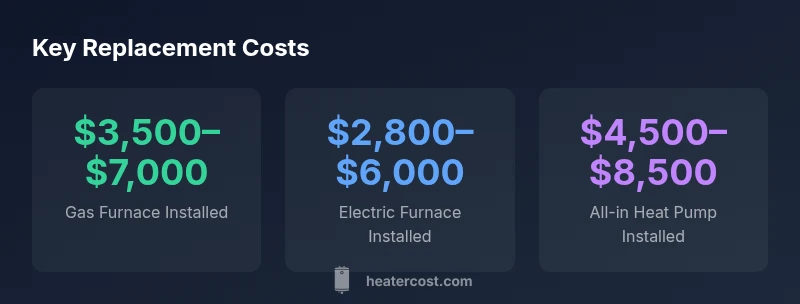
Base prices vary by system type and efficiency. A typical gas furnace replacement might cost between $3,500 and $7,000 installed, with higher-efficiency models at the upper end. Electric furnaces generally run a bit lower, roughly $2,800 to $6,000 installed, reflecting simpler fuel delivery and fewer venting requirements. Heat pumps, which provide both heating and cooling, often cost more upfront, in the ballpark of $4,500 to $8,500 installed, depending on climate and whether a backup heat source is needed. Oil furnaces, while less common today, can range from $5,000 to $10,000 depending on fuel delivery system upgrades and storage considerations. These ranges assume standard ducted homes and typical installation tasks; if your home requires extensive ductwork, attic or crawlspace access, or the addition of an air handler, your costs can move closer to the upper end of these ranges. For precise figures, obtain multiple written quotes that itemize equipment, labor, and permit fees.
The role of installation complexity and ductwork
Installation complexity plays a pivotal role in pricing. If ductwork must be redesigned for better airflow, or if a home lacks proper venting for gas models (including vent routing and exhaust requirements), contractors will charge more for materials and labor. Retrofitting dampers, improving air sealing, or upgrading the blower motor and air handler also adds to the bill. In homes with limited attic or crawlspace access, labor time increases and so do safety considerations. Budget additional funds for duct sealing, insulation, and potential testing to verify air balance after the system is installed. These factors often push final costs beyond the base equipment price, especially when upgrading to high-efficiency or heat-pump systems.
Choosing between fuel types: gas, electric, heat pump
Your choice of fuel source defines both upfront cost and ongoing operating expenses. Gas furnaces typically have higher upfront costs but lower operating costs in many regions where natural gas is affordable. Electric furnaces are cheaper to purchase but can become more expensive to operate in very cold climates. Heat pumps offer efficient year-round heating and cooling, but their upfront price is higher and performance depends on climate and insulation. In milder climates, heat pumps can deliver excellent value, while in extreme winters, a hybrid approach might be recommended. Evaluating the full life-cycle cost—purchase price, installation, energy use, maintenance, and expected life—helps homeowners determine the most economical option over the system’s lifetime.
Efficiency ratings and long-term savings
Efficiency ratings such as AFUE for furnaces and SEER/HSPF for heat pumps directly influence operating costs. Higher-efficiency models usually cost more upfront but reduce monthly energy bills and may qualify for incentives. A well-matched system with quality ductwork, proper insulation, and a modern, programmable thermostat increases realized savings. Keep in mind that energy prices vary by region and season, so payback periods can differ. When assessing quotes, compare not just the sticker price but also estimated annual energy cost reductions and the system’s expected lifespan.
Hidden costs and avoidable pitfalls
Common hidden costs include permit fees, electrical panel upgrades, ductwork modifications, and safety inspections. Some contractors may underquote to win the job and then add costs for flexible ducts, air sealing, or refrigerant replacement later. Avoid those surprises by requesting a detailed, itemized proposal that lists equipment, labor, ductwork, permits, and any ancillary components. Verify the contractor’s license and insurance, check references, and confirm the proposed warranty terms. Establish a clear payment schedule tied to milestones to prevent scope creep.
How to estimate your price: a step-by-step method
Follow these steps to arrive at a realistic replacement budget:
- Define the system type you want (gas, electric, heat pump) and target efficiency (AFUE/SEER/HSPF).
- Have a licensed contractor inspect your current ductwork, electrical supply, and venting to identify upgrade needs.
- Request at least three written quotes that itemize equipment, labor, permits, and any ductwork work.
- Compare energy costs for each option using your local rates and climate data.
- Add a contingency of 5–15% for unplanned issues.
- Check for available incentives and financing options before signing. This method aligns with best practices recommended by Heater Cost to help homeowners estimate and compare costs effectively.
Financing, incentives, and permits
Financing options, utility rebates, and tax credits can significantly affect the total cost of a heater replacement. Investigate federal, state, and local programs that support high-efficiency equipment and heat pumps. Some utilities offer instant discounts or low-interest financing. Permits are also a factor in many jurisdictions; failure to obtain required permits can lead to fines or code issues. Start by asking your HVAC contractor for a permit-friendly plan and confirm which costs are included in quotes.
Authority sources and data transparency
To support cost estimates and planning, we reference authoritative sources and local codes. For complete background, see the following resources and data references: https://www.energy.gov/energysaver/home-heating-systems, https://www.energystar.gov, https://nrel.gov. These sources provide guidance on efficiency, installation considerations, and incentives that influence overall replacement costs.
Installed heater replacement cost ranges by system type
| System Type | Installed Cost Range | Key Considerations |
|---|---|---|
| Gas Furnace | $3,500–$7,000 | Fuel costs, venting, permits |
| Electric Furnace | $2,800–$6,000 | Electrical panel, compatibility |
| Heat Pump (Air-Source) | $4,500–$8,500 | Climate zone, SEER/HSPF requirements |
| Oil Furnace | $5,000–$10,000 | Fuel storage, delivery logistics |
Got Questions?
What factors influence replacement costs the most?
The most influential factors are system type, efficiency (AFUE/SEER/HSPF), required ductwork, venting and gas lines, permits, and labor rates.
Key factors are system type, efficiency, ductwork, permits, and labor costs.
Should I replace my furnace and air conditioner at the same time?
If both are old and inefficient, a combined replacement can save on labor and improve system balance; assess warranty and refrigerant compatibility.
If both are old, replacing together can save money and improve comfort.
How long does installation typically take?
Most replacements take 1–2 days for a standard installation; complex jobs can stretch to 3 days.
Most installs take a day or two.
Are there tax credits or incentives for heater replacements?
Some regions offer incentives for high-efficiency furnaces, heat pumps, or rebates; check federal, state, and utility programs.
There may be incentives—check local programs.
Is it worth replacing an old heater if it still works?
If you're facing frequent repairs, rising fuel costs, or inefficient performance, replacement is often cost-effective; factor warranty and energy savings.
If it's unreliable or costly to operate, replacement is worth considering.
What about permits?
Permits ensure safety and code compliance; costs vary by locality and may be required for gas or vent upgrades.
Permits are necessary in many places; expect a permit fee.
“Replacing a heater is an investment in comfort and energy efficiency; a well-planned replacement pays off through years of reliable heat.”
The Essentials
- Know your fuel type upfront to estimate costs
- Budget for permits and potential ductwork
- Compare multiple quotes from licensed HVAC pros
- Consider efficiency ratings for long-term savings
- Plan for maintenance after installation