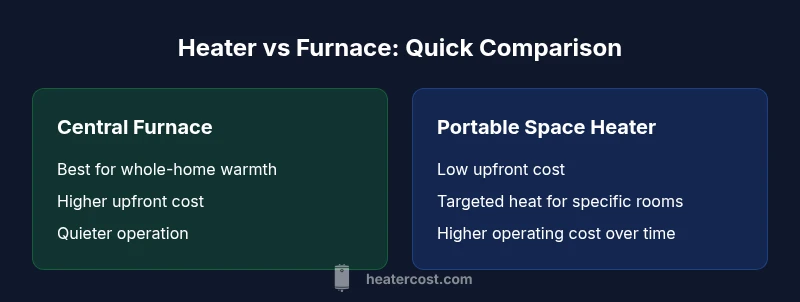
Heater vs Furnace: Which Heating System Is Right for You
Compare heaters and furnaces to decide cost, efficiency, installation, and maintenance. Heater Cost breaks down differences, pros, cons, and who each option suits.


heater vs furnace: which heating system is better for your home? Central furnaces deliver even warmth and long-term cost efficiency, while portable heaters offer flexibility for targeted rooms or temporary use. For full-home comfort, a properly sized furnace or heat pump generally wins on efficiency and consistency. This guide from Heater Cost explains key differences, typical use cases, and how to decide based on your space and budget.
What do 'heater' and 'furnace' really mean in today's homes?
In everyday conversations, 'heater' and 'furnace' are used interchangeably, but they describe two very different approaches to warming a house. A furnace is a central heating appliance that heats air and distributes it through ducts to every room of the home. A heater, by contrast, usually refers to a portable device that generates heat for a single space or a small area. When homeowners say heater, they might mean space heaters, pellet stoves, heat pumps, or even radiant mats for specific zones. The Heater Cost team emphasizes understanding the scope of coverage each option provides, because the choice affects upfront costs, ongoing energy use, installation requirements, and safety considerations. According to Heater Cost analysis, selecting the right approach starts with assessing space, heat demand, and how long you usually need heat each day.
How central heating systems (furnaces) work and what it implies for cost
A central furnace fires fuel (gas, oil, or electricity) to warm air, which is then pushed through a network of ducts by a blower. The warm air is distributed to every room, creating consistent temperatures across living spaces. Because a furnace serves the whole home, its operation tends to be efficient on a per-square-foot basis when properly sized and well maintained. Installation costs are typically higher and require professional service, plus possible ductwork modifications. Maintenance usually includes annual inspections, filter changes, and occasional blower or heat exchanger servicing. From a budgeting perspective, a furnace can offer lower ongoing costs per BTU than portable heaters, but the total cost of ownership depends on fuel type, efficiency class, and local energy prices. The Heater Cost team notes that proper sizing and installation quality are critical determinants of long-term performance.
How space heaters fill gaps and when they make sense
Space heaters provide rapid, affordable warmth for a single room or small zone without the need for permanent installation. They come in various forms—ceramic, infrared, radiant, and convection—and can be effective for rooms that are used intermittently or as a supplemental heat source during cold snaps. However, they typically have higher operating costs if used for extended periods and require careful placement to avoid fire hazards. For renters or short-term occupancy, space heaters can reduce the need for full-system upgrades. When considering heater vs furnace, these devices are best viewed as temporary or supplemental solutions rather than permanent replacements for central heating. Safety practices, including thermostat coordination, tip-over prevention, and regular cord inspection, are essential to minimize risk.
Efficiency metrics explained: AFUE, BTU, and heat distribution
Efficiency assessments help compare a furnace to a heater, though the metrics differ by system type. Furnaces use AFUE (Annualized Fuel Utilization Efficiency) to express how effectively fuel is converted into usable heat. Higher AFUE values indicate better efficiency, which translates into lower operating costs over time for the same space. Heaters, especially electric portable models, rely more on electrical resistance and heat transfer methods rather than fuel combustion, so AFUE is not the right metric for them. Instead, consider heat output in BTUs for central systems and room-rank effectiveness for space heaters. The Heater Cost analysis emphasizes that true cost-per-watt and heat retention in your home inform the best balance between upfront investment and ongoing energy use.
Installation considerations: when adding a furnace vs using portable heaters
Installing a central furnace involves evaluating space for the furnace itself, ductwork routing, ventilation requirements, and thermostat integration. In many homes, adding or upgrading a furnace also means updating electrical panels or gas lines, which adds to both time and expense. Portable heaters require minimal or no installation—plug in, place safely, and monitor usage. For landlords and property managers, the decision often hinges on whether a unit’s heat load justifies a permanent upgrade or if temporary, modular heating suffices for tenants. Planning should include safety clearances, CO detectors for combustion-based furnaces, and clear guidelines on heater usage in shared spaces. The Heater Cost team recommends a phased approach when possible to avoid over-investment before occupancy patterns are fully understood.
Safety and maintenance considerations for heaters and furnaces
Safety is a core factor in the heater vs furnace decision. Furnaces require proper ventilation, CO monitoring, and annual professional inspections to prevent dangerous buildups and ensure filter cleanliness. Portable heaters demand vigilant placement away from flammables, automatic shutoff features, and adherence to usage guidelines to reduce fire and electrical risks. Maintenance for central systems focuses on duct cleanliness, blower operation, heat exchanger integrity, and regular refrigerant checks (for heat pumps). For renters, safety often means relying on certified professionals for any heating upgrades and using portable heaters only with supervision and appropriate surge protection. The Heater Cost guidance highlights that routine maintenance can extend system life, improve efficiency, and reduce unexpected breakdowns over time.
Climate, home size, and heat load: which option scales best
Homes vary dramatically in how heat is lost through walls, windows, and rooflines. In larger or poorly insulated homes, a furnace can deliver stable warmth at a reasonable cost per square foot, especially in wide-open floor plans. In smaller apartments or rooms with good natural light and insulation, a portable heater may provide adequate warmth with lower initial investment. Climate also matters: very cold regions with long heating seasons tend to favor central systems for consistent comfort and efficiency, while milder climates or seasonal usage patterns may justify occasional space heating. The Heater Cost team emphasizes performing a home heat load assessment to gauge whether you need a robust central system or if supplemental electric heating will suffice.
Cost considerations: upfront, operating costs, and maintenance need
Choosing between heater vs furnace often comes down to total cost of ownership. Central furnaces require a larger upfront investment for equipment, installation, and potential ductwork improvements, yet they usually deliver lower operating costs per unit of heat when run consistently. Portable heaters cost less to buy but incur higher energy costs if used for long periods, plus ongoing safety considerations. If rebates or incentives are available, a central upgrade could become more attractive, especially in homes with high heat demand. The Heater Cost analysis notes that when evaluating costs, it’s essential to consider insulation quality, thermostat efficiency, and local fuel prices, as these factors influence overall value over the system’s life.
Practical decision paths for renters, homeowners, and property managers
Renters face significant limitations on permanent upgrades; in many cases, space heaters paired with programmable thermostats provide the most practical solution. Homeowners and property managers should assess whether extending ductwork, upgrading insulation, or investing in a high-efficiency furnace will yield better long-term comfort and cost stability. A multi-zone approach can leverage central heating for common areas while using electric space heaters for targeted rooms that require extra warmth. The decision framework should also consider the building’s age, fuel availability, and maintenance resources. The Heater Cost team recommends drafting a simple heat plan that compares upfront costs, anticipated fuel costs, and expected lifespan for each option to guide a well-supported choice.
Myths and realities about heater vs furnace often seen in homes
A common myth is that space heaters can fully replace a central system in any home. Reality shows that while space heaters are convenient for quick, localized warmth, they usually cannot provide the uniformity and control of a central furnace, particularly in larger homes. Another misconception is that newer electric heaters automatically outperform gas furnaces; actual performance depends on insulation, climate, and usage patterns. Understanding these nuances helps avoid overestimating the capabilities of portable devices and underestimating the value of central heating in terms of comfort and efficiency. The Heater Cost team encourages readers to anchor decisions in space, budget, and long-term goals rather than hype or anecdotal success stories.
Comparison
| Feature | Central Furnace | Portable Space Heater |
|---|---|---|
| Heating capacity (whole-home vs single room) | Best for whole-home warmth | Best for one room or small area |
| Operating costs | Typically lower per BTU when sized well (fuel or electricity dependent) | Higher cost per hour if used extensively |
| Installation and space needs | Requires professional installation and ductwork | Minimal to no installation; portable and relocatable |
| Maintenance | Annual professional service and filter changes | Minimal routine maintenance; safety checks needed |
| Safety considerations | CO detectors and proper ventilation | Clearances and supervision to prevent fires |
The Good
- Helps you choose the right heating strategy for your space and budget
- Clarifies upfront vs ongoing costs and maintenance needs
- Highlights safety, efficiency, and space considerations
Negatives
- Requires analysis to avoid over-investment in the wrong system
- No one-size-fits-all solution; local climate and home design matter
- Portable heaters carry higher safety risks if used improperly
Central furnace generally delivers better long-term value for most homes; space heaters are best as supplements or for renters with temporary needs
If you want consistent, whole-home warmth and efficiency, a central furnace is the stronger long-term choice. Space heaters can reduce upfront costs and provide targeted heat but come with higher operating costs and safety considerations. Use heaters strategically and consider upgrading insulation and control systems to maximize overall comfort and savings.
Got Questions?
What is the main difference between a heater and a furnace?
A furnace is a central heating unit that heats air for the entire home, while a heater is usually a portable device intended for a single space. The choice affects heat distribution, cost, and safety considerations.
A furnace heats the whole house from a central location; a heater is for one room or small areas.
Is a furnace more expensive to install than using space heaters?
Yes, furnaces require professional installation, ductwork, and sometimes electrical or gas upgrades, which increases upfront costs. Space heaters need minimal setup and no permanent changes.
Furnace installation is more involved and costly upfront.
Are space heaters safe for homes with kids and pets?
Space heaters can be safe when used with strict guidelines, proper clearance, timers, and CO or smoke alarms. Always supervise children and pets around portable units.
Be careful with placement and supervision when kids or pets are around space heaters.
Do central heating systems save money over time?
Central systems can be more efficient and cheaper to operate per unit of heat when properly sized and maintained, especially in larger homes. Running costs depend on fuel type and insulation.
If sized right and well maintained, central heating often saves money over time.
When should I upgrade from space heating to central heating?
Upgrade when space heating cannot maintain comfort or when you notice frequent high energy bills, poor indoor temperature consistency, or frequent outages. A home heat load assessment helps decide.
If your home is hard to heat or you’re upgrading anyway, consider central heating.
The Essentials
- Prioritize whole-house warmth with a central furnace when heat load is high
- Use space heaters only for supplemental or temporary heating
- Invest in insulation before upgrading heating equipment
- Assess total cost of ownership, not just upfront price
- Safety plans are essential for any active heating solution
- Consider climate and housing type to choose the right approach