Difference Between Heater and Space Heater: A Practical Comparison
Explore the difference between heater and space heater with an objective comparison. Learn about design, usage, costs, safety, and when to choose central heating versus portable heat for homeowners, renters, and property managers.


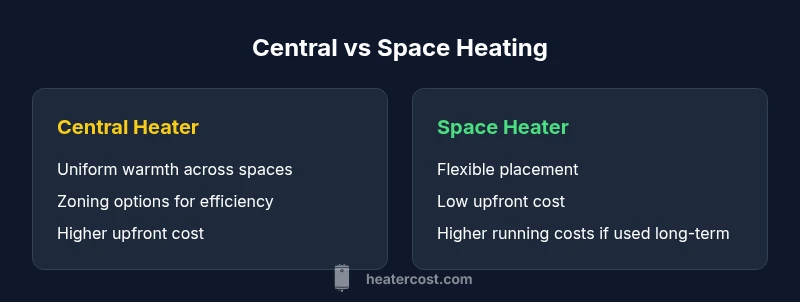
A heater typically refers to a central or built-in system that warms an entire space or home, while a space heater is a portable unit designed for localized heat. For whole-home comfort and efficient operation, a properly sized central heater is usually best; for flexible, quick spot heating in a single room or rental space, a space heater shines. See our detailed comparison chart for nuances and scenarios.
Defining the terms: heater vs space heater
In everyday conversation, the word heater can refer to any device that generates heat, but for accuracy in home heating, a "heater" often means a central or built-in system such as a furnace, boiler, or heat pump that warms an entire dwelling or large zones. A "space heater" is a portable unit that heats a localized area, typically a single room or workspace. According to Heater Cost, this distinction matters for planning, budgeting, and safety, because central systems affect whole-home comfort and long-term energy spend, while space heaters offer targeted warmth with minimal installation. Understanding the difference helps homeowners, renters, and property managers avoid mismatched expectations and hidden costs when starting a heating project. The Heater Cost team emphasizes that the best choice depends on space size, climate, usage patterns, and safety considerations, not just sticker price.
How central heating works: the 'heater' in most homes
Central heating systems are designed to deliver uniform warmth across multiple rooms via a single heat source and a network of ducts or radiant distribution. The core components are a furnace or boiler, a heat exchanger, a distribution system (ducts or hydronic pipes), and a thermostat-based zoning strategy. When you set a schedule, the thermostat signals the system to heat the air or water, which is then circulated to different zones. The energy source could be gas, oil, electricity, or a heat pump, depending on your home and region. Because central systems are built into the house, installation costs are typically higher and require professional service, but the long-term energy efficiency can be superior when properly sized and zoned. For landlords and homeowners, this means balancing upfront investment with predictable, even temperatures across living spaces.
How space heaters operate and typical use cases
Space heaters are portable devices designed for localized warmth and quick deployment. They come in several forms, including electric resistance heaters (coil or ceramic), infrared/radiant heaters, and repurposed units with fan-assisted heat flow. Their primary advantage is flexibility: you can move them to a chilly corner, a drafty office, or a temporary heated space without changing the home’s infrastructure. They’re often a lower upfront cost than installing a central system and can be an effective supplemental heat source during shoulder seasons. However, operating costs can add up quickly if used as a primary heat source, especially in larger spaces or prolonged cold snaps. When used safely—keeping clearances, using built-in tip-over and overheat protection, and never running unattended in risky environments—space heaters provide reliable, targeted warmth.
Energy efficiency and running costs: what to expect
The efficiency gap between central heating and space heaters depends on usage patterns and space geometry. Central systems, especially when paired with modern thermostats and zoning, can maintain consistent temperatures with lower energy waste per square foot in many homes. Space heaters, by contrast, deliver heat where you need it, but they heat smaller volumes with less overall efficiency if used for extended periods. From Heater Cost analysis, a key insight is that the cost-effectiveness of either option hinges on climate, insulation quality, and how well you size the unit to the space. If a central system is appropriately sized and insulated, its cost per heated square foot can be lower over the life of the system; for occasional, localized heating, space heaters can be cheaper upfront and deliver fast comfort.
Safety considerations and maintenance routines
Safety is a critical factor in choosing between a heater and a space heater. Central heating systems undergo regular professional maintenance, which reduces the risk of breakdowns and ensures safe, efficient operation. Space heaters require vigilant, user-led safety practices: keep them away from combustibles, ensure proper cord management, use models with tip-over and overheat protection, and avoid running them in damp areas or overnight in unmonitored spaces. Regular inspection of electrical outlets, cords, and the unit’s filters (where applicable) helps prevent fire hazards and electrical issues. Maintenance tasks for central systems include annual servicing, filter changes, and duct cleaning as needed, whereas space heaters demand periodic cleaning and replacement when components wear or electrical safety standards evolve.
Practical decision framework: when to pick which
To decide between a heater (central system) and a space heater, start with room size and climate. For homes with cold seasons and multiple rooms that require consistent warmth, a central system with zoning is often the best long-term value. If you only need heat in a portion of a room, or if you’re renting and cannot modify the building’s infrastructure, a space heater can provide flexible, immediate comfort. Factor installation costs, ongoing energy rates, and safety concerns into your math. A practical approach is to estimate the heating load for the space, compare projected annual energy costs with and without central heating, and map those figures against the upfront and maintenance costs of space heaters. Heaters that support programmable thermostats and smart controls can help bridge the cost gap between the two options.
Common myths and mistakes to avoid
A frequent mistake is assuming any portable heater can replace a central system. Space heaters are excellent supplements, but they won’t reliably heat an entire home during deep freezes. Another error is underestimating insulation and air leakage; without addressing drafts, space heaters work harder and cost more. Some buyers overlook safety features, choosing models without tip-over protection or automatic shutoff, which increases risk. Lastly, mixing energy sources without understanding the overall energy cost dynamics can lead to higher bills; always consider total home energy strategy, including insulation, air sealing, and thermostat optimization.
Real-world scenarios and decision tips
In a modern apartment with good insulation but inconsistent interior temperatures, a space heater used for targeted zones during peak times can provide comfort without changing the building’s heating, especially in shoulder seasons. In larger homes with multiple stories and variable occupancy, a central system with zoning can keep temperatures balanced and reduce the risk of cold spots, though it requires higher upfront investment. For rental properties or seasonal spaces, space heaters offer a low-commitment, flexible option that can be removed when leaving. In all cases, measure your total cost of ownership, including installation, maintenance, energy consumption, and any safety-related expenses.
Conclusion and guidance from the Heater Cost team
Choosing between a heater (central system) and a space heater hinges on space, climate, and usage patterns. A central system excels in providing uniform warmth and long-term efficiency for larger homes, while space heaters deliver portable, immediate heat for specific tasks or rooms. The Heater Cost team emphasizes evaluating insulation quality, potential zoning, and total cost of ownership before committing to a solution. When in doubt, start with an energy audit and a simple payback analysis to understand how these options compare in your living situation.
Comparison
| Feature | Heater (central/whole-home) | Space Heater (portable) |
|---|---|---|
| Heating Capacity | Designed for whole-home or large zones with even distribution | Localized heat for a single room or small area |
| Energy Source | Gas, oil, electricity, or heat pump depending on system | Electric plug-in or battery-assisted options in some models |
| Installation & Setup | Permanent installation, professional sizing and ductwork (if needed) | Portable setup; plug in and position as needed |
| Typical Cost Range | Higher upfront cost; installation and retrofitting may be required | Lower upfront cost; ongoing electricity use based on usage |
| Safety & Compliance | Integrated safety features; regular professional maintenance | Built-in safety features (tip-over, overheat); strict placement rules |
| Best For | Whole-home comfort, energy zoning, long-term stability | Spot heating, quick deployment, flexibility |
The Good
- Provides uniform warmth across larger spaces (central heater)
- Can be more energy-efficient with zoning and programmable controls
- Lower long-term maintenance if properly sized and installed
- No reliance on portable devices in critical rooms
- Better resale value for homes with modern central systems
Negatives
- High upfront and installation costs
- Longer lead times for installation and potential renovations
- Less flexible for renters or short-term needs
- Ductwork and space constraints can limit placement
Central heating generally wins for long-term, even whole-home warmth; space heaters excel for flexible, short-term, or supplemental heat.
Choose central heating when you value uniform comfort and efficiency across a larger area. Opt for space heaters when you need quick, temporary heat or when you cannot modify the building's heating system. The Heater Cost team supports a careful assessment of space, insulation, and usage to determine the best fit.
Got Questions?
What is the main difference between a heater and a space heater?
A heater typically refers to a central system that warms an entire space, while a space heater is a portable unit for localized heat. The scale of heating, installation needs, and cost implications differ markedly between the two.
A heater usually means central heating that warms many rooms, while a space heater is a portable unit for one room. They serve different scales of heating and come with different installation and cost considerations.
Can space heaters be used as the primary heating source?
Space heaters can supplement or temporarily replace central heating in small spaces or short timeframes, but they are generally not practical as the sole heating source for a whole home over a long winter. Efficiency and safety concerns also factor in.
Space heaters are best for supplemental heat or small spaces, not as the primary heating for an entire home during long cold periods.
Are space heaters safe for homes with kids or pets?
Space heaters can be safe with proper precautions: keep them away from children and pets, use models with tip-over and overheat protection, and ensure cords are out of reach. Regular inspection is essential.
Yes, but only if you follow safety guidelines like placing it away from kids and pets and using models with safety features.
What factors influence space heater running costs?
Running costs depend on the heater type, room size, insulation, and how long you run the unit. Electric space heaters can be inexpensive upfront but costly to operate continuously in large rooms.
Costs depend on the heater type, how big the space is, insulation, and how long you use the heater.
Do central systems require professional installation?
Yes. Central systems typically require professional sizing, ductwork or piping installation, and commissioning to ensure safe and efficient operation.
Yes, you usually need a pro to install central heating and set up zoning correctly.
Which is more environmentally friendly overall?
Environmental impact depends on efficiency, fuel source, and usage. Central systems with modern efficiency features and green fuels can be more sustainable, while efficient space heaters used sparingly can be greener for small spaces.
It depends on efficiency and fuel source; both can be green with the right setup and usage.
The Essentials
- Assess space size and climate before choosing heating.
- Consider total cost of ownership, not just upfront price.
- Use zoning and thermostats to maximize central system efficiency.
- Reserve space heaters for supplemental or portable needs.
- Prioritize safety features and proper placement in all cases.