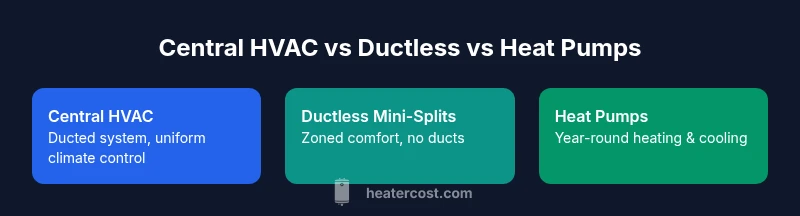
Different Heating and Cooling Systems: A Side-by-Side Guide
Compare different heating and cooling systems to find the best fit for comfort, efficiency, and budget. This 2026 guide covers central HVAC, ductless, heat pumps, and furnaces/boilers with installation, maintenance, and ROI considerations.


Choosing between different heating and cooling systems comes down to climate, home layout, and long-term costs. For most homes, heat pumps or central HVAC offer a balance of comfort and efficiency, while ductless mini-splits excel in zones or retrofits. Gas furnaces and boilers remain strong options in colder climates with existing infrastructure.
Why Understanding Different Heating and Cooling Systems Matters
According to Heater Cost, choosing the right heating and cooling system can significantly impact annual energy bills, comfort, and long-term reliability. Understanding how different heating and cooling systems work helps homeowners, renters, and property managers align upfront costs with ongoing savings. The Heater Cost team found that climate, home insulation, and occupancy patterns are among the biggest drivers of value when selecting a system. A poorly matched system leads to hotspots, drafts, and unnecessary energy waste. This guide uses 2026 context to compare core types, from ducted central systems to modern ductless setups. It emphasizes practical decision criteria like climate, existing ductwork, and the availability of incentives.
- Climate suitability matters: Heat pumps excel in milder winters, while gas furnaces dominate in extreme cold with older ductwork.
- Existing infrastructure influences cost: Ducted systems require ductwork; ductless systems can retrofit without ducts.
- Maintenance and lifetime costs vary: Regular maintenance and potential repairs should be weighed against installation costs.
- Incentives and energy costs vary by region: Local utilities and federal programs can affect total cost of ownership.
By the end, you’ll know which system offers the best balance of upfront cost, energy efficiency, and long-term comfort for your home. According to Heater Cost, strategic sizing and proper installation maximize ROI, so don’t skip a professional assessment.
Major Categories at a Glance
This section provides a quick inventory of the four core categories homeowners consider when evaluating different heating and cooling systems. Each category has distinct strengths, installation realities, and maintenance needs that affect long-term cost and comfort. The goal is to map your home’s climate, existing structure, and budget to the best-fit option.
Central HVAC (Ducted)
- Definition: A single system that heats and cools through a network of ducts and vents.
- Strengths: Uniform temperature, simplified controls, and strong zoning potential when paired with modern thermostats.
- Considerations: Ductwork can be costly to install or retrofit; sealing and insulation are critical for efficiency.
- Best for: Homes with existing ducts and stable climate patterns; larger single-zone layouts benefit from centralized control.
Ductless Mini-Splits
- Definition: Individual indoor units connected to an outdoor condenser, no ductwork required.
- Strengths: Excellent zoning, easy retrofits, flexible placement, and fast installation.
- Considerations: Outdoor compressor units may affect exterior aesthetics and space; some noise considerations depending on model.
- Best for: Older homes without ducts, additions, or rooms that require independent temperature control.
Heat Pumps (Air-Source and Geothermal)
- Definition: A system that transfers heat rather than generating it, providing both heating and cooling.
- Strengths: High efficiency for moderate climates, year-round comfort, and potential for significant energy savings.
- Considerations: Performance drops in extreme cold without backup heat; geothermal options cost more but can offer substantial long-term savings.
- Best for: Regions with milder winters or homes with good insulation; those pursuing low operating costs when electricity is affordable.
Furnaces and Boilers (Gas/Electric)
- Definition: Fuel-burning or electric resistance systems that generate heat for distribution via ducts or radiant heat.
- Strengths: Very strong heating capacity in extreme cold, established reliability, and compatibility with existing infrastructure.
- Considerations: Higher fuel costs in some regions; combustion safety and ventilation requirements; maintenance is essential.
- Best for: Very cold climates or homes with legacy ductwork where other upgrades aren’t feasible.
Efficiency, Comfort, and Cost: What Saves Money Over Time
When evaluating efficiency, comfort, and cost, it helps to understand the core tradeoffs of different heating and cooling systems. Efficiency is typically measured by standardized metrics, but real-world performance depends on climate, insulation, and usage patterns. Comfort depends on even temperature distribution, humidity control, and reliable cooling on hot days. Cost considerations include upfront installation, ongoing energy use, and maintenance.
- Climate and usage drive value: In moderate climates, heat pumps can provide year-round comfort with relatively low operating costs. In very cold regions, a supplemental or backup heating option may be necessary.
- Ductwork matters: If you already have ducts, central HVAC can be cost-effective and reliable. If ducts are needed, ductless systems can offer zone control with potentially lower footprint.
- Efficiency metrics matter: SEER, HSPF, COP, and AFUE provide a framework for comparing systems, but real-world savings require a thorough energy audit and proper sizing.
- Incentives can alter ROI: Federal, state, and utility programs often reduce the effective cost of upgrade projects and equipment with rebates or tax credits.
For homeowners, renters, and property managers, the payoff is not just the system label but the alignment of climate, home envelope, and schedule. Heater Cost’s research emphasizes a holistic approach: evaluate insulation quality, air leakage, and thermostat controls before selecting a system. This ensures the long-term value of the investment is realized.
The Most Common Systems: Central HVAC vs Ductless vs Heat Pumps vs Furnaces/Boilers
Central HVAC (Ducted) offers a single control point for heating and cooling across the home. It works well in larger homes with well-sealed ducts and consistent occupancy. Efficiency improvements come from modern variable-speed equipment and smart zoning capabilities. Ductless Mini-Splits provide precise zone control, making them ideal for retrofit projects, room additions, or homes where ductwork is impractical. Heat Pumps deliver year-round comfort by transferring heat, and high-efficiency models can reduce electricity use substantially in climate zones without severe winter cold. Furnaces and Boilers (Gas/Electric) are robust in extreme cold and can be paired with radiant floor heating or baseboard systems. In new builds, you can optimize for energy efficiency from the start, while retrofits should weigh ductwork, venting, and space constraints.
- Central HVAC is best when you want uniform comfort and appliances with integrated smart controls.
- Ductless minis are best when you need zone-specific comfort without major renovations.
- Air-source heat pumps excel in moderate climates with cold-season backups.
- Furnaces/boilers are best where ductwork exists and winters are severe.
Installation Realities, Maintenance, and Longevity
Installation complexity and timelines vary by system. Central HVAC installations often require significant ductwork, outdoor condenser placement, and indoor air handler alignment, which can add to project time and disruption. Ductless systems typically install faster, with outdoor units paired to multiple indoor heads. Heat pumps require careful refrigerant handling and may demand electrical upgrades; geothermal heat pumps involve larger trenching or boreholes and higher upfront costs but offer long-term energy savings. Maintenance needs are widely similar across systems: regular filter changes, coil cleaning, and annual inspections are essential to sustain efficiency and prevent failures. Lifespan expectations differ by components and usage; ducted systems tend to last longer with proper maintenance, while ductless units may require more frequent head replacements in some climates. Consider local utility incentives and warranties when evaluating long-term value. Heater Cost emphasizes gathering multiple bids and verifying contractor credentials to avoid under- or over-sizing the system.
Practical Scenarios and ROI Considerations
Consider the following practical scenarios to illustrate ROI and decision-making: A moderate-climate home with existing ducts may find central HVAC to be a cost-effective, comfortable choice, especially if smart zoning is leveraged. A retrofit in an older home without ducts could benefit from ductless minis for room-by-room control, with the upside of quicker installation. A new build in a chilly region could pair a well-designed air-source heat pump with supplemental heat at very cold times, balancing upfront costs and long-term savings. For renters and property managers, ductless systems provide flexibility and reduced disruption when a traditional system upgrade is not feasible. In all cases, a professional load calculation and energy audit help ensure the selected system delivers the expected energy efficiency and comfort gains.
How to Decide: A Step-by-Step Guide
- Assess climate and comfort priorities: determine how often you require heating vs cooling, and consider humidity control needs.
- Inspect the home envelope: check insulation, air sealing, and window performance to estimate potential energy savings.
- Inventory existing infrastructure: identify whether you have ductwork that can be leveraged or if a ductless approach is preferable.
- Compare upfront cost vs. long-term savings: evaluate installation costs, energy use, and maintenance requirements.
- Check incentives and financing: explore federal, state, and local programs and any utility rebates.
- Plan maintenance and service: set expectations for routine maintenance and service intervals with your contractor.
- Get multiple professional bids: verify equipment sizing and warranty terms, ensuring you receive a robust comparison.
- Simulate real-world usage: consider family schedules, occupancy, and thermostat habits that influence energy consumption.
This decision framework helps ensure you select a system that aligns with climate, envelope performance, and budget. The Heater Cost team recommends documenting a 5- to 7-year ROI projection before committing to any upgrade, including installation, energy costs, and maintenance.
Feature Comparison
| Feature | Central HVAC (Ducted) | Ductless Mini-Splits | Air-Source Heat Pumps | Furnaces/Boilers (Gas/Electric) |
|---|---|---|---|---|
| System Type | Ducted, centralized system | Independent indoor units with outdoor condenser | Heat pump system for heating and cooling | Ducted or radiant heat with gas/electric fuel |
| Typical Installation Cost Range | $5,000–$15,000 | $2,000–$7,000 | $4,000–$12,000 (air-source) | $3,000–$8,000 (gas/electric) |
| Energy Efficiency Metrics | SEER via centralized equipment, zoning potential | Moderate to high efficiency with zoning | High efficiency for heating and cooling, COP focus | AFUE and efficiency for heating only, depending on fuel |
| Annual Running Cost Context | Moderate to high operating costs depending on usage | Low to moderate when well-sized for zones | Low to moderate in temperate climates with electricity prices | Variable, often higher in extreme cold without backup heat |
| Best For | Homes with existing ducts and uniform cooling/heating | Retrofits, zones, or rooms without ducts | Regions with balanced heating/cooling needs and favorable electricity costs | Homes with existing ductwork needing robust winter heat |
| Maintenance Needs | Slightly higher due to ductwork, filter checks | Moderate; occasional duct cleaning recommended | Moderate to high; refrigerant and outdoor unit care | Moderate; regular filter changes and burner checks |
| Lifespan (years) | 15–20+ with proper maintenance | 12–20 depending on usage | 12–20 for heat pump components, longer for well-maintained models | 15–25 for furnaces/boilers with proper servicing |
The Good
- Uniform comfort and centralized control
- Good for homes with existing ducts and simple upgrades
- Zoned comfort potential with modern controls
- Proven reliability in extreme cold environments
Negatives
- Higher upfront installation costs with ductwork
- Duct leakage and losses can reduce efficiency
- Longer installation timelines in retrofit projects
- Maintenance and potential repair costs for complex duct systems
Heat pumps generally offer the strongest value for many homes, with central HVAC as a solid alternative when ducts exist. In very cold climates, a traditional furnace or boiler remains a viable backstop.
Heat pumps deliver year-round comfort with strong energy efficiency in moderate climates and can offset higher upfront costs through long-term savings. Central HVAC is a good fit for homes with ducts and predictable usage. In extreme cold, consider backup heat or a hybrid approach to maintain reliability.
Got Questions?
What is the main difference between a heat pump and a furnace?
A heat pump transfers heat between indoors and outdoors, providing both heating and cooling. A furnace generates heat by burning fuel or using electric resistance. In moderate climates, heat pumps often reduce energy use, while furnaces are more reliable in severe cold. A hybrid approach can combine both for best results.
A heat pump moves heat; a furnace creates heat. In many places, a heat pump handles most days, with a furnace as backup during very cold snaps.
Do ductless mini-splits require outdoor units?
Yes, ductless mini-splits use an outdoor condenser connected to indoor air-handling units. They’re ideal for zone control and retrofit projects where ductwork isn’t available. The outdoor unit is weatherproof and designed to operate across seasonal temperatures.
Yes, there’s an outdoor unit that links to the indoor heads for zoned heating and cooling.
Can these systems be installed in rental properties?
Many systems can be installed in rentals, but the owner should consider long-term service, noise, and maintenance access. Ductless mini-splits are popular for rentals because they require less invasive installs and offer tenant-control of zones.
Rentals can work well with ductless or centralized setups, provided the landlord plans for maintenance.
Are there incentives for upgrading heating and cooling?
Incentives vary by location and program. Federal and utility rebates or tax credits may apply, reducing upfront costs. Check local utility programs and Energy.gov guidance to identify eligible incentives.
There are often rebates or credits available; check with local utilities and Energy.gov for current programs.
How often should I service my system?
Most systems benefit from annual professional inspections, with filter changes every 1–3 months depending on usage. Regular coil cleaning and refrigerant checks help maintain efficiency and prevent breakdowns.
Annual professional checkups plus regular filter changes keep systems running smoothly.
Which system is best for a small apartment?
Ductless mini-splits are typically ideal for small apartments due to zoning and minimal space requirements. They provide independent temperature control without the need for ductwork and are cost-effective to install in smaller units.
For a small apartment, a ductless mini-split often works best for zone control and easy installation.
The Essentials
- Prioritize climate and ductwork when choosing a system
- Heat pumps excel in moderate climates and offer year-round efficiency
- Ducted systems suit existing ducts and uniform comfort
- Ductless minis shine for zones and retrofits
- Inspect incentives to improve ROI on upgrades