Water Heater vs Hot Water Heater: A Practical Guide for Homeowners
Compare water heater options—tank, tankless, and hybrid—to understand costs, efficiency, installation, and suitability for your home.


Defining the terms: water heater vs hot water heater
In everyday conversations, people say water heater and hot water heater interchangeably. The Heater Cost team notes that these terms describe the same appliance that heats water for showers, laundry, and appliances. The distinction is linguistic rather than functional, but understanding the terminology matters when shopping for replacements or evaluating options. By focusing on actual performance characteristics—storage capacity, energy efficiency, and recovery rate—you can compare models on an apples-to-apples basis. As you read, you’ll see how the Heater Cost analysis frames the decision for homeowners, renters, and property managers who want reliable hot water without overspending. In practical terms, this guide uses water heater vs hot water heater to refer to the same device, while clearly differentiating technologies such as storage tanks, tankless systems, and hybrid heat pumps.
Core type distinctions: storage tank, tankless, and heat-pump
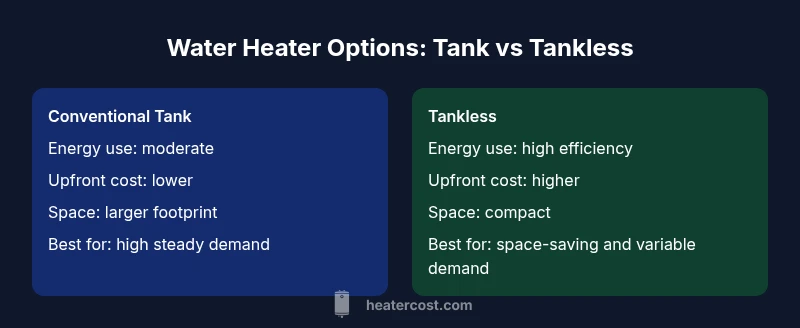
Most homes use a storage-tank model by default, but there are several modern options worth considering. A conventional storage-tank water heater stores hot water in a tank and keeps it ready at a set temperature. Tankless water heaters heat water on demand, delivering hot water without standby losses, but require careful sizing and sometimes venting adjustments. Heat-pump water heaters, also known as hybrid units, use ambient heat to reduce energy use, particularly in mild climates. The Heater Cost team emphasizes that the right pick depends on climate, family size, and existing plumbing. The following sections explore how each type behaves under common usages such as morning showers, evening dishwashing, and simultaneous taps. Tank-based systems can be a good fit for legacy homes with simple retrofits, while tankless and hybrid options can offer long-term energy savings for modern layouts.
How performance matters: recovery rate, temperature stability, hot water availability
Two key performance metrics influence daily satisfaction: recovery rate (how fast the unit heats a new portion of water) and temperature stability (how consistently the water stays at the desired temp under load). Tank-based systems deliver hot water from a reserve tank; recovery rate depends on the burner or heating element size. Tankless units typically have high instantaneous flow rates but may require multiple units or staged installation to meet peak demand. Hybrid units offer improved efficiency and respond quickly to changes in demand. For households with simultaneous showers and laundry, the arrangement matters: a large tank, multiple tankless heaters, or a whole-house heat pump model can improve reliability. The Heater Cost perspective emphasizes balancing upfront equipment costs with long-term energy usage; in many cases, modest adjustments to thermostat settings can yield meaningful savings without compromising comfort.
Installation considerations and space requirements
Installation is more than plugging in a unit. Tank-based systems generally require a larger footprint and a dedicated space, plus appropriate venting for gas models and condensation management for electric ones. Tankless systems save space and can be installed in closets or utility rooms, but they require adequate clearance, proper gas supply or electrical service, and sometimes water separator filters. Hybrid heaters add another layer of integration with existing HVAC or electrical infrastructure. When planning installation, consider local codes, permit requirements, and the need for expansion space if future water demand increases. A professional assessment helps identify hidden constraints, such as limited access to the venting path or the need to upgrade electrical service, which can influence total cost and project duration.
Cost and value considerations
Total cost comes from three broad components: upfront equipment price, installation labor, and ongoing operating costs. Conventional tanks usually have lower upfront costs and simpler installation, while tankless and hybrid models carry higher initial prices but can reduce energy usage over time. In practice, the payback period depends on water usage patterns, climate, and local utility rates. Regions with high hot water demand and frequent use tend to see longer payback periods for tankless systems, while households with modest demand in a stable climate can reap savings sooner. A full quote should itemize equipment, venting, electrical work, and any necessary changes to plumbing, along with a projected annual energy cost. This approach provides a transparent basis for comparing options and avoids surprise charges.
Energy efficiency and incentives
Energy efficiency varies by model, with tankless and hybrid heaters typically offering higher efficiency ratings than many traditional storage tanks. Look for efficiency ratings and energy factor (EF) labels, and compare them across models. In many regions, incentives, rebates, or tax credits can offset part of the upfront cost—availability depends on local programs and the product chosen. Even small efficiency gains multiply over years, especially in homes with high hot water usage. When evaluating incentives, include installation costs and potential energy savings to determine the true value proposition of each option.
Sizing guides by household needs
Sizing a water heater to your household usage rather than the home’s square footage is essential. For storage tanks, select a capacity that matches peak-hour demand; for tankless, ensure flow rates meet simultaneous draws from showers, sinks, and appliances. Sizing tools from manufacturers and utility programs can help, but a professional assessment is advised to factor in climate, incoming water temperature, and family habits. In small apartments, a compact tankless unit may suffice; in larger households with several bathrooms, a high-capacity tank or multiple fixtures might be more appropriate. The right size minimizes the risk of running out of hot water during peak times while avoiding energy waste from oversized units.
Maintenance routines that extend life
Regular maintenance keeps hot water flowing smoothly. For storage tanks, flush the tank periodically to remove sediment, inspect the anode rod, and test the temperature/pressure relief valve. Tankless models benefit from descaling in hard-water areas, occasional filter changes, and ensuring gas lines or electrical connections remain secure. Hybrid units require airflow checks and refrigerant/thermostat checks to sustain efficiency. Establish a preventive maintenance schedule, document visits, and retain warranty records. Proper care reduces leaks and corrosion, extending the life of your investment.
Common myths and misunderstandings
Many homeowners assume tankless systems always deliver endless hot water; in practice, flow rate limits and incoming water temperature can constrain performance. Others think higher efficiency means zero operating costs; efficiency improves, but total usage still drives bills. Some believe you should always replace a tank heater with a larger tank to cover heavy demand; often, smarter scheduling or a hybrid solution can meet peak needs more efficiently. There’s also a belief that maintenance isn’t necessary; regular service preserves warranty coverage and helps catch issues before they escalate.
How to decide: quick decision rules
To choose between a conventional tank, tankless, or hybrid water heater, start with your daily hot water usage and space constraints. If you have limited space and variable demand, a tankless unit may offer the best balance of efficiency and convenience; if you have very high consistent demand or budget constraints, a larger storage tank is often the safer choice. Climate and utility incentives can influence the decision; in energy-conscious markets, hybrid water heaters may provide meaningful savings. Finally, obtain multiple quotes and verify warranties, installation timelines, and local permit requirements to ensure a smooth transition.
Authority sources