Why Heat Won't Work in Your Car: Troubleshooting Guide
Learn why your car’s heat may fail and how to diagnose common causes—from coolant issues to HVAC failures—with practical steps, safety tips, and maintenance ideas.


The dash heater is likely failing due to a coolant or HVAC control issue inside the dash: either low coolant, a stuck thermostat, a clogged heater core, or a faulty blend door. Quick checks: verify coolant level and condition, inspect for leaks, ensure the thermostat opens, and confirm the blower fan and temperature settings are working. If no heat remains, schedule a professional inspection.
Common causes of no heat in a car
According to Heater Cost, no-heat conditions in a car's cabin most often trace to coolant or HVAC issues. The leading culprits are low coolant, a thermostat stuck closed, or a heater core clogged with mineral deposits. Leaks, worn hoses, or a failed radiator cap can drain coolant and undermine cabin warmth. A malfunctioning blend door actuator or a weak blower motor can also prevent warm air from reaching the cabin. Finally, air pockets after refilling coolant can briefly disrupt heat until the system self-purges. Understanding these possibilities helps you triage quickly and avoid unnecessary repairs.
How the cooling system and HVAC interact to heat your car
The car’s heating system uses hot coolant pumped from the engine through a heat exchanger called the heater core. The blower then pushes air over the core to warm the air before it enters the cabin. The blend door and actuators decide how much hot vs cold air blends into the airflow. If any part of this chain fails—low coolant, restricted flow, thermostat issues, or a stuck blend door—the result is reduced or absent heat. Knowing the flow helps you identify where to look first: coolant availability, circulation, and air distribution paths.
Quick checks you can perform safely (non-destructive)
Before tearing into dashboards, perform safe checks: inspect the coolant reservoir for level and color; top up if needed with the appropriate coolant (and only when the engine is cool). Look for signs of leaks under the vehicle. Listen for blower fan operation when you set the heat; if you hear no fan, the issue may be the fuse or motor. Check the temperature blend setting and ensure the dash controls respond. If your heater doesn’t respond or if the engine overheats, stop driving and seek professional help—driving with overheating coolant is dangerous.
Diagnosing the most likely causes (stepwise reasoning)
- Cause: Low coolant level or coolant leak; Likelihood: high. Solution: top up coolant when cold and inspect for leaks, then pressure test the system. Difficulty: easy.
- Cause: Stuck thermostat; Likelihood: high. Solution: thermostat replacement or thermostat housing service; Difficulty: medium.
- Cause: Clogged heater core; Likelihood: medium. Solution: heater-core flush or replacement; Difficulty: medium.
- Cause: Blower motor or fuse failure; Likelihood: medium. Solution: replace fuse, test blower motor; Difficulty: easy.
- Cause: Faulty blend door actuator; Likelihood: low. Solution: inspect/replace actuator; Difficulty: medium.
Following this flow helps you pinpoint the right fix without unnecessary parts swapping.
Step-by-step guide to common fixes (practical sequence)
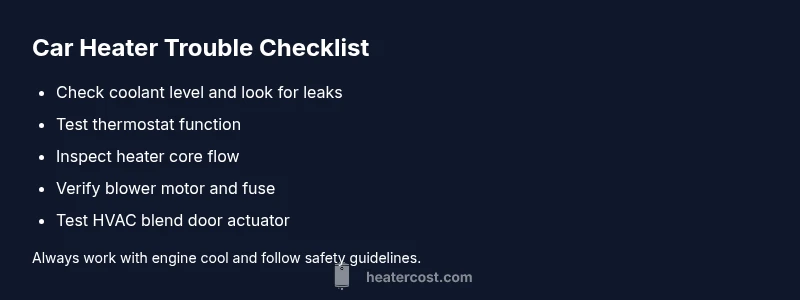
- Safety check and preparation: let the engine cool, disconnect battery if you’ll work near electrical components. 2) Check coolant level and leaks: tighten caps, fill to the correct level, and trap air pockets by running the engine with the radiator cap off briefly (only if safe). 3) Test thermostat: feel the upper radiator hose after engine warms; if it remains cold for too long, thermostat may be stuck closed and needs replacement. 4) Assess heater core flow: feel for heat at the heater core hoses; listen for clogs by flushing the core or performing a professional flush. 5) Inspect HVAC controls and blower: verify fuses, test blower speed, and check blend-door action with diagnostic tools. 6) Refill and test: refill coolant, bleed air, and verify heat output through a full driving cycle. If heat still fails, proceed to professional service.
Safety tips and prevention to avoid future issues
- Always wait until the engine is cool before opening any coolant components to prevent burns.
- Use the recommended coolant type and mix; improper coolant can cause overheating and corrosion.
- Regularly inspect hoses and clamps for signs of wear or leaks; a small leak today can lead to heat loss later.
- If you hear unusual blower noise or feel inconsistent heat, don’t ignore it—address it early to prevent cascading failures.
When to seek professional help and maintenance
If you confirm a leak, overheating, or persistent no-heat after basic checks, it’s time to involve a professional. A trained technician can pressure-test the cooling system, test the heater core, and diagnose blend-door or actuator faults with specialized tools. Routine maintenance including coolant flushes and thermostat checks can prevent heat loss and extend the life of your heating system.
Steps
Estimated time: 60-120 minutes
- 1
Prepare and safety-check
Ensure the engine is cool. Disconnect the battery if you’ll work near electrical components. Gather tools and wear gloves. This reduces the risk of burns and injuries.
Tip: Never open a hot coolant reservoir; hot steam can cause severe burns. - 2
Check coolant level and look for leaks
With the engine cool, inspect the reservoir and radiator for level and signs of leaks. Top up with the correct coolant if needed, and inspect hoses for cracks or bulges.
Tip: Use the vehicle's manual to confirm the proper coolant type and mixing ratio. - 3
Test the thermostat indirectly
Start the engine and feel the upper radiator hose after it reaches operating temperature. If the hose stays cold for too long, the thermostat may be stuck closed.
Tip: If you’re unsure, don’t force a thermostat replacement while hot; wait until cooled. - 4
Assess heater core flow
Check for heat at the heater hoses and ensure coolant is circulating. If you suspect a clog, a core flush may be required and should be done by a pro if you don’t have proper equipment.
Tip: A heater-core flush requires proper disposal of coolant and appropriate tools. - 5
Inspect blower and blend controls
Turn on the climate controls and listen for the blower; verify airflow at maximum. Check fuses and test the blend door actuator for proper movement.
Tip: Electrical checks can reveal a simple fuse fix or a faulty actuator that’s easy to replace. - 6
Test heat output and road-test
After any fixes, run the engine, bring it to operating temperature, and test heat again across heat settings. Confirm the cabin warms evenly during a drive.
Tip: Bleed air from the cooling system if you notice persistent air pockets.
Diagnosis: No heat from car heater or inconsistent cabin temperature
Possible Causes
- highLow coolant level or coolant leaks
- highStuck thermostat
- mediumHeater core blockage or restriction
- mediumBlower motor, fuse, or control failure
- lowFaulty blend door actuator or vacuum/servo issue
Fixes
- easyTop up coolant and inspect for leaks; pressure test the system
- mediumReplace the thermostat or thermostat housing as needed
- mediumFlush or replace the heater core if restricted
- easyCheck and replace blown fuses; test blower motor operation
- mediumInspect and replace the blend door actuator if faulty
Got Questions?
Why is there no heat in my car even when the engine is warm?
No heat usually points to coolant or HVAC issues, such as low coolant, a stuck thermostat, or a clogged heater core. HVAC controls or a faulty blower can also prevent warm air from entering the cabin. Start with coolant level, then check thermostat and heater core flow.
If your engine is warm but there’s no heat, the problem is often coolant or HVAC components like the thermostat or heater core. Start by checking coolant level and then inspect the heater controls and blower.
Can low coolant affect heater performance?
Yes. The heater relies on hot coolant from the engine. Low coolant reduces heat transfer to the heater core, resulting in little or no warm air. Fix the leak and restore proper coolant levels before testing heat again.
Low coolant means less heat reaches the heater core, so the cabin won’t warm up. Refill after fixing leaks and bleeding the system as needed.
Is it safe to drive a car with heater problems?
If overheating is not present and there is no coolant leak, you can drive to a service center, but monitor for rising engine temperature. If you see an overheating signal, stop and seek help immediately to avoid engine damage.
You can usually drive to a shop if the engine isn’t overheating, but don’t ignore a rising temp gauge.
How long does heater core replacement take?
Heater core replacement can require dashboard access and may take several hours, depending on the vehicle. It’s a more involved repair that typically requires professional service.
Replacing the heater core is a major job that usually takes several hours and often requires a mechanic.
What maintenance helps prevent heater failures?
Regular coolant flushes, thermostat checks, and HVAC system inspections help prevent heater failures. Address leaks, monitor belt and blower health, and keep controls responsive with routine checks.
Keep up with coolant maintenance and HVAC checks to reduce the chance of heat loss.
Watch Video
The Essentials
- Check coolant first before diving deeper
- Thermostat and heater core are common failure points
- HVAC controls and blower reliability matter
- Seek professional help if overheating occurs