Car Heater Troubleshooting Guide
Learn how to diagnose and fix a car heater that doesn't work. Step-by-step checks, practical tests, and maintenance tips from Heater Cost to restore cabin warmth safely.


If your car heater does not work, start with the basics: check the HVAC fuse and coolant level, then verify the blend door and heater valve operate. In many cases, coolant health or a blown fuse is the root cause. Following these quick checks can restore heat quickly, avoiding unnecessary repairs. According to Heater Cost, coolant issues and electrical faults are the most common culprits.
Why the car heater stops producing heat
The car heater relies on several systems working in harmony: the cooling system, the HVAC controls, and the blower fan. When you notice a loss of heat, the problem is almost always linked to coolant health or an HVAC component failure. If the coolant level is low, or the heater core isn't receiving warm coolant, you won’t feel heat in the cabin. The Heater Cost team emphasizes that basic maintenance—like checking coolant levels, inspecting for leaks, and ensuring electrical fuses for the HVAC system are intact—prevents most common failures. In some cars, a faulty blend door can block heated air from reaching the cabin entirely, making heat seem unavailable even when the engine is warm.
Tip: Keep an eye on the dashboard temperature gauge. If the engine runs hotter or cooler than usual, it can signal coolant or thermostat issues that affect the heater.
Quick checks you can perform before diving in
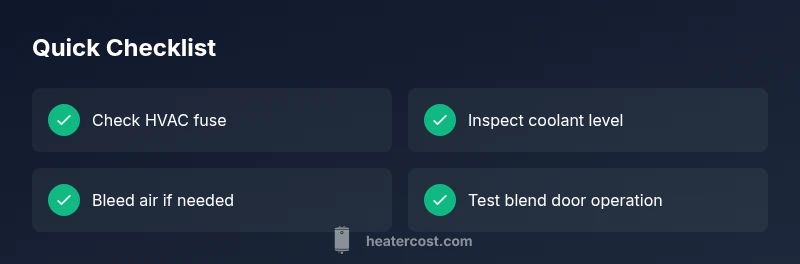
- Inspect the HVAC fuse and relays in the passenger-compartment and engine-bay fuse boxes. Replace any blown fuse with one of the same amperage rating.
- Check the coolant level in the reservoir and, if indicated, top up with the manufacturer-approved coolant mix. Look for visible leaks under the vehicle.
- Test the temperature gauge: if the engine isn’t reaching normal operating temperature, the heater won’t produce warm air.
- Ensure the climate control is set to heat, the fan is on, and the blend door can move freely. A stuck control can send cool air even when hot settings are selected.
- Listen for unusual sounds from the dashboard or under the hood that could indicate a faulty heater valve or a stuck blend door. According to Heater Cost, many failures start with simple electrical or coolant issues.
If these quick checks don’t restore heat, move to a more systematic diagnostic approach to identify the root cause.
HVAC system basics: blend doors, valves, and control signals
Your car’s HVAC system uses blend doors to mix hot and cold air and a heater control valve to regulate coolant flow to the heater core. If the blend door is stuck, or the valve fails to open, the heater won’t warm the cabin even if the engine is hot. Electrical or vacuum lines powering these components can degrade over time, especially in older vehicles. In some models, a faulty actuator emits a distinct click when requesting heat, signaling a mechanical failure. Understanding this helps you troubleshoot without guessing, saving time and money.
Practical note: For many vehicles, the behavior of the heater depends on both the climate control software and physical actuators. A software hiccup can mimic a mechanical failure, so consider cycling the climate settings to reset the system if you notice erratic behavior.
Electrical checks you can safely perform
Electrical issues are a common reason car heaters fail. Start with the simplest steps: ensure the ignition is fully on, and check for blown fuses related to the HVAC system. If you’re comfortable, disconnect and reconnect battery terminals to reset minor electronic glitches (do this only if you know how to handle it safely).
Important safety reminder: Do not work on live circuits. Wear eye protection and gloves when checking fuses or terminals, and avoid touching metal parts with wet hands. If you smell burning insulation or see melted wires, stop and seek professional help. Heaters and electrical components are integrated into many vehicle systems; a fault can affect airbags and other critical functions.
Diagnostic test you can run at home to identify the culprit
A practical at-home approach combines symptom observation with basic checks:
- Symptom: Heat is weak or absent. Diagnosis: likely coolant flow issue or blend door problem.
- Symptom: Cold air despite heat setting. Diagnosis: blend door stuck or heater valve not opening.
- Symptom: Steam, sweet smell, or visible coolant leaks. Diagnosis: coolant leak or heater core problem.
Solutions from Heater Cost emphasize starting with fuses and coolant levels, then inspecting the heater valves and blend doors. If you confirm a coolant leak, you should address the leak first before chasing electronic faults, as coolant loss rapidly leads to engine damage.
When to seek professional help and what to expect
If you’re unsure about any step or you identify a coolant leak, a faulty thermostat, or a suspected heater core problem, it’s time to call a professional. A certified mechanic can pressure-test the cooling system, inspect the heater core and blend door for blockages or failure, and diagnose electrical issues with specialized equipment. Expect a diagnostic fee and potential repair costs that vary by vehicle make and the exact parts required. The Heater Cost team recommends obtaining a written estimate that itemizes parts and labor before authorizing major repairs.
Long-term care to prevent recurrence
Regular maintenance is your best defense against heater failures. Schedule periodic coolant flushes according to your vehicle manufacturer’s recommendations, replace worn hoses, and inspect the heater core for signs of leakage. Keeping the cooling system in good shape ensures the heater core receives warm coolant reliably. Also, consider seasonal climate checks: before winter, test your heater and defroster to confirm full functionality. These proactive steps reduce the risk of surprising heat loss on cold days.
Steps
Estimated time: 60-120 minutes
- 1
Check HVAC fuse and relays
Locate the appropriate fuse box (under the dash or in the engine bay). Inspect the HVAC fuse; if it’s blown, replace with a fuse of the same amperage. Recheck the heater after replacement to see if heat returns.
Tip: Carry spare fuses and a simple fuse tester; verify the circuit is powering the HVAC when the heater is set to heat. - 2
Inspect coolant level and top up if needed
With the engine cool, check the coolant reservoir level against the full mark. If low, top up using the correct coolant type for your vehicle. Look for leaks around hoses, radiator, and the reservoir cap.
Tip: Never open the coolant cap when the engine is hot; wait for it to cool and use protective gloves. - 3
Bleed air from the cooling system
If the system was recently serviced or you notice temperature fluctuations, bleed air according to your vehicle’s service manual. Trapped air can prevent warm coolant from reaching the heater core.
Tip: Follow the manufacturer’s bleed sequence; some cars require special bleeder valves or procedures. - 4
Test thermostat operation
Start the engine and monitor the temperature gauge. If the gauge rises slowly or stays cool, the thermostat may be stuck open. Consider replacement if symptoms persist.
Tip: Replace with OEM or equivalent high-quality thermostat for reliable operation. - 5
Check blend door and heater valve
With the climate control set to heat, listen for actuator sounds and feel air at different vents. If hot air never comes out, the blend door or valve could be stuck or failing.
Tip: Some vehicles require professional service to access the dash or HVAC plenum. - 6
Inspect heater core for leaks or blockages
If coolant is leaking into the cabin or you smell sweet coolant, the heater core may be failing. Blockages can also reduce heat flow to the cabin.
Tip: Heater core replacement is labor-intensive; budget for a shop if needed. - 7
Test system under load and road test
Take a short drive with the heater on high. Confirm the system maintains heat as the engine reaches operating temperature. Note any changes in heat with RPM changes.
Tip: Document symptoms to share with a technician if you seek help. - 8
Finalize with preventive checks
If heat is restored, schedule a coolant flush per manufacturer guidance and inspect hoses for wear. Keep an eye on dashboard indicators that could warn of future failures.
Tip: Regular thermal system maintenance reduces unexpected cold-weather breakdowns.
Diagnosis: Car heater blows cool air or fails to produce heat
Possible Causes
- highBlown HVAC fuse or failed relay
- highLow coolant level or coolant leak
- mediumBlend door or heater control valve stuck/not moving
- mediumThermostat not reaching operating temperature
- lowAir in cooling system requiring burping
Fixes
- easyCheck/replace HVAC fuse and relays; reset electrical connections
- easyTop up coolant after inspecting for leaks; fix leaks as needed
- mediumInspect and test blend door actuator or heater control valve; replace if faulty
- mediumReplace malfunctioning thermostat or bleed air from cooling system
- easyPerform proper burping of cooling system if air is trapped
Got Questions?
Why is my car heater blowing cold air?
Cold air usually means the heater core isn’t receiving hot coolant or the blend door isn’t directing air through the heater core. Start with coolant level, then check the blend door operation and thermostat. If the issue persists, a professional diagnosis may be needed.
Cold air from the heater typically means either coolant isn’t reaching the heater core or the blend door isn’t directing air properly. Check coolant level and blend door operation, then consult a technician if needed.
Can low coolant cause the heater to fail?
Yes. Low coolant can prevent the heater core from receiving warm coolant, resulting in little to no heat. Inspect for leaks, top up to the recommended level, and watch for temperature gauge anomalies.
Low coolant can stop the heater from getting warm air. Check for leaks, refill to the right level, and monitor the temperature gauge.
Is it safe to bleed the cooling system myself?
Bleeding the cooling system is a delicate job. If your vehicle requires it, follow the manufacturer’s procedure exactly and wear protective gear. If unsure, have a professional perform the bleed to avoid burns or coolant spray.
Bleeding the cooling system can be risky. If you’re unsure, have a professional handle it to prevent burns or injury.
When should I replace the thermostat?
Replace the thermostat if the engine never reaches proper operating temperature, or if it runs hot or cold inconsistently. A faulty thermostat can keep the engine from warming up, which also prevents the heater from delivering heat.
Replace the thermostat if the engine won’t reach temperature or fluctuates abnormally; it keeps the heater from warming properly.
Why does the heater core smell sweet or coolant-like?
A sweet coolant odor usually indicates a leak into the cabin via the heater core. This warrants professional assessment and possible heater core replacement to restore safe cabin air quality.
A sweet coolant smell means the heater core may be leaking, which should be checked by a pro.
What is a typical cost range to repair a car heater?
Costs vary with vehicle and parts, from minor fixes like a fuse or blend door to major work like heater core replacement. A professional diagnosis will clarify the exact scope and price, with ranges depending on parts and labor.
Repair costs vary a lot; get a professional diagnosis to know the exact scope and price.
Watch Video
The Essentials
- Start with fuses and coolant checks to fix most car heater issues
- Blend door and heater valve problems are common but solvable
- Bleed air and ensure the engine reaches operating temperature for proper heating
- Call a pro for heater core leaks or electrical faults to avoid safety risks