Heater Repair Cost in 2026: What Homeowners Should Expect
Learn realistic heater repair cost ranges by system type, discover key cost drivers, and get budgeting tips from Heater Cost to decide when to repair or replace.


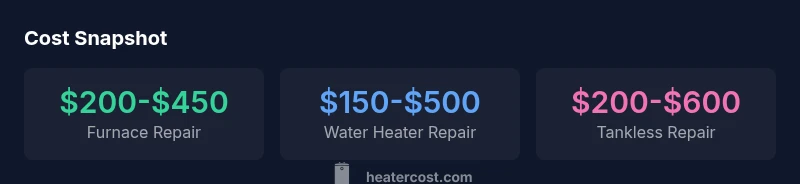
Homeowners typically pay between $150 and $600 for a heater repair visit, with diagnostic fees often applied. Costs hinge on heater type, parts needed, and labor time. Common furnace repairs run roughly $200-$350, water heater repairs around $180-$500, and tankless systems can exceed $350-$600 due to access and venting. Getting a written, itemized estimate helps prevent surprise charges.
What drives heater repair cost
When homeowners ask about the heater repair cost, the first answer is that price is driven by the full scope of the service, not just the visible symptom. In most markets, a diagnostic visit is charged separately from any parts or labor. The rough breakdown begins with a base trip fee, often in the range of $50 to $100, then labor charges that depend on the unit type and complexity. A technician may perform a visual inspection, test common failure points, check safety switches, and verify thermostat signals before any part is replaced. The condition of the system—age, prior maintenance, and the presence of corrosion or mineral buildup—significantly affects both diagnosis length and replacement part costs. The Heater Cost Team notes that older systems frequently require more extensive inspections to locate intermittent failures, which can raise both time and material costs. For budgeting, assume a two-hour to three-hour window for labor on a typical repair, with higher-end units or multi-day diagnostics pushing costs upward. Always request an itemized estimate that lists labor, parts, and diagnostic fees.
Key takeaway: the upfront diagnostic and scope determine most of the cost variation, not only the replacement part.
Cost considerations by heater type
Different heating technologies carry different repair price profiles. Gas furnaces require gas valves, sensors, and burners; electric furnaces rely on heating elements and control boards; tank water heaters use elements or thermocouples; tankless units, though compact, demand access to both electrical and venting systems and can incur higher labor costs when service points are cramped. In general, gas furnaces tend to have higher repair bills due to safety components, while electric furnaces can be cheaper to repair when the issue is a failed heating element or control board. Tank water heaters often involve element and thermostat replacements, which are usually straightforward but labor-intensive if the unit is tucked in a tight space. Tankless systems can be the most variable, because access and venting, mineral buildup on burners, and gas line considerations affect both parts and labor. Budget ranges for common repairs fall roughly in the $150 to $600 band depending on the type and job complexity. The Heater Cost analysis underscores the value of knowing your unit’s age and efficiency rating when forecasting costs.
Common repair scenarios and price ranges
Several repairs show up most often, and knowing the typical ranges helps homeowners plan. Igniter or flame sensor replacement is common in older gas furnaces, and may cost in the lower-to-mid range depending on part availability. Thermostat replacements are frequent and usually inexpensive, yet they can involve wiring checks and compatibility with smart controls. Burner cleaning or nozzle replacement affects efficiency and might require gas line testing to ensure safety. For electric furnaces, failed heating elements or control boards drive costs upward. Water heaters exhibit issues with heating elements, thermostats, and sacrificial anodes, each with its own price band. Tankless water heaters often require service for venting, burner maintenance, or descaling due to mineral buildup, which can push costs higher. Across these scenarios, diagnostic fees can be a meaningful part of the total, especially if the cause is intermittent.
When to repair vs. replace
Deciding between repair and replacement hinges on age, reliability, and the cost-to-benefit balance. Most furnaces offer useful life in the range of 15–20 years under good maintenance; water heaters tend to deliver 8–12 years, with tankless models often lasting longer if maintained. If repair costs approach or exceed a sizable fraction of the replacement price, or if the system’s efficiency is far below current standards (high energy bills, frequent cycling), replacement can be the wiser long-term choice. Consider energy efficiency ratings (AFUE for furnaces, Energy Factor for water heaters) to estimate future savings. The Heater Cost perspective emphasizes that a well-timed upgrade often reduces ongoing operating costs and improves comfort, even if the initial outlay is higher. Always compare an itemized repair quote with a replacement quote to make a data-driven decision.
How to budget and plan for repairs
Proactive budgeting helps manage unexpected heater repair costs. Establish a maintenance plan that includes seasonal inspections, thermostat calibration checks, and safety tests. Maintain a log of parts replaced and the unit’s age to anticipate future needs. If possible, negotiate a fixed-price service contract that covers diagnostic fees, routine maintenance, and minor repairs, reducing the chance of price spikes for urgent issues. Keep a small emergency fund dedicated to heating system problems, so you can address urgent issues without delaying essential repairs. The goal is to keep your heating system running safely and efficiently while avoiding costly, last-minute decisions.
How to choose a technician to keep costs fair
The cheapest quote is not always the best. Look for licensed HVAC professionals with current certifications and clear warranty terms. Ask for multiple written estimates and ensure each includes labor, parts, diagnostic fees, and trip charges. Request references and verify online reviews, then call to discuss the specific symptoms you’re seeing. A good technician will explain the problem in plain language, itemize the recommended fixes, and provide a realistic timeline. If a proposed fix involves unusual parts or rapid labor, ask whether there are alternative options or refurbished parts. Finally, confirm that the technician will test safety controls after service and provide a post-service checklist.
What to expect during a service visit
A typical service visit starts with a safety briefing, followed by a diagnostic assessment of the thermostat, controls, fuel supply, venting, and heat exchanger. The technician should provide an itemized estimate covering labor, parts, and any diagnostic fee before proceeding. If parts are needed, they will source them and present a revised timeline and cost. Expect a safety check of CO or gas leaks where applicable, along with a test of cycling, blower operation, and temperature rise. After repairs, a final test run should verify proper operation and efficiency. If your unit is older or has multiple issues, you may be offered a replacement option; make sure you understand the long-term cost implications.
Energy efficiency impact on long-term costs
Higher-efficiency units typically reduce energy consumption and monthly bills, which can offset higher upfront replacement costs over time. AFUE ratings for furnaces indicate how efficiently fuel is converted to heat, while water heater efficiency metrics determine standby heat loss. For homeowners, upgrading to a higher-efficiency model can yield substantial savings, especially in regions with colder climates or high energy prices. Maintenance also plays a critical role: clean filters, venting, and combustion optimization help sustain efficiency and reduce the likelihood of expensive repairs caused by wear or dirt buildup. The Heater Cost team observes that informed decisions about efficiency often lead to meaningful long-term cost reductions when compared with piecemeal repairs.
Practical cost-saving strategies and questions to ask
To trim heater repair costs, schedule maintenance before peak seasons to avoid urgent calls, compare quotes from multiple providers, and inquire about bundled services or discounts for routine maintenance. Ask for a detailed parts list and hourly labor rate, as well as the expected lifespan of any replacement parts. Inquire about energy-saving options, such as smart thermostats or high-efficiency burners, as a long-term investment. Finally, maintain clear records of all service visits and replacements; this helps you track patterns and plan future budgets more accurately. By combining proactive maintenance with informed contractor selection, homeowners can reduce the overall impact of heater repair costs over time.
Estimated repair cost ranges by heater type
| Heater Type | Typical Repair Cost Range | Notes |
|---|---|---|
| Gas furnace | $200-$600 | Safety components; valve and sensor wear |
| Electric furnace | $150-$500 | Heating elements and boards common |
| Tank water heater | $150-$500 | Element/thermostat replacements |
| Tankless water heater | $200-$600 | Access and venting affect cost |
Got Questions?
What is the typical furnace repair cost?
Costs vary by model and issue, but most repairs fall within a few hundred dollars. Diagnostic fees, parts, and labor all contribute to the final price, so an itemized quote is essential.
Most furnace repairs cost a few hundred dollars, with an itemized quote showing exactly what you’re paying for.
Is it cheaper to repair or replace a heater?
If the repair cost approaches or exceeds half the price of a new unit, or if the system is old and inefficient, replacement may be more cost-effective in the long run.
If the repair is almost as expensive as a new unit, or the system is very old, replacing it can save money over time.
Should I get multiple quotes for a heater repair?
Yes. Obtaining 3 written estimates helps you compare prices, scope of work, and durations. Look for consistent itemization and warranty terms.
Get a few quotes so you can compare what each contractor will do and what it costs.
Do emergency or after-hours calls cost more?
After-hours calls often incur a higher diagnostic fee and premium labor rates. If possible, schedule during normal hours when feasible.
Emergency calls can cost more, so plan ahead when you can.
Can I do any heater maintenance myself?
You can perform safe, basic maintenance like changing filters and clearing obstructions, but avoid attempting repairs or parts replacements that require gas, electricity, or venting work.
Some simple maintenance you can do safely, but avoid major repairs yourself.
How can I verify a technician's license?
Check your state’s hvac licensing board or consumer protection agency. Ask for license numbers, insurance, and proof of ongoing training.
Check the license and insurance, then read reviews for confidence.
“Pricing for heater repairs varies widely because every system is different; a precise estimate should itemize labor, parts, and diagnostic fees.”
The Essentials
- Know your heater type to anticipate costs
- Diagnostic fees and labor shape the final price
- Compare multiple itemized estimates before proceeding
- Repair vs. replace depends on age, efficiency, and total costs
- Maintenance lowers long-term costs and extends lifespan